
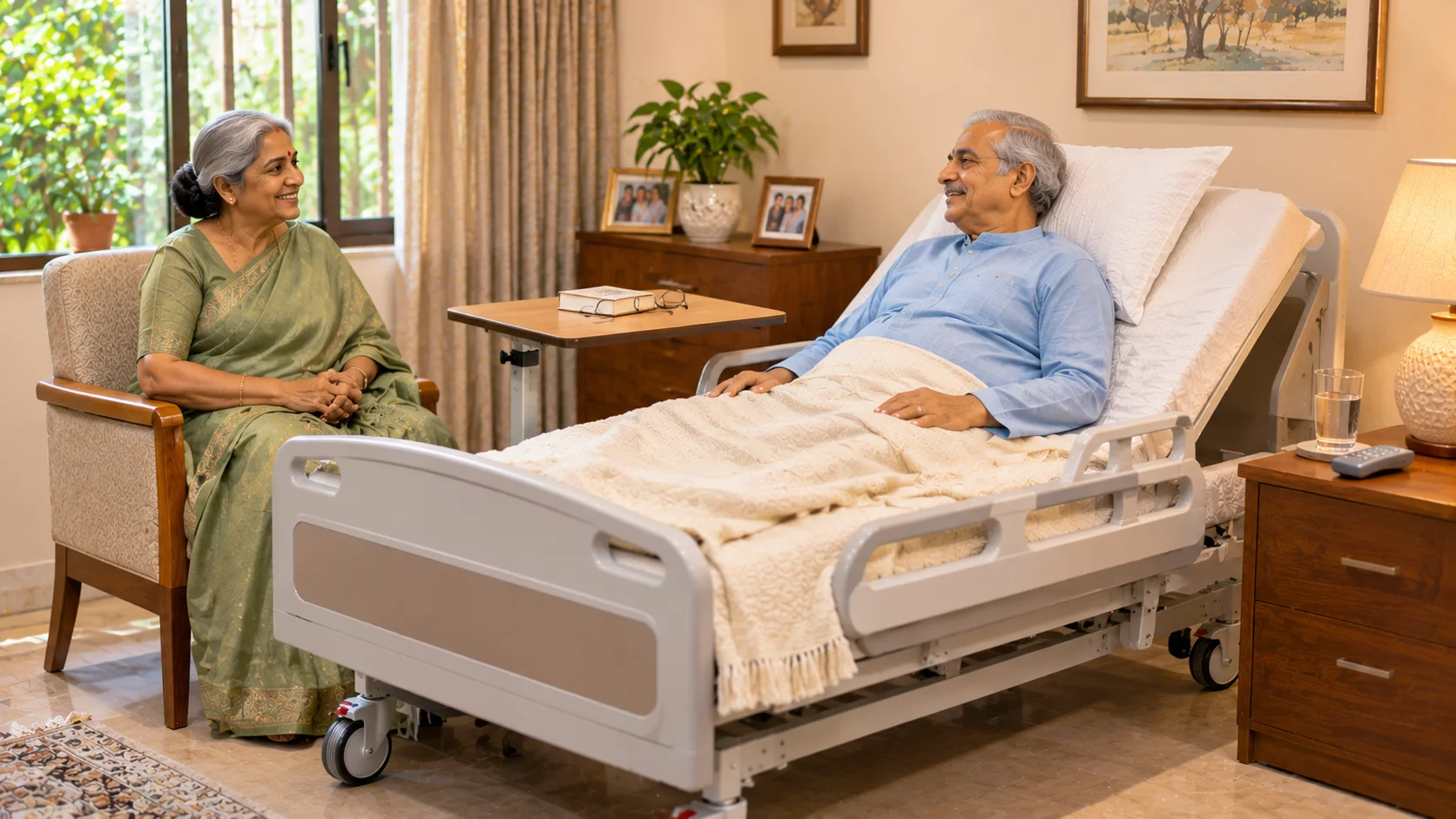
Many heart patients find it easier to breathe and rest with the head and chest raised, and a hospital bed lets the family set and hold that position smoothly. Look for a bed that raises the back gently, supports the knees, adjusts in height for easy getting up and can be operated with a simple remote. Always follow the cardiologist on activity, positions and warning signs. Chest pain, severe breathlessness or fainting need emergency care and should never wait on bed settings.
After a heart attack, bypass surgery, a heart failure admission or a long illness, many patients come home needing rest, careful movement and a comfortable way to sleep. Lying flat can make some of them breathless, and getting up quickly can make them dizzy. A hospital bed with an adjustable back, knee section and height control can help the patient rest safely and move with less strain. This guide explains how raised positions are commonly used, what features to look for and how to prepare the room. It is general information and does not replace the cardiologist’s advice.
Why Position Matters for Heart Patients
For some people with heart or lung conditions, lying flat increases the feeling of breathlessness, and they prefer to sleep propped up. A raised upper body can also make it easier to cough, eat and take medicines. Raised legs are advised for some patients and not for others, so the cardiologist should say which positions suit the patient. A bed that can hold an exact angle and return to it every night is more reliable than a stack of pillows.
Features That Help
| Feature | Why It Helps | Check Before Buying |
| Adjustable back section | Lets the patient rest with head and chest raised | Smooth, steady raising and holding |
| Knee section | Stops sliding and supports the legs | Moves with the back section |
| Height adjustment | Makes it easier to sit at the edge and stand slowly | Low height for feet flat on the floor |
| Easy remote | Lets the patient or family adjust without exertion | Large, clear buttons |
| Stable, quiet motors | Avoids startling and disturbed sleep | Noise level and smoothness |
| Reachable call arrangement | Helps the patient summon help at night | Phone or bell within reach |
Using Raised Positions Safely
- Ask for the angle. The cardiologist or nurse may suggest a particular angle for rest and for sleep.
- Raise slowly and let the patient settle for a few minutes.
- Lift the knees slightly so the patient does not slide down. See Fowler’s position explained.
- Support the head and neck with a slim pillow in line with the spine.
- Come up gradually. Before getting out of bed, raise the back, let the patient sit at the edge for a moment and stand slowly to avoid dizziness.
CALL FOR HELP IMMEDIATELY
Call the doctor or emergency services at once for chest pain or pressure, severe breathlessness, fainting, a very fast or irregular heartbeat, swelling that increases quickly, or a sudden change in alertness. Do not wait to adjust the bed first. This guide gives general information only and does not replace the cardiologist’s instructions.
Rest, Activity and Daily Routine
- Follow the activity plan. The cardiologist or physiotherapist will say how much walking and sitting is safe. The bed should support that plan, not replace it.
- Keep medicines organised. Place them where the caregiver can reach them but the patient cannot confuse them.
- Keep the room calm and ventilated. A cool, quiet room helps rest. Use fans carefully so cables do not cross the walkway.
- Plan night-time safety. Keep a soft light, a clear path to the bathroom and a phone within reach.
Preparing the Home in India
- Power cuts. A patient who depends on a raised position at night should not be stuck flat during an outage. Ask about backup or a manual release and read electric beds and power cuts in India.
- Room and lift access. Measure the doors and lift with the hospital bed size and dimensions guide.
- Set-up before discharge. Use the hospital discharge checklist so the bed is ready.
- Safety around cables. See patient safety with electric adjustable beds.
Choosing Between Bed Types
A patient who is fairly mobile and mainly needs a comfortable raised position may be well served by a recliner-style bed, as described in recliner bed vs sofa bed vs daybed. A patient who is weak, has swelling or needs nursing care will usually do better with a hospital bed with height adjustment and more positions. Your cardiologist and physiotherapist can help you decide, and we are happy to talk through the options.
Keeping a Simple Record
A small notebook beside the bed can be very useful. Note the angle or position the patient rests in, the time of medicines, any breathlessness or dizziness and what helped. When you meet the cardiologist, this record is easier to discuss than memory alone. It also helps different family members and attendants follow the same routine. Do not use the notebook to decide medical changes yourself. Use it to give the doctor a clear picture of how the days and nights have gone.
A bed that holds a comfortable raised position and helps the patient get up slowly can make recovery at home calmer and safer. Follow the cardiologist’s advice, keep a plan for emergencies and choose a bed that is easy to operate. If you need help matching a bed to the patient, our team is here to guide you.
Explore our Electric Hospital Bed collection or the Recliner Bed range, or talk to our team about the right choice.
Related Reading