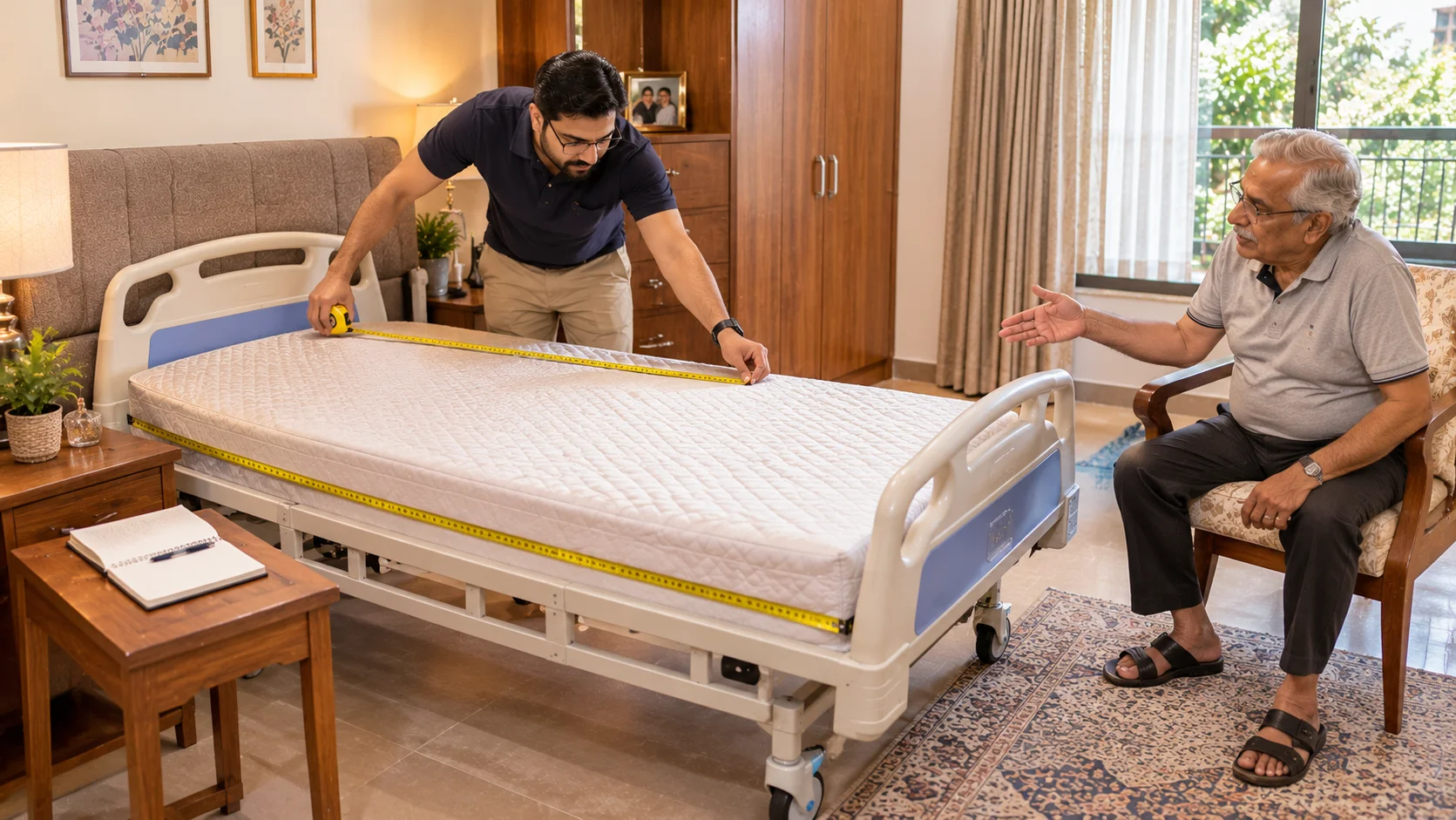
Hospital beds in India are commonly about 198 to 213 cm (roughly 6.5 to 7 feet) long and 90 to 98 cm (about 3 feet) wide, with hospital mattresses sold in sizes such as 72 by 36, 75 by 37 and 76 by 38 inches. Home double beds are wider, so a hospital bed can feel narrow. Before buying, measure the room, doorways, lift and the space needed on both sides of the bed, and match the mattress to the bed platform.
When families order a hospital bed, size is usually an afterthought until the delivery team arrives and the bed will not go through the door. Hospital beds are built to a fairly standard footprint, but they differ from home beds in length, width and height, and the numbers matter for room layout, mattress choice and access. This guide gives the typical measurements, what to check before ordering and how to avoid the common surprises.
Typical Hospital Bed Dimensions in India
| Item | Typical Size | Notes |
| Bed length | 198 to 213 cm (about 6.5 to 7 ft) | Five-function cots are often at the longer end |
| Bed width | 90 to 98 cm (about 3 to 3.2 ft) | Narrower than most home double beds |
| Overall height | About 60 cm in many listings | Check whether this includes the head and foot panels |
| Foam hospital mattress | 72 x 36, 75 x 37 or 76 x 38 inches | Usually 4 to 7 inches thick |
| Home single bed for comparison | About 3 x 6 ft | Similar width to a hospital bed |
These figures come from supplier and marketplace listings seen in October 2026. Models differ, so always ask for the exact dimensions of the bed you are buying, including the side rails and any panels.
Why the Size Matters
- Access. A bed that is too long or wide for the room blocks movement for the patient and caregiver.
- Mattress fit. The mattress must match the bed platform, or gaps will appear that are unsafe and uncomfortable.
- Delivery. Doors, corridors and lifts must be wide and long enough for the frame and mattress.
- Comfort. A taller or heavier person may need a longer or wider bed than the standard.
Measure Before You Order
- Measure the room and mark the bed outline with tape on the floor to see how it feels.
- Allow space on both sides if a caregiver will help. Around 90 cm on the working side is a common guide, and more if a wheelchair or walker is used.
- Measure doors and corridors, including tight turns, since a 90 cm wide frame needs a clear opening.
- Check the lift or stairs. A 210 cm bed may not stand upright in a small lift, so ask whether it can be dismantled.
- Note the socket position for an electric bed and plan the cable route.
- Confirm the mattress size with the supplier and keep it on your quotation.
Hospital Bed Size vs Your Home Bed
Many Indian home beds are wider than a hospital bed, for example queen and king sizes. If the patient will stay in your existing bed, converting it into an adjustable bed keeps the width and the room as they are, which is often easier than fitting a narrower hospital bed beside it. Our guide on converting a standard bed into an adjustable bed explains the process, and our guide to recliner beds for small bedrooms covers clearances.
Wider and Longer Options
Heavier and taller patients may need more than the standard bed. Ask whether wider platforms or longer mattresses are available, and check the rated weight capacity in writing. Because Zero-G beds are made to order, share the user’s height and weight when you place the order so the bed can be built to match.
Mattress Thickness and Side Rails
A thicker mattress raises the sleeping surface, which can lower the effective height of side rails and make getting in and out harder. If rails are used, check that the gaps around the mattress are safe, as covered in our guide on patient safety with electric adjustable beds.
IMPORTANT NOTE
Always confirm the exact dimensions, weight capacity and mattress size with the supplier before ordering. Do not assume that a bed called single, standard or full-size matches the figures in this article.
Common Sizing Mistakes
- Ordering without measuring the lift, then finding the bed cannot be carried up.
- Assuming a hospital mattress equals a home mattress, when the sizes differ.
- Forgetting the space a caregiver needs on the working side.
- Ignoring the socket position for an electric bed.
- Not checking whether side rails add to the width.
Room Layout Tips
Place the bed so that at least one long side is fully accessible, and both sides if a caregiver helps with transfers. Keep the head end against a wall for stability unless the supplier advises a gap, and keep the path to the bathroom clear. If you use a wheelchair or walker, leave enough turning space beside the bed rather than only on paper.
If the Bed Does Not Fit
If the room is small, there are options. Ask whether the bed can be delivered dismantled, consider a narrower or shorter model, move other furniture, or choose a conversion so the patient stays in the bed that already fits the room. A supplier who explains these choices is usually one you can trust with the installation.
A few minutes with a tape measure can save a failed delivery and an unusable bed. Measure the room, the route and the space around the bed, confirm the mattress size and write the dimensions on your order. Then choose between a hospital bed and an adjustable home bed according to your room.
Explore our Electric Hospital Bed collection or the Bed for Patients range.
Related Reading