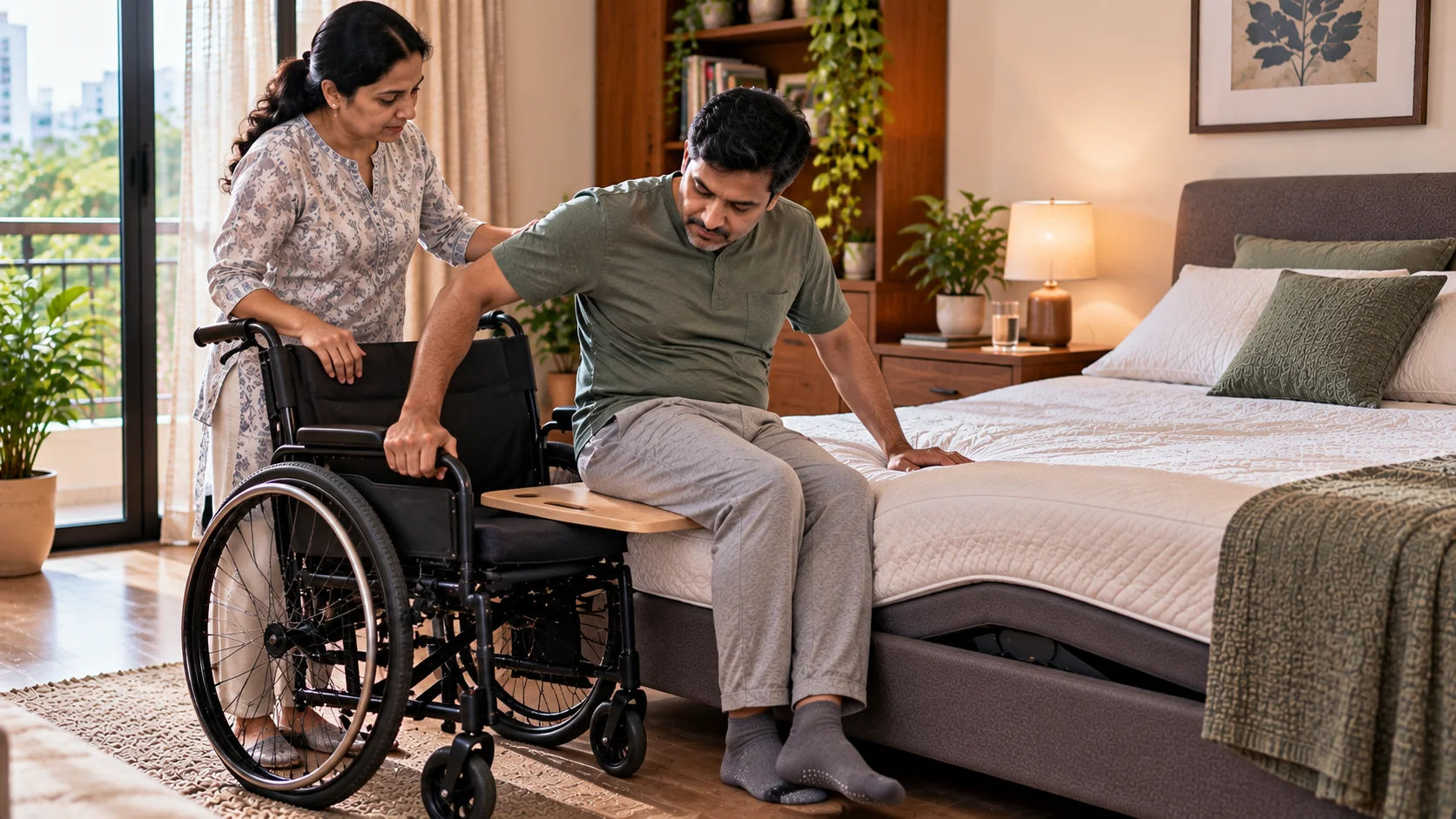
After open-heart surgery the breastbone is healing, so for the first six to eight weeks you avoid pushing or pulling with your arms. That makes getting out of a flat bed hard. A semi-reclined position on the back is usually advised, and an adjustable bed raises you without arm effort. If a leg vein was used, raise the leg to reduce swelling. Follow your surgical team’s exact instructions.
Open-heart surgery, whether bypass grafts or a valve operation, usually means the surgeon divides the breastbone (sternum) and wires it back together. It heals like a broken bone, so you are given ‘sternal precautions’ for the first weeks. These affect nearly everything, including how you get in and out of bed. Here is how an adjustable bed can help during recovery from open-heart surgery, alongside the guidance of your cardiac team.
What Sternal Precautions Usually Mean
While the breastbone heals, you are typically told not to push or pull with your arms, not to lift heavy loads, to avoid reaching behind you and to support the chest when coughing. The exact limits, often for six to eight weeks, come from your surgeon. Pushing up from a flat bed relies heavily on the arms and chest, which is exactly what you are meant to avoid.
How the Bed Helps With Those Precautions
| Precaution or Problem | On a Flat Bed | On an Adjustable Bed |
| No pushing with the arms | Hard to sit up from flat | The motor raises the torso for you |
| Sleeping on the back | Flat can feel strained and breathless | A semi-reclined angle is more comfortable |
| Coughing and clearing the chest | Painful when lying flat | An upright angle makes coughing and splinting easier |
| Leg incision swelling | Leg hangs or lies flat | Raising the leg section helps drain fluid |
| Fatigue and low energy | Every transfer is tiring | Lowering the bed and using presets save effort |
Call your cardiac team promptly for fever, a wound that opens, leaks or becomes red or swollen, a clicking or moving breastbone, chest pain, new breathlessness, rapid weight gain or swelling, fainting, or an irregular, racing heartbeat. This article covers comfort and mobility only, and your surgeon’s written instructions come first.
A Step-by-Step Night Setup
- Raise the head and torso section to roughly 30 to 45 degrees, which eases breathing and takes tension off the chest.
- Add a small knee lift, 10 to 15 degrees, so you stay in place.
- Sleep on your back, as most teams advise in the early weeks, with a pillow under each arm to stop them falling away from the chest.
- Keep a firm ‘heart pillow’ within reach to hug against the breastbone when you cough or sneeze.
- Keep the remote on a side you can reach without stretching or twisting.
Getting Out of Bed Without Using Your Arms
- Let the motor sit you up, rather than pulling on rails or sheets.
- Roll to your side as one unit, keeping your elbows tucked in.
- Drop your legs over the edge and let their weight help you sit.
- Stand using your legs, with your arms relaxed or lightly supported, as your team advises.
- Lower the bed beforehand so your feet touch the floor easily.
If a Leg Vein Was Used for the Bypass
Many bypass operations take a vein from the leg, leaving an incision that can swell. Raising that leg when resting helps fluid drain, and an adjustable bed’s leg section does this without piling pillows. This follows the same principle as in how adjustable beds improve circulation and reduce swelling. Keep the leg clean, watch for redness or discharge and follow your team’s guidance on compression stockings.
Breathing, Coughing and Staying Active
Deep breathing and coughing clear the lungs and reduce the risk of chest infection, but both hurt after surgery. Hold the heart pillow firmly against the chest, breathe deeply every hour while awake and take pain relief as prescribed so you can keep it up. Short, frequent walks, as advised by your team and cardiac rehabilitation, matter as much as rest. Raising the head also eases breathing, in line with the principles in adjustable beds for heart failure and orthopnea.
Safety and Family Support
Tell the people at home about your precautions so they do not pull on your arms to help you up. Keep the path to the bathroom clear and lit, and ask for help with anything heavy. A bed that is simple to operate lets you rest without needing assistance for every transfer, and the safety points in how to ensure patient safety with electric adjustable beds are worth reading with the family.
Cardiac Rehabilitation and Gradual Return to Activity
Most centres offer cardiac rehabilitation, a supervised programme of exercise, education and support that starts a few weeks after surgery. It builds strength safely and helps with confidence, nutrition and managing risk factors such as blood pressure and cholesterol. Rest remains important, but people recover best when they combine good sleep with regular, gradual activity. Ask your team when you can drive, return to work and resume normal movement, and use the bed as a place to recover from that activity rather than a place to avoid it.
Open-heart recovery depends on protecting the breastbone while keeping the body gently active. An adjustable bed supports both: it lifts you without arm effort, gives a comfortable semi-reclined sleeping position and raises a swollen leg. Follow your team’s precautions closely, and lean on a bed that helps you rest well.
Explore our Bed for Patients range or Electric Hospital Bed options.
Related Reading: