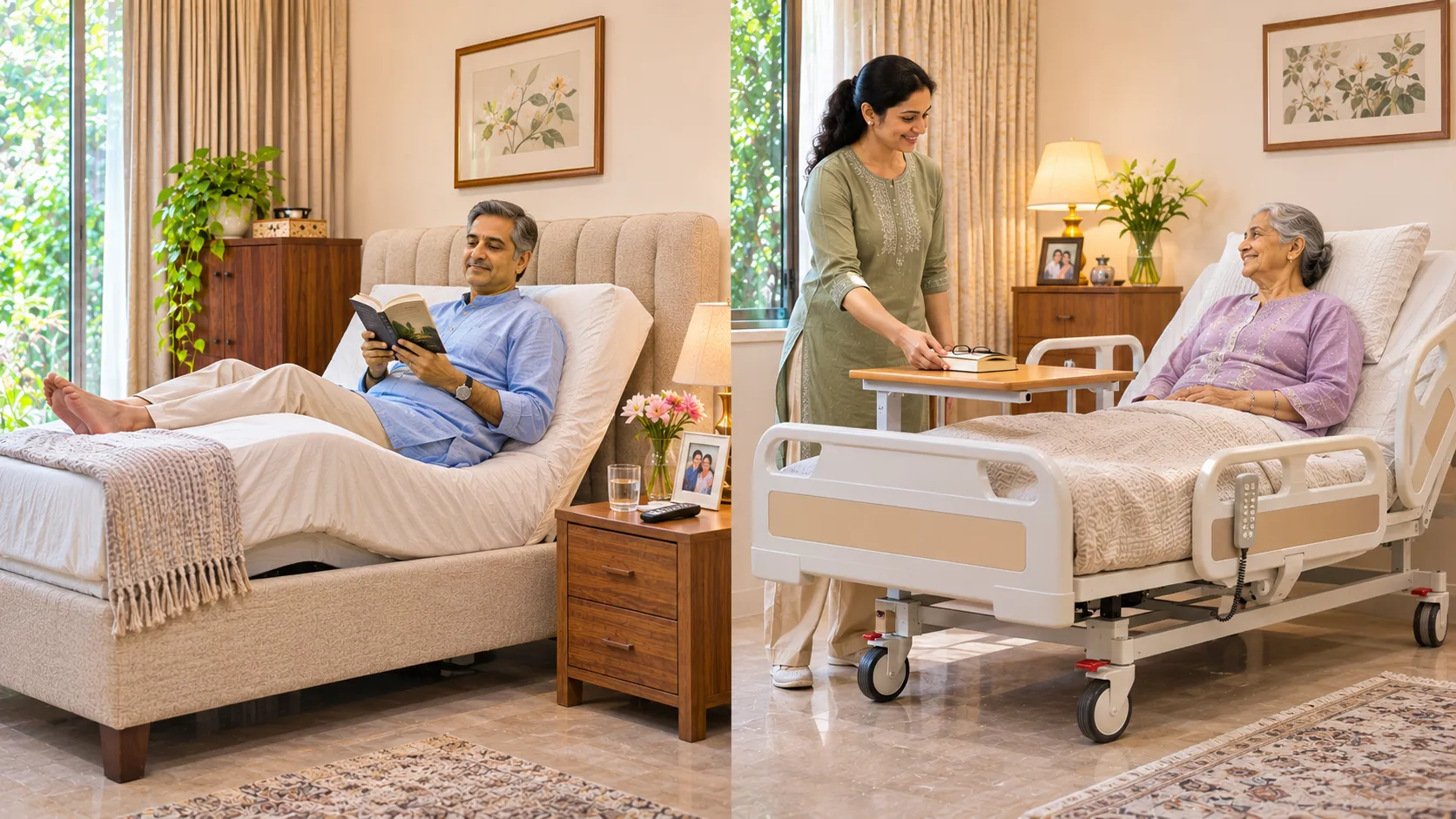
A hospital bed for a stroke patient should let the caregiver raise the back and knees smoothly, change height for care and transfers, and support regular repositioning to protect the skin. Look for a firm, stable frame, easy-to-use controls, a pressure-relieving mattress and rails only if the doctor advises them. Positioning after a stroke is specific to each person, so follow the neurologist or physiotherapist about the affected side, swallowing and angles.
When a family member comes home after a stroke, the bed becomes the centre of daily life. A well-chosen hospital bed makes feeding, washing, transfers and rest safer and less tiring for everyone. This guide explains what to look for in a bed for a stroke patient at home, how positioning is usually approached and how to build a simple daily routine. It gives general information only. Every stroke is different, so the neurologist, physiotherapist and nurse must guide the details.
Why the Right Bed Matters After a Stroke
After a stroke, one side of the body may be weak, swallowing may be affected and the person may tire easily or find it hard to change position. A bed that supports gentle, frequent repositioning helps protect the skin, supports breathing and eating and eases transfers to a chair or wheelchair. It also protects the caregiver, who may be lifting and turning several times a day.
Features That Help at Home
| Feature | Why It Helps | Check Before Buying |
| Adjustable back section | Supports sitting up for meals, medicines and visitors | Smooth movement and steady hold |
| Knee section | Reduces sliding down when the back is raised | Moves with the back section |
| Height adjustment | Lets the bed match chair height for transfers and the caregiver’s waist for care | Range from lowest to highest |
| Easy remote | Allows adjustment without effort, sometimes by the patient | Large clear buttons |
| Pressure-relieving mattress | Helps protect skin when movement is limited | Suitable thickness and bending ability |
| Side rails | May help with turning and prevent falls where advised | Doctor’s advice and rail design |
Positioning: General Principles
Stroke positioning is individual, and the care team usually tells the family how to position the affected arm and leg and how high to raise the head. The principles below are commonly discussed, but they must be adapted to the patient.
- Support the weak side. Use pillows or rolled towels as shown by the physiotherapist so the affected arm and leg are comfortable and not left hanging or twisted.
- Raise the head for meals. Many patients are fed and given medicines with the back raised, and kept upright for a while afterwards. See Fowler’s position explained.
- Change position regularly. Follow the turning routine given by the nurse, often every two hours when the patient cannot move.
- Avoid sliding. Lift the knee section slightly when the back is raised.
- Keep the head and neck supported. Avoid pushing the chin onto the chest.
IMPORTANT NOTE
Call the doctor or emergency services urgently if the patient has sudden weakness, trouble speaking, facial drooping, severe headache, choking, breathlessness or sudden confusion. Do not rely on the bed settings to manage warning signs. This guide does not replace the advice of the treating doctor, physiotherapist or nurse.
Protecting the Skin
A person who cannot move easily is at risk of pressure sores over the tailbone, hips and heels. Regular turning, clean dry skin, a suitable mattress and checking the skin daily all help. Raising the back section drags the skin if the body slides, so the knee lift matters. Read more on our page about adjustable beds for bed sores, and keep sheets smooth with our guide to changing bedsheets for a bedridden patient.
Transfers and Safety
- Lower the bed so the patient’s feet can rest flat on the floor, if the care team has approved sitting at the edge.
- Lock the castors and keep the wheelchair or chair close and also locked.
- Keep the path clear of wires, tubes and loose mats.
- Move slowly and let the patient sit for a moment before standing, as advised by the physiotherapist.
- Never lift by the weak arm. Ask the physiotherapist to show a safe technique.
Our article on patient safety with electric adjustable beds covers cables, controls and other safety points in more detail.
A Simple Daily Routine
- Morning: wash, skin check, medicines and breakfast with the back raised.
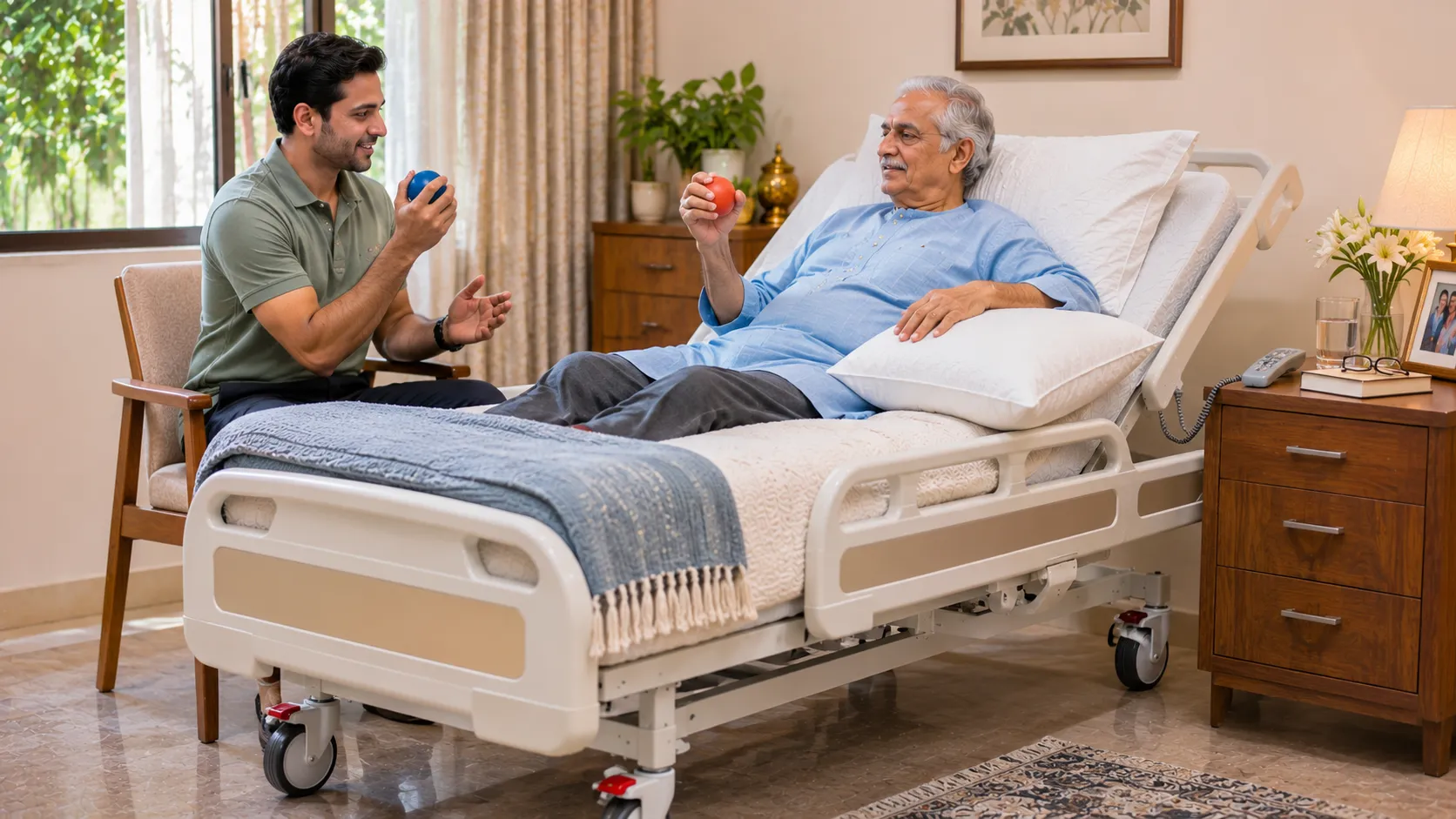
- Daytime: short periods of sitting up, physiotherapy exercises as advised and position changes on schedule.
- Evening: light meal, then raise the back for a while before lying lower.
- Night: a comfortable position, clear path to the bathroom or commode and a way for the patient to call for help.
Practical Points for Indian Homes
- Room and door width. Measure the door, lift and room before ordering. See hospital bed size and dimensions in India.
- Power cuts. Ask about backup and manual release. See electric beds and power cuts in India.
- Attendant help. If a hired attendant will assist, ask the supplier to demonstrate the controls to them too.
- Set-up before discharge. Use the hospital discharge checklist so the bed is ready when the patient arrives.
A good bed will not treat a stroke, but it can make recovery at home safer, calmer and less tiring. Choose a bed that adjusts smoothly, set it up with the care team’s advice and build a steady routine. If you need help matching a bed to your situation, we are glad to guide you.
See our Electric Hospital Bed collection or the Bed for Patients range, or talk to our team about your family’s needs.
Related Reading