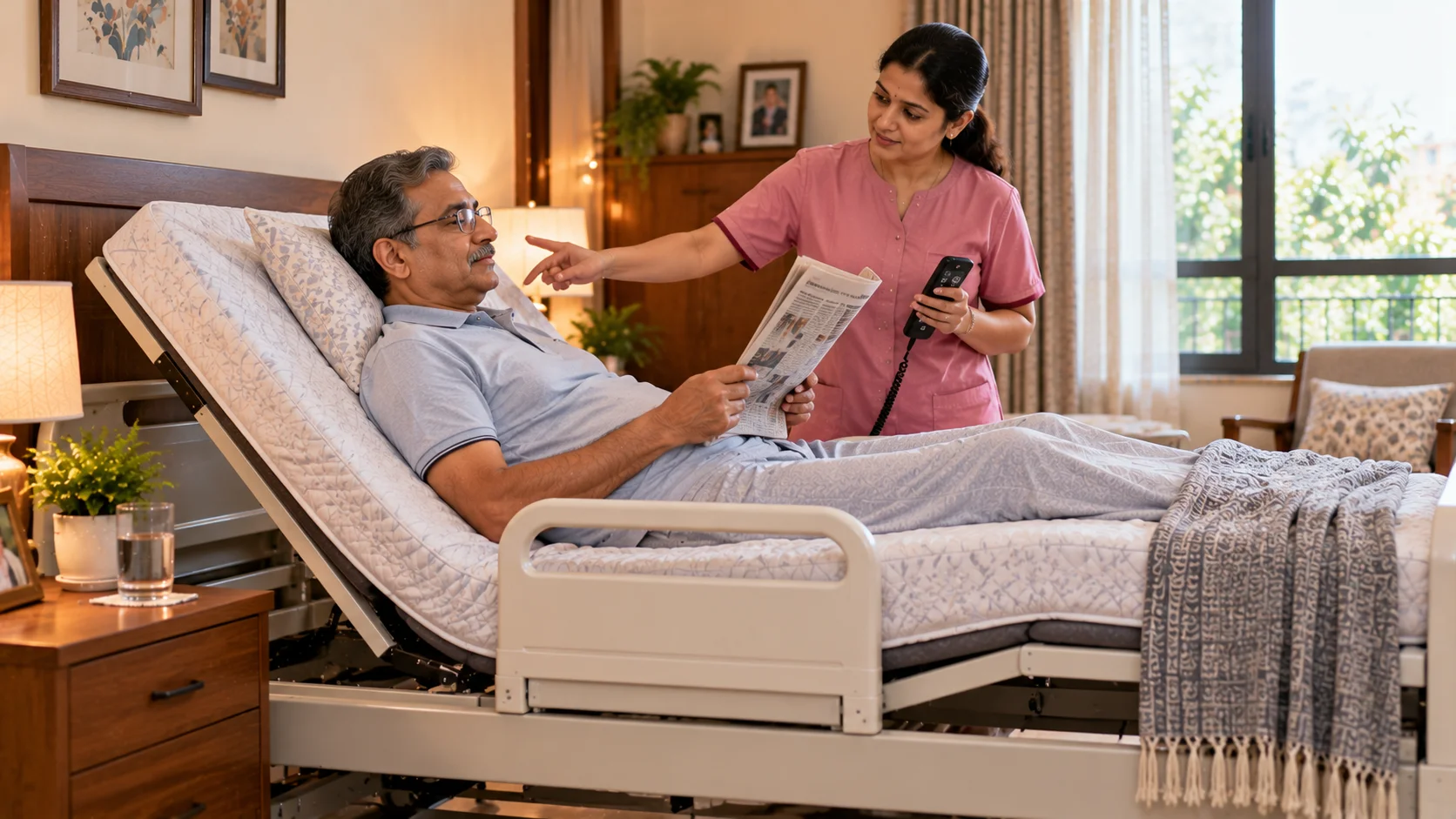
When a family chooses an electric hospital bed for home use, they often focus on adjustment functions, mattress compatibility and room size. There is another practical question that deserves attention before installation: what happens if the electricity goes off while the bed is raised?
An electric bed relies on power to operate its motorised adjustments. The behaviour during an outage depends on the model and the backup or emergency functions actually supplied with it. A battery, manual lowering system or other emergency provision should never be assumed to be included unless the supplier confirms it for that specific model.
This guide explains what to ask before buying, how to prepare for an outage, and which details should be recorded for the user and caregiver. It does not assume that every Zero-G Beds configuration includes a battery backup or manual emergency lowering feature; those specifications need to be confirmed directly.
Why Power-Cut Planning Matters
In everyday use, a powered bed may be adjusted several times to sit up, elevate the legs or return to a flatter resting position. If power is unavailable, the remote may not be able to operate those movements until power is restored, unless the particular system includes an appropriate backup or emergency function.
For some households, an outage may be an inconvenience. For a person who depends on a specific position or needs caregiver help to change position, it can raise practical questions that should be discussed in advance.
The goal is not to assume that an outage will cause an emergency. It is to understand the limits of the equipment and prepare a safe, realistic response with the supplier and care team where relevant.
Ask These Questions Before Ordering
When discussing an electric hospital bed, ask the supplier to explain the exact power and emergency arrangements for the model you are considering.
Does the model include a battery backup?
Some electric beds may offer backup options, while others may not. Ask whether a battery is included, optional or unavailable for the selected configuration. Confirm which functions it supports and how long it is intended to operate under the manufacturer’s stated conditions.
Do not assume that a backup battery can power every movement or operate indefinitely. Ask for the official specification and instructions.
Is there an emergency lowering method?
Ask whether the bed has a manufacturer-approved way to return it to a safe position when normal power is unavailable. If such a method exists, the supplier should explain who is permitted to use it, what tools are needed and whether training is required.
Do not try to turn, push or dismantle parts of a motorised system based on guesswork. Unapproved force or modifications may damage the bed or create a risk for the person using it.
What happens if the bed is left in a raised position?
Ask what the specific model does when power is lost during movement and when the motor is not running. The behaviour may depend on the drive system, controls and any backup function. Obtain an explanation for the model, rather than relying on general information about electric beds.
Are any functions available without mains power?
A remote may have its own battery, but that does not mean the bed’s motors will operate without power. Separate the power requirements of the remote from those of the bed mechanism.
Ask which components require mains electricity, whether backup power is available and what the user should do during an outage.
Prepare the Room and Power Connection
Before installation, identify the electrical outlet that will serve the bed and ask the supplier about its power requirements. Keep the route from the outlet to the bed clear and avoid placing cables where they may be trapped by moving sections, walked on or exposed to spills.
The final power arrangement should follow the manufacturer’s instructions and any applicable electrical guidance. Do not use an improvised extension, adapter or damaged cable to make the bed reach an outlet. If the outlet location is inconvenient, discuss it before installation rather than rerouting a cable unsafely afterwards.
For a home-care user, make sure the responsible family member or caregiver knows where the power connection is and how to disconnect it safely if instructed to do so. Store the manual and service information where they can be found quickly.
Create a Simple Outage Plan
A useful outage plan starts with the equipment instructions, the user’s needs and the support available in the home. It should not involve improvising a manual method that the manufacturer has not approved.
The plan can include:
- Know the current bed position. Before an anticipated outage, where practical, follow the supplier’s instructions for preparing the bed. Do not reposition someone in a way that conflicts with clinical guidance.
- Keep the manual accessible. Record the model name, supplier contact and instructions for any confirmed backup or emergency function.
- Identify who can help. Ensure the relevant family member or caregiver knows whom to contact and what actions are permitted.
- Avoid forcing the mechanism. Do not manually push the platform or attempt to release motors unless the model’s instructions explicitly describe that procedure.
- Escalate care concerns. If the person’s position is medically important or they cannot be safely supported during an outage, follow the clinician’s advice and the household’s care plan.
If an outage occurs and the bed cannot be moved, do not improvise a repair. Contact the supplier or qualified service provider and follow the instructions given for the actual model.
What to Confirm During Handover
During installation or handover, ask the technician to show the permitted controls and explain the response to a power failure. Have the caregiver repeat the steps back so there is no confusion about what can and cannot be done.
Confirm these details in writing where possible:
| Topic | What to confirm |
|---|---|
| Power connection | Required outlet and cable instructions |
| Backup | Whether a backup battery is included or available |
| Emergency operation | Whether a manufacturer-approved emergency method exists |
| Limitations | Which functions do and do not operate during an outage |
| User support | Who should be contacted if the bed cannot be repositioned |
| Service | Model identification and after-sales contact details |
These details are important even if outages are rare. They help the household distinguish a planned procedure from a guess made under pressure.
Choose the Bed Around the Actual Care Requirement
The need for backup depends on how the bed is used and the user’s circumstances. A person who changes position occasionally may have different priorities from a user who relies on a particular position or needs assistance for nearly every movement.
If a healthcare professional has specified positioning or transfer requirements, share those requirements with the supplier. Confirm that the selected bed and its emergency arrangements are appropriate for the intended use. A sales discussion should not replace clinical advice, and an adjustable bed should not be treated as a medical device that automatically solves every care challenge.
Review the Electric Hospital Bed range and ask Zero-G Beds to confirm the exact power, control and backup specifications of the configuration you are considering.
Before choosing an electric hospital bed, confirm what the model supports during an outage and which actions the manufacturer permits. Review the Zero-G Beds electric hospital bed range and resolve power and emergency-operation questions before confirming your setup.