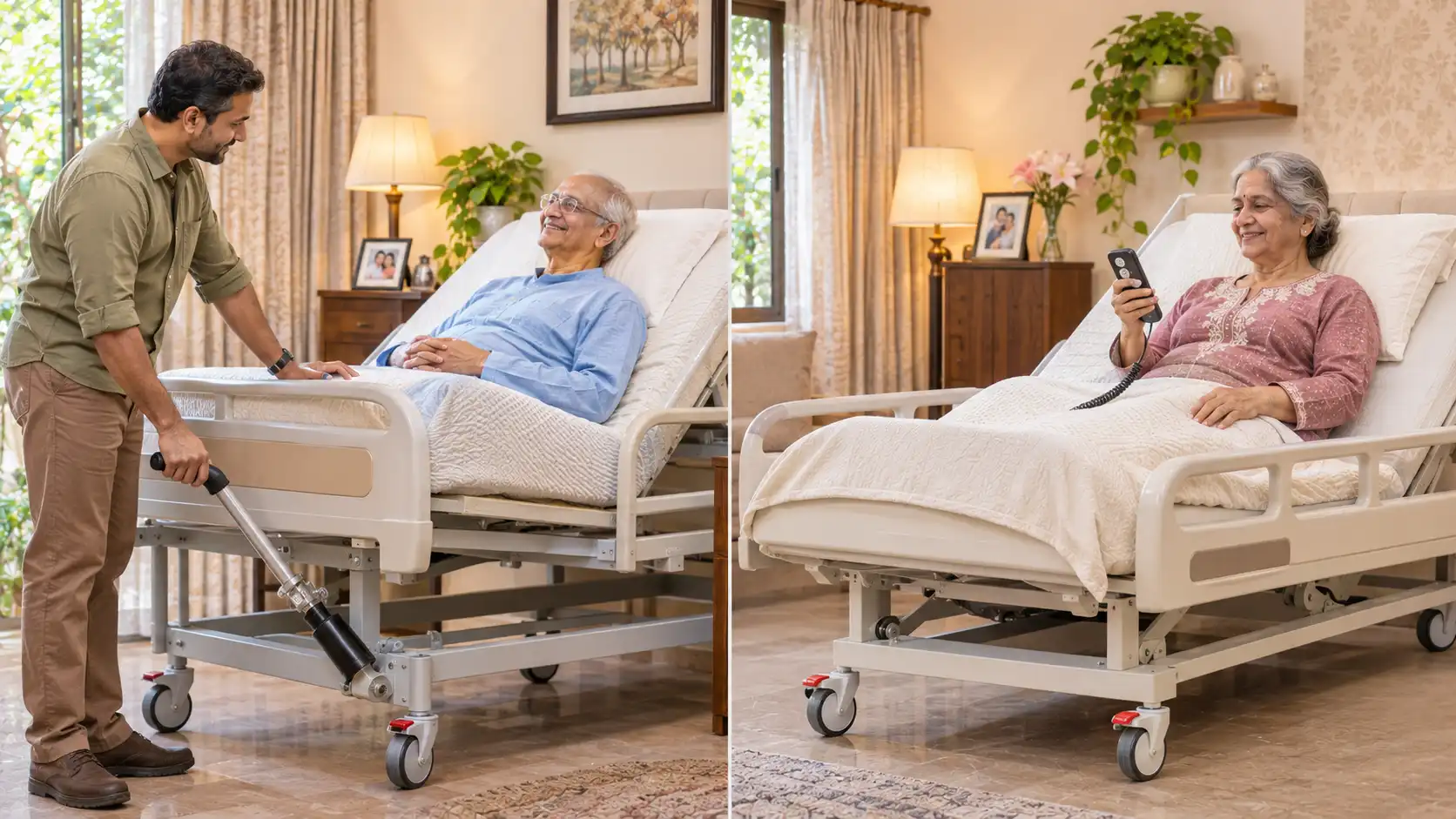
Choose a recliner bed if the patient can sit up, move with little help and wants a comfortable, home-like bed that raises the back and legs, as in recovery, old age or breathing discomfort. Choose a hospital bed if the patient is mostly bedridden, needs frequent repositioning, height adjustment for nursing care or side rails. Many families find a motorised hospital bed gives the most care features, while a recliner bed suits those who are partly mobile. Your doctor or physiotherapist should advise on the final choice.
Families setting up care at home often ask the same question: should we buy a recliner bed or a hospital bed? Both raise the back and legs, and both can be motorised, so they look similar on a website. In daily use they serve different needs. This guide compares them on comfort, positions, care, space and cost, so you can decide with confidence. It is general information, and your doctor or physiotherapist should guide the final decision.
The Basic Difference
A recliner bed is built for comfort and recovery. It looks like a regular bed, raises the back and often the legs, and lets a person sit up, lean back or lie flat. A hospital bed is built for care. It adds features such as height adjustment, side rails and more positioning options for a caregiver who is looking after someone who cannot move easily. Some beds combine features of both, so always check the actual specification.
Recliner Bed vs Hospital Bed at a Glance
| Point | Recliner Bed | Hospital Bed |
| Best for | Partly mobile patients, elderly users, recovery, breathing comfort | Bedridden or low-mobility patients needing nursing care |
| Look and feel | Home-like, blends with a bedroom | Clinical, care focused |
| Positions | Back and leg raise, often with preset positions | Back, knee and often height and tilt adjustments |
| Height adjustment | Often limited | Often available, easing nursing tasks |
| Side rails | Usually optional or absent | Commonly available |
| Caregiver access | Good for a helper nearby | Designed for hands-on care |
| Space needed | Close to a regular bed | Slightly more room for care access |
When a Recliner Bed Is the Better Choice
- The patient can sit up and transfer with little help. Examples include recovery after joint surgery. See recliner beds after knee or hip replacement.
- Comfort and sleep matter most. Raising the upper body can ease breathing discomfort at night, as described in best recliner bed positions for night-time asthma.
- The bed must fit a bedroom. A recliner bed looks like normal furniture, which many elderly parents prefer.
- A couple shares the room. Read adjustable beds for couples if one partner needs a different position.
When a Hospital Bed Is the Better Choice
- The patient is mostly or fully bedridden. Frequent repositioning and pressure care are easier with more adjustment.
- A caregiver does hands-on care. Height adjustment reduces back strain, as covered in electric beds for caregivers.
- Side rails are needed. They can help with turning and, where advised, to reduce the risk of falls.
- The patient is leaving hospital. A bed that matches what the hospital used makes the transition easier. Use the hospital discharge checklist.
IMPORTANT NOTE
The right bed depends on the patient’s condition, mobility and the advice of the treating doctor. Side rails are not suitable for every patient, and a patient with confusion or restlessness may need special precautions. Ask the doctor or physiotherapist before choosing rails, angles or positions.
Questions That Make the Choice Easier
- Can the patient get in and out of bed alone? If yes or with light help, a recliner bed may be enough.
- How many times a day will the position change? Frequent changes favour a motorised bed of either type.
- Who is the caregiver? Ask how comfortable they are reaching, lifting and turning.
- How much room is there? Check door width, lift size and space around the bed with hospital bed size and dimensions in India.
- Is the need short term or long term? A growing need favours more care features.
Cost, Service and Long-Term Value
Prices depend on the model, motors and mattress rather than the label alone, so compare written specifications. Whichever you choose, ask who installs the bed, who services it in your city and what the warranty covers. Our warranty guide explains the terms to look for. A bed that is easy to service will be more comfortable and safer over months of use.
Can One Bed Do Both Jobs?
Sometimes. Certain motorised beds offer recliner-style comfort together with care features such as height adjustment. If your needs sit between the two, ask us about such options. If you are thinking of converting an ordinary bed, read can any bed become a recliner bed first.
A Quick Example
Consider a parent who has come home after a hip fracture and can sit up with a little help. A recliner bed may be the natural fit, since it lets them rest comfortably and transfer to a chair as they recover. Now consider a parent who cannot turn in bed and needs washing, feeding and skin care in bed every day. A hospital bed with height adjustment, a knee section and better access for the caregiver will usually serve them better. Many families start with one and, as needs change, discover they should have chosen the other, so think about where the patient is likely to be in three to six months, not only today.
Final Thoughts
A recliner bed gives comfort for people who are still fairly mobile, while a hospital bed gives caregivers the tools they need for someone who cannot move easily. Match the bed to the patient, the caregiver and the room, and check service support before you buy.
Explore our Recliner Bed range or the Electric Hospital Bed collection, or speak to our team to find the right fit.
Related Reading