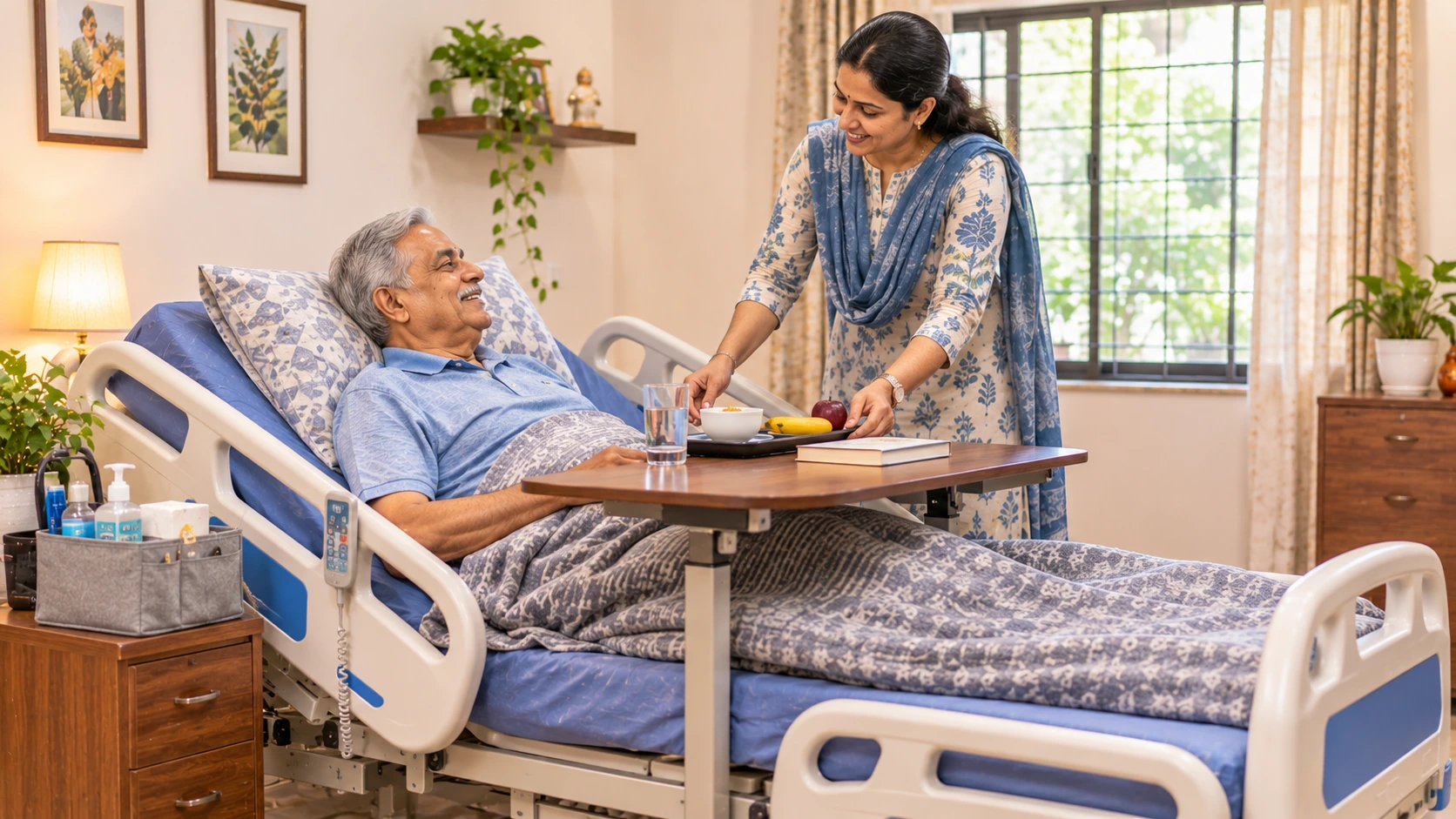
Hospital bed brochures use unfamiliar words such as Fowler, Gatch, castors, deck, autocontour and CPR release. In short, Fowler means raising the back, Gatch means raising the knees, castors are the wheels, the deck is the platform that holds the mattress and rails are the side barriers. This glossary explains each term in plain language and tells you why it matters when you choose or use a hospital bed at home.Â
Buying or renting a hospital bed for home care means reading brochures and quotations full of terms that sound clinical and confusing. Many families nod along and later discover that they ordered the wrong thing, or did not understand what the supplier meant. This glossary explains the words you are most likely to meet, in the order that makes most sense, so you can ask better questions.
Positions and MovementsÂ
| Term | What It Means | Why It Matters |
| Fowler’s position | The back section is raised so the person sits up | Used for meals, breathing comfort and rest. See our guide to Fowler’s position |
| Semi-Fowler, high Fowler | Lower and higher angles of the Fowler position | Different angles suit different needs |
| Gatch or knee break | The knee section is raised, so the knees bend slightly | Stops the patient sliding towards the foot end |
| Trendelenburg | The whole bed tilts with the head lower than the feet | A clinical position, used only on medical advice |
| Reverse Trendelenburg | The whole bed tilts with the head higher than the feet | Also clinical. Our guide on Trendelenburg positions explains the risks |
| Cardiac chair position | The back is raised and the legs lowered, like an armchair | Helps some patients sit more comfortably |
| Autocontour | The back and knee sections move together | Reduces sliding and skin dragging as the back rises |
Parts of the BedÂ
| Term | What It Means | Why It Matters |
| Deck or platform | The base that holds the mattress, usually in sections | Decides how the bed bends |
| Head and foot panels | The boards at each end of the bed | Easy-to-clean panels help hygiene |
| Side rails or bed rails | Barriers along the sides | Useful for some patients, with entrapment risks. See our guide on side rails |
| Assist rail or handle | A short rail used to help sit up or stand | Supports getting out of bed |
| Castors | The wheels under the bed | Look for smooth wheels with locks |
| Central locking | One pedal that locks all castors | Makes the bed stable and easy to secure |
| IV pole or drip stand | A pole that holds infusion bags | Only needed on medical advice |
| Over-bed table | A table that slides across the bed | Convenient for meals and activities |
Â
Controls and Electrical TermsÂ
| Term | What It Means | Why It Matters |
| Manual crank | A handle that you turn to raise a section | Needs someone to operate it |
| Hydraulic | A pump or pedal moves the bed | Smoother than a crank, but still manual |
| Electric or motorised | Motors move the sections | Easier for patient and caregiver. Read how an electric bed works |
| Handset or remote | The control used to move the bed | Look for large, clear buttons |
| Control box | The unit that receives signals and runs the motors | Keep it dry and undamaged |
| Manual release or CPR release | A way to lower sections without power | Useful in a power cut or emergency |
| Lock-out | Disables certain controls | Prevents accidental movement |
Â
Capacity and Care TermsÂ
| Term | What It Means | Why It Matters |
| Safe working load | The maximum total weight the bed is built to carry | Includes the patient, mattress and bedding |
| Bariatric bed | A wider, stronger bed for heavier patients | Ask for it if the user’s weight is high |
| Pressure-relieving mattress | A mattress designed to spread pressure | Protects skin. See our guide to hospital bed mattresses |
| Low bed | A bed that lowers close to the floor | Reduces the risk of injury from falls |
| Height adjustment | The whole bed raises and lowers | Protects the caregiver’s back and eases transfers |
How to Use This Glossary When You ShopÂ
- Take the glossary with you and tick the terms that matter to your patient.Â
- Ask the supplier to explain any term that is not clear.Â
- Match each term to a need, for example height adjustment for caregiver back strain.Â
- Write down what is included in the quotation, using the same words.Â
- Check the terms against our guide to semi fowler, full fowler and ICU beds if you are comparing models.Â
IMPORTANT NOTEÂ
This glossary gives general information and does not replace medical advice. The positions and features that suit a patient depend on their condition, so ask the doctor or physiotherapist before choosing or using any position.Â
Terms That Often Cause ConfusionÂ
- Semi-electric: usually motors for the back and knees, with height set by hand.Â
- Fully electric: motors for the back, knees and height.Â
- Five function: back, knees, height, and head-down and head-up tilt.Â
- Low bed: not the same as a bed with a low mattress. Ask how low it goes.Â
- Weight capacity: check whether it is the bed’s rating or the mattress’s rating.Â
Home-Style Beds and the Same WordsÂ
Many of these terms also apply to home-style adjustable and recliner beds. For example, a back rest that moves from 0 to 90 degrees is the Fowler movement, and a leg rest that moves from 0 to 45 degrees covers the knee and leg lift. Zero-G beds follow these ideas with a softer look. You can see how they work on our recliner beds and electric hospital bed pages.Â
Once you know that Fowler means the back, Gatch means the knees, the deck is the platform and the castors are the wheels, a hospital bed brochure becomes much easier to read. Use this glossary to ask clear questions, check what is included and choose a bed that suits the patient, not just the specification sheet.Â
Explore our Electric Hospital Bed collection or the Bed for Patients range.Â
Related ReadingÂ