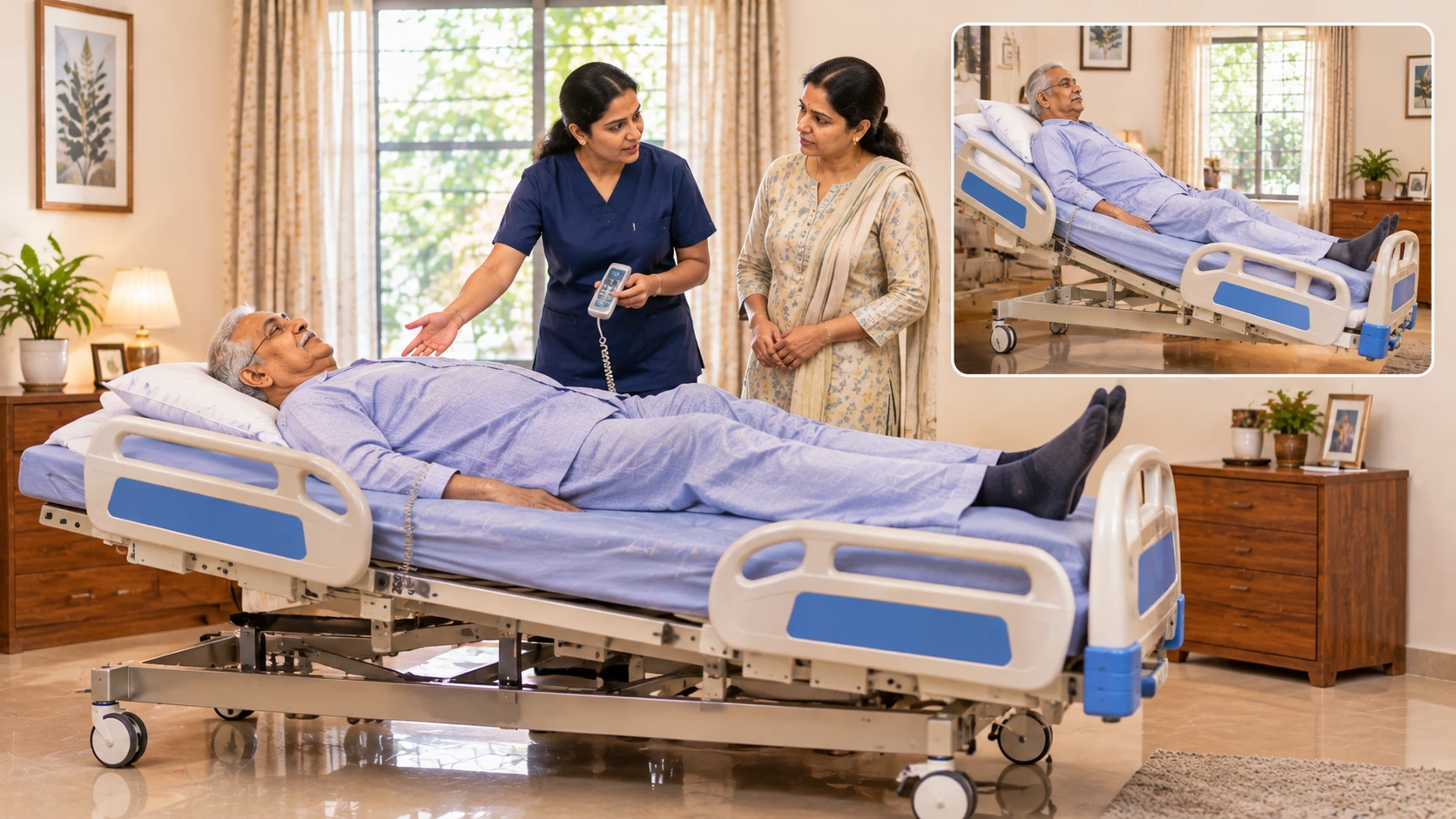
In the Trendelenburg position the whole bed tilts so the head is lower than the feet, and in reverse Trendelenburg the whole bed tilts so the head is higher than the feet. Unlike Fowler’s position, the bed does not bend at the hips. Both are used only on medical instruction, and Trendelenburg in particular carries risks such as breathing difficulty and raised pressure in the head. Most home recliner and adjustable beds do not tilt this way, and most families never need it.
Anyone who has read a hospital bed brochure or listened to nurses at a bedside will have heard the words Trendelenburg and reverse Trendelenburg. They sound alarming, and many families wonder whether the bed they are buying needs to do this. The short answer is that these are specialist positions for clinical use, and understanding them helps you choose a hospital bed sensibly and use it safely.
The Positions at a Glance
| Position | How the Bed Moves | Commonly Cited Angle | Typical Clinical Use | Main Cautions |
| Trendelenburg | Whole bed tilts, head down and feet up | Roughly 15 to 30 degrees | Some surgical procedures and specific medical situations | Breathing difficulty, pressure in the head and risk of aspiration |
| Reverse Trendelenburg | Whole bed tilts, head up and feet down | Roughly 15 to 30 degrees | Surgery, and to reduce reflux or help breathing in some patients | Sliding towards the foot end |
| Fowler’s | Bed bends at the hips so the upper body rises | 15 to 90 degrees depending on the type | Eating, breathing comfort and everyday rest | Pressure on the tailbone if held long |
| Zero Gravity | Head slightly raised and knees raised to about heart level | Head about 15 to 20 degrees, legs raised | Comfort and back relief | Not suitable for everyone, so check with your doctor |
Angles vary between sources and bed models, so treat these as typical ranges, not instructions.
Trendelenburg Position
Named after the German surgeon Friedrich Trendelenburg, this position tilts the entire bed, so the patient lies flat on their back with the feet higher than the head. It has long been used in some operations on the lower abdomen and pelvis. It was also once widely used to raise blood pressure in shock, but that routine use is now questioned, and current practice relies more on other methods. At home, nobody should use it without a clear instruction from a doctor.
Reverse Trendelenburg Position
Here the whole bed tilts the other way, with the head higher than the feet, while the body stays straight. Doctors may use it in surgery or in selected patients to reduce acid reflux, help breathing or lower pressure in the head. Because the body stays straight, it differs from sitting up in Fowler’s position, which bends the body at the hips.
How They Differ From Fowler’s and Zero Gravity
- Fowler’s position bends the bed at the hips so the person sits more upright, and is the everyday position for meals and breathing comfort. Our guide to Fowler’s position explains the angles.
- Trendelenburg and reverse Trendelenburg tilt the whole bed, which most home adjustable beds cannot do.
- Zero Gravity raises the legs and slightly raises the head to spread body weight, and is a comfort position rather than a clinical one. See our Zero Gravity page.
Why These Positions Carry Risks
- Breathing. In Trendelenburg, the abdominal organs press on the diaphragm, which can make breathing harder.
- Pressure in the head and eyes. Blood tends to shift towards the head, which is unsafe for some patients.
- Aspiration. Stomach contents can move up more easily when the head is lower.
- Sliding. In reverse Trendelenburg the patient can slide towards the foot end without a foot support.
- Circulation and comfort. Holding either position for long can cause discomfort or skin problems.
IMPORTANT NOTE
Trendelenburg and reverse Trendelenburg should only be used when a doctor or nurse has instructed you to, for a stated period. Do not use them as a comfort position at home. If a patient becomes breathless, dizzy, confused or in pain in any position, return the bed to a flat or comfortable position and call for medical help.
Do You Need a Bed That Tilts?
Most families do not. Tilt functions are usually found on five-function ICU-style beds, which also adjust the back, knees and height. They suit bedridden patients with complex needs, and they are used when the care team asks for them. For comfort, reflux, sitting up and leg support, a bed that raises the back and knees is enough. Our guide to semi fowler, full fowler and ICU beds explains how the bed types differ.
What to Ask a Supplier About Tilt Functions
- Ask whether the bed tilts at all, and which direction.
- Ask who has advised the patient to use it, and what the doctor wants.
- Ask how the tilt is controlled, and whether it can be locked out.
- Ask about safety features, such as foot boards and mattress retainers.
- Ask how the bed returns to flat if the power fails. Our guide on electric beds and power cuts covers this.
Home-Style Recliner Beads
Home recliner beds focus on comfort. Zero-G beds, for example, have a back rest that moves from 0 to 90 degrees and a leg rest that moves from 0 to 45 degrees, which covers sitting up, reading, Zero Gravity and sleeping positions. If your doctor advises a tilt position, tell the supplier before you order and ask whether it is available. You can see the range on our recliner beds and electric hospital bed pages.
Trendelenburg and reverse Trendelenburg are clinical tools, not everyday comfort settings. Knowing what they are helps you understand what a nurse asks of you, choose a bed with the right functions and avoid using them by mistake. For everyday care, the back rest, knee rest and height adjustment do most of the work.
Explore our Electric Hospital Bed collection or the Bed for Patients range.
Related Reading