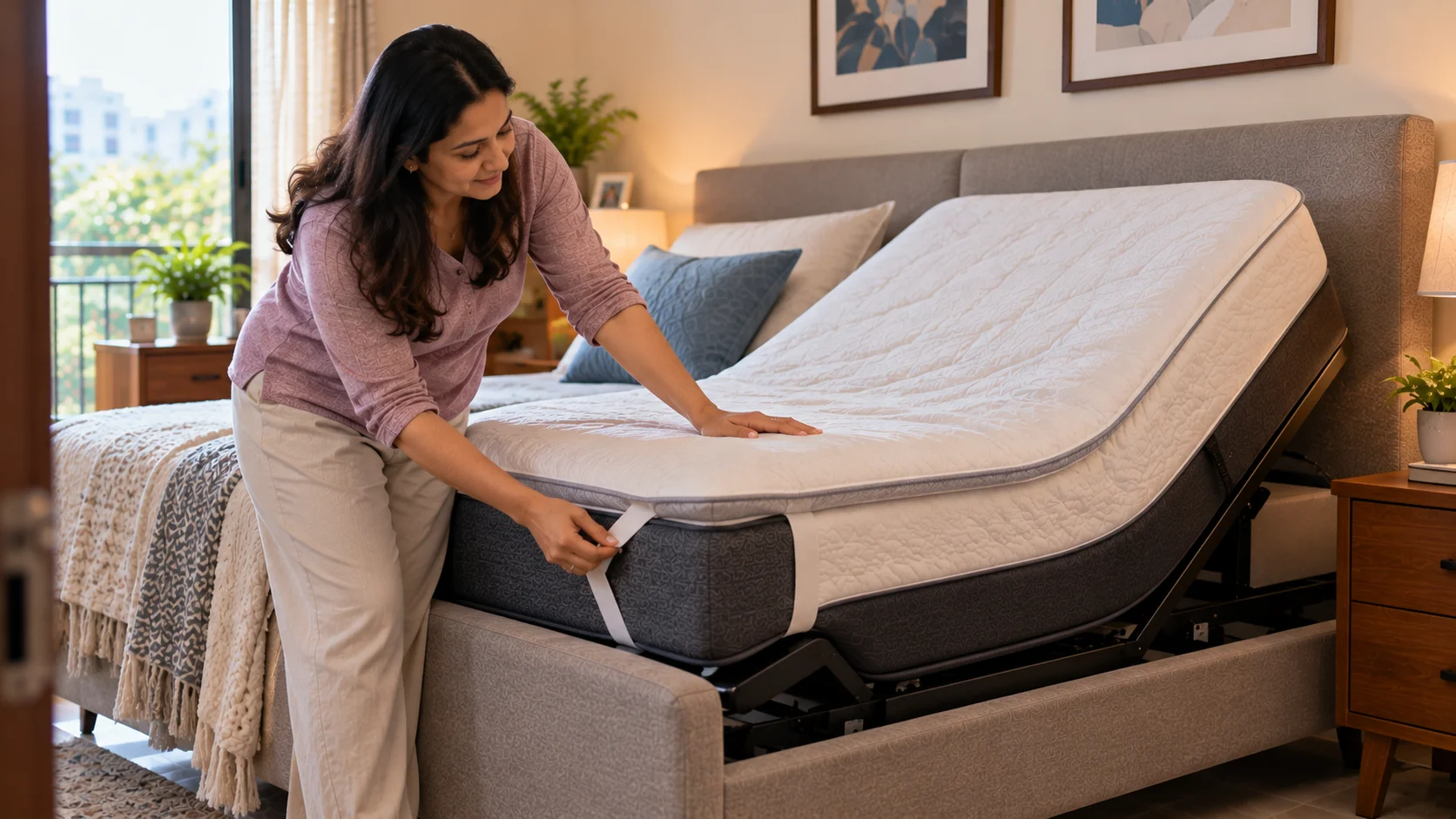
A mattress topper may work on an adjustable bed if it bends with the mattress, stays in place as the head and leg sections move, and does not interfere with the mechanism. Some toppers can bunch or slide when the base changes position.
Before adding one, check the bed manufacturer’s instructions and confirm that the topper suits the mattress and frame. At Zero-G Beds, we recommend checking flexibility and fit before thickness or softness.
Can you put a topper on an adjustable bed?
Often, yes, if the topper flexes with the bed and the manufacturer permits it. Suitability depends on the materials, construction, thickness, weight and retention method.
Test the topper with the bed flat, then raise and lower the head and leg sections slowly. Watch for folding, bunching, sliding, gaps or unusual resistance. Stop if the topper shifts or interferes with the mattress or moving parts, and ask the supplier if you are unsure.
What to check before choosing a topper
1. Flexibility
An adjustable base bends the mattress at specific points. A topper must follow that movement without creating stiff ridges or pulling away from the mattress. Very rigid or heavily structured toppers may not adapt well. Ask the topper supplier whether the product has been designed for use on adjustable beds, and confirm that answer against the bed manufacturer’s guidance.
2. Thickness and weight
A thicker topper is not automatically better. Added thickness can change how the bed feels, how far the mattress surface sits from any retaining parts, and how securely bedding fits. Extra weight can also affect movement. Check the combined mattress and topper arrangement against the specifications for the base, including any stated limits.
3. Grip and stability
A topper that slides may bunch when the head or foot section moves. Check whether the topper has a suitable non-slip underside or secure attachment method that is compatible with the mattress. Do not use improvised straps or attachments that could catch on the mechanism, damage the mattress or restrict movement.
4. Size and shape
The topper should match the mattress dimensions and corners. An oversized topper can overhang; an undersized one may leave exposed edges. Either situation can feel uncomfortable and may make it harder to keep bedding in place. If the bed has a split or independently moving surface, check whether one large topper or separate pieces are appropriate for that design.
5. Care and cleaning
Read the care label. Some toppers need a removable cover; others cannot be machine washed or exposed to certain cleaning products. For care settings, also check whether the cover can be cleaned as often as the routine requires.
Compare common topper considerations
| Check | Why it matters on an adjustable bed | What to do |
| Flexibility | The topper must follow the mattress as it bends | Ask for adjustable-bed compatibility and test the full movement range |
| Thickness | Extra height can affect fit and feel | Confirm the permitted thickness and check the fitted bedding |
| Grip | Sliding can create folds or bunching | Use only a compatible retention approach approved by the supplier |
| Weight | The combined setup must remain within equipment limits | Check the model specifications for the complete arrangement |
| Cleaning | Care requirements vary by material | Follow the care label and manufacturer instructions |
Test the topper safely at home
After confirming compatibility, make the bed in its normal position and centre the topper on the mattress. Keep hands, feet, pets and loose items away from moving joints while operating the mechanism. Use the control to raise and lower the bed slowly, following the manufacturer’s instructions.
Check both sides: does the topper stay centred, lift at a corner, form a ridge or pull the fitted sheet tight? Test head and leg movements, as the topper may behave differently at each bend point.
If the bed supports multiple preset positions, test only those that are permitted by the manual. Do not put your weight on a moving section to force the topper into place. If the topper is trapped, folds repeatedly or causes an unusual sound or movement, return the bed to a safe position and ask the supplier for advice.
Do you need a topper at all?
Before buying an accessory, identify what you want to change. A topper cannot correct an unsuitable mattress or damaged base. If you are comparing mattress types, read our guide to orthopedic bed mattresses in India.
If comfort has changed recently or pain is affecting sleep, consider speaking with an appropriate healthcare professional instead of relying on a topper as treatment. For persistent discomfort, the main question may be mattress suitability, support or a health issue rather than the absence of an extra layer.
Review the specifications for your adjustable bed frame before choosing an accessory. If you are also comparing mattress options, see the natural latex mattress range and confirm compatibility with your exact base.
Common mistakes to avoid
- Buying based on softness or thickness alone.
- Assuming a topper marketed as “universal” has been tested with your adjustable frame.
- Using loose ties, cords or fasteners near moving parts.
- Ignoring mattress retention and letting the topper slide repeatedly.
- Forgetting to test both head and leg movement after installation.
- Covering or obstructing the bed’s joints, cables or controls.
Keep the topper only if it stays stable, the bed moves normally and the combined surface remains comfortable.
Review our adjustable bed frame and contact us to confirm topper compatibility.