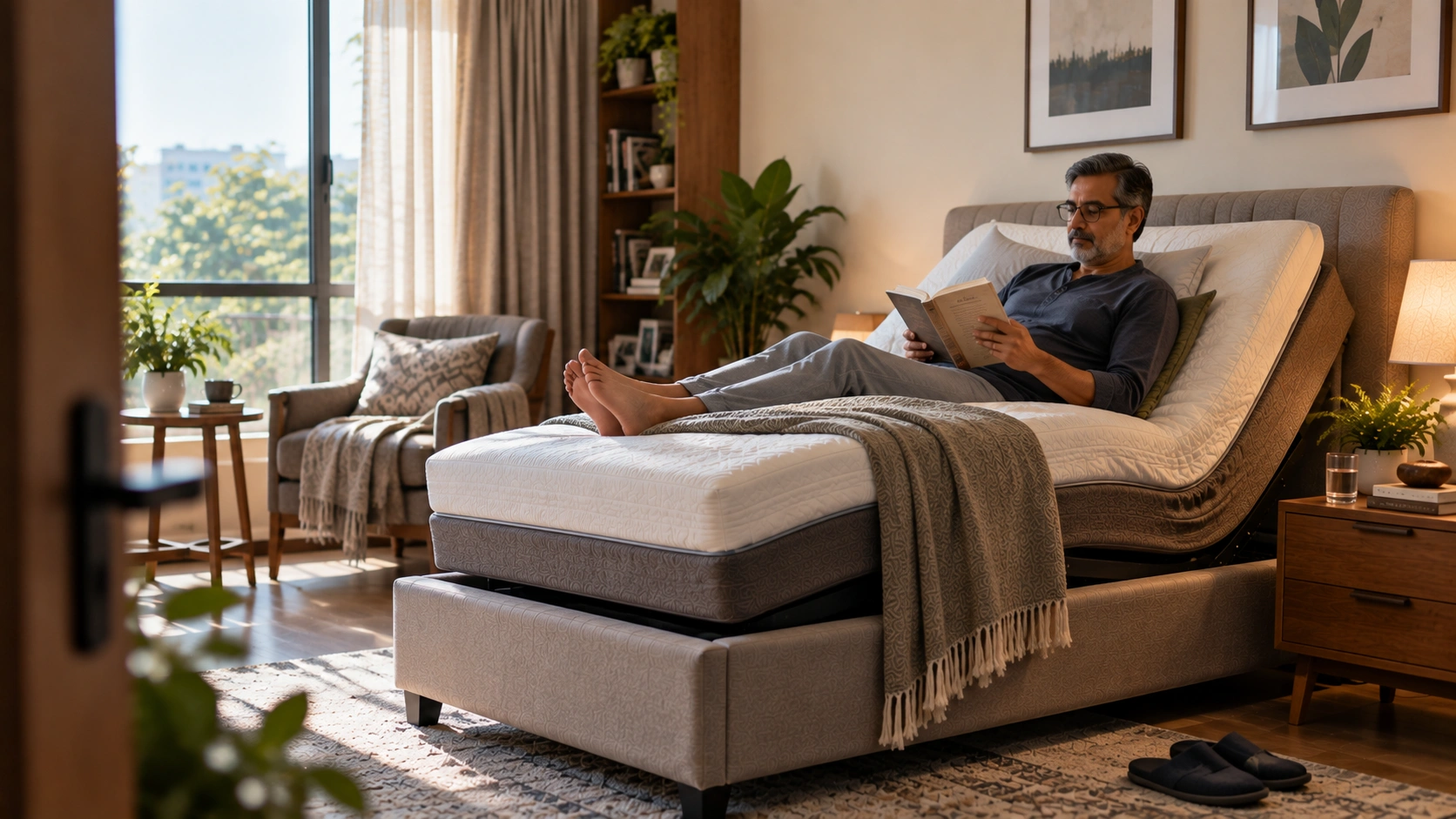

Adjustable beds for arthritis help most when used in a gentle knee-elevated or Zero Gravity position, which takes pressure off both inflamed joints and the lower spine at the same time. Since arthritis and back pain frequently occur together especially in the hips, knees, and lower back the right adjustable bed position can address both without needing separate solutions for each.
Arthritis and back pain are often treated as two separate problems, but for many people they’re deeply connected. Inflamed joints in the hips and knees change the way you naturally hold your body at night, which in turn puts uneven strain on the lower spine. An adjustable bed for arthritis approaches this as one connected system rather than treating the joints and the back separately and that’s exactly why it tends to work better than joint-specific pillows or back-specific wedges used on their own.
How Arthritis Makes Back Pain Worse (and Vice Versa)
When a joint say, the knee or hip is inflamed, the body naturally shifts weight away from it, even during sleep. That compensation pattern often twists or tilts the lower back into a position it wasn’t designed to hold for eight hours, leading to stiffness that has nothing to do with the spine itself but everything to do with how the joints nearby are behaving. Over time, this cycle reinforces itself: joint pain causes poor sleep posture, poor posture causes back pain, and back pain makes it harder to find any comfortable position at all.
The Positions That Help Both Joints and Spine Together
Gentle Knee-Elevation Position
Raising the knee section slightly reduces pressure on both the knee joints themselves and the lower back, since it shortens the distance the spine has to bridge unsupported. This is usually the gentlest starting point for people managing arthritis flare-ups alongside back discomfort.
Zero Gravity Position
For more significant relief, the Zero Gravity position legs raised above heart level with a mild head recline reduces pressure across the hips, knees, and lower spine simultaneously. It’s frequently the most effective single setting for people managing arthritis-related back pain, since it addresses the whole kinetic chain rather than one joint at a time.
Side-Lying with Leg Support
For hip arthritis specifically, side-lying with the leg section slightly raised and a pillow between the knees can reduce direct pressure on the hip joint while keeping the spine in a more neutral position. This is a variation worth trying if flat back-lying feels uncomfortable on inflamed hips.
We go into more detail on fine-tuning these exact angles in how to set up your adjustable bed for maximum lower back pain relief, which applies just as well when arthritis is part of the picture.
What to Look for in an Adjustable Bed for Arthritis
- Gentle, gradual motor movement rather than a fast or jerky recline, which can aggravate sensitive joints
- Independent leg and head control so you can fine-tune around whichever joint is currently flaring up
- A supportive but not overly firm mattress, since arthritis-friendly setups usually need some cushioning at pressure points like hips and knees
- Height adjustability, which meaningfully reduces the strain of getting in and out of bed during a flare-up
- A simple remote with large, easy-to-press buttons for hands affected by joint stiffness
Our dedicated Adjustable Bed for Arthritis range is built around exactly this list, with gentler motor profiles and additional joint-friendly cushioning options.
Daytime Habits That Support Nighttime Relief
An adjustable bed does a lot of the work, but a few daytime habits make the nighttime relief last longer. Gentle stretching before bed helps loosen joints that have stiffened during the day. Staying consistently active with low-impact movement walking, swimming, or light yoga keeps joints from stiffening further and often reduces the compensation patterns that strain the back in the first place. And using your adjustable bed’s elevated positions for short periods during the day, not just at night, can help manage flare-ups as they happen rather than only after they’ve already disrupted your sleep.
When to Involve a Doctor or Physiotherapist
An adjustable bed for arthritis and back pain is a genuinely helpful tool, but it works best as part of a broader management plan. If joint pain is worsening, spreading to new areas, or accompanied by swelling, redness, or fever, that’s a signal to involve a doctor rather than relying on positioning alone. Similarly, a physiotherapist can help identify whether your particular pattern of arthritis and back pain calls for specific angles beyond the general recommendations here.
Understanding the Different Types of Arthritis and How They Affect Sleep
Not all arthritis behaves the same way at night, and understanding your specific type can help you fine-tune your adjustable bed setup further. Osteoarthritis, the most common form, tends to stiffen through inactivity, which is exactly why gentle, consistent elevation overnight rather than staying rigidly flat often reduces morning stiffness noticeably. Rheumatoid arthritis, an inflammatory condition, can flare unpredictably and often benefits from a slightly cooler, well-ventilated mattress alongside gentle positioning, since inflammation and heat retention can compound discomfort together. Whichever type you’re managing, the underlying principle stays the same: reduce direct pressure on the affected joints while keeping the spine in a neutral, supported curve, and adjust the exact angle based on how your body responds on any given night.
Bedroom Setup Tips Beyond the Bed Itself
An adjustable bed for arthritis works best as part of a slightly broader bedroom setup, not in isolation. Keeping the room warm enough overnight can meaningfully reduce joint stiffness for arthritis sufferers, since cold tends to intensify pain in affected joints. A supportive pillow that keeps the neck aligned with the rest of the elevated spine avoids creating a new pressure point higher up, even while the bed itself is correctly positioned lower down. And placing a nightstand or grab rail within easy reach reduces the twisting or reaching motions that can aggravate both arthritic joints and a sensitive lower back during the transition out of bed in the morning.
Choosing Between an Adjustable Bed for Arthritis and a Standalone Back Pain Model
Many customers ask whether they should choose a bed specifically marketed for arthritis or one marketed for back pain, assuming the two are meaningfully different products. In practice, the core mechanics overlap significantly both rely on independent head and leg elevation and a genuine Zero Gravity preset. The real difference tends to be in the finer details: arthritis-focused models often prioritize gentler motor acceleration and softer pressure-point cushioning, while back-pain-focused models may emphasize a slightly firmer lumbar support zone. If you’re managing both conditions together, which is common, it’s worth asking specifically about motor gentleness and cushioning rather than assuming either category automatically covers your needs.
Arthritis and back pain rarely exist in isolation, and treating them as one connected system rather than two separate problems is exactly where an adjustable bed for arthritis earns its value. Start gently, prioritize independent leg and head control, and give your body a week or two to adjust before judging the results.
Explore our Adjustable Bed for Arthritis range, or browse Adjustable Bed for Back Pain options if spinal relief is your primary concern.
Related Reading: