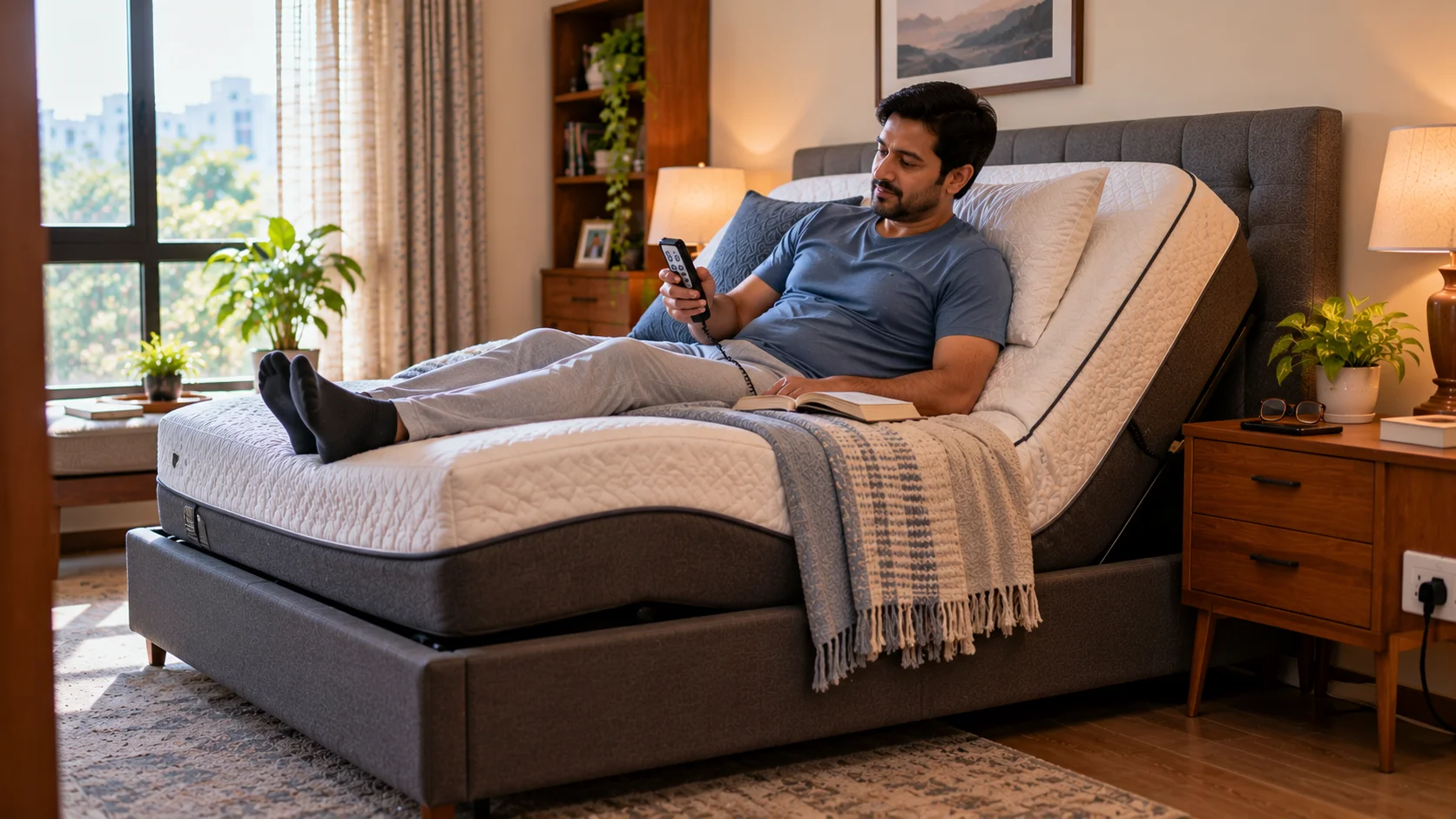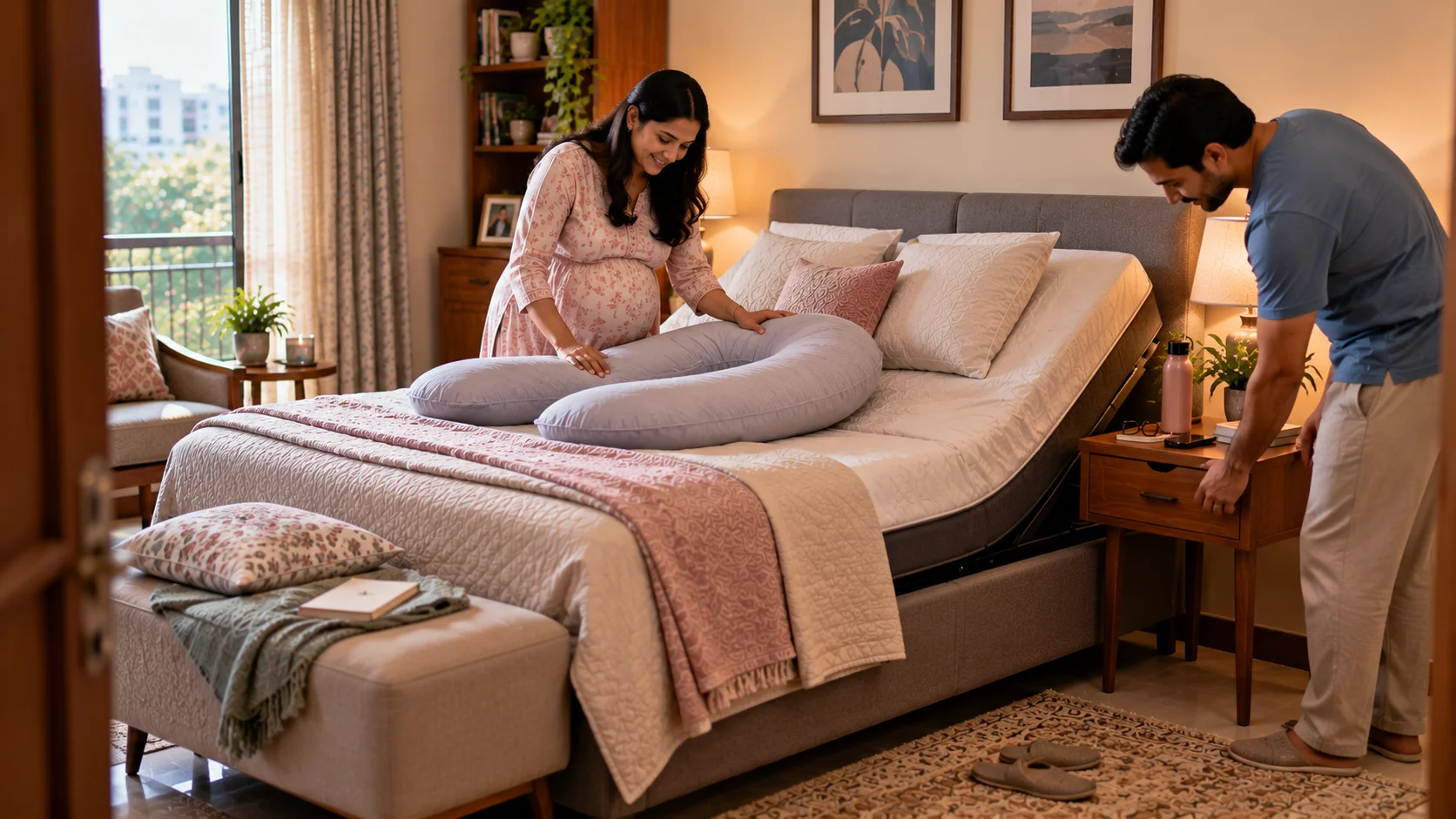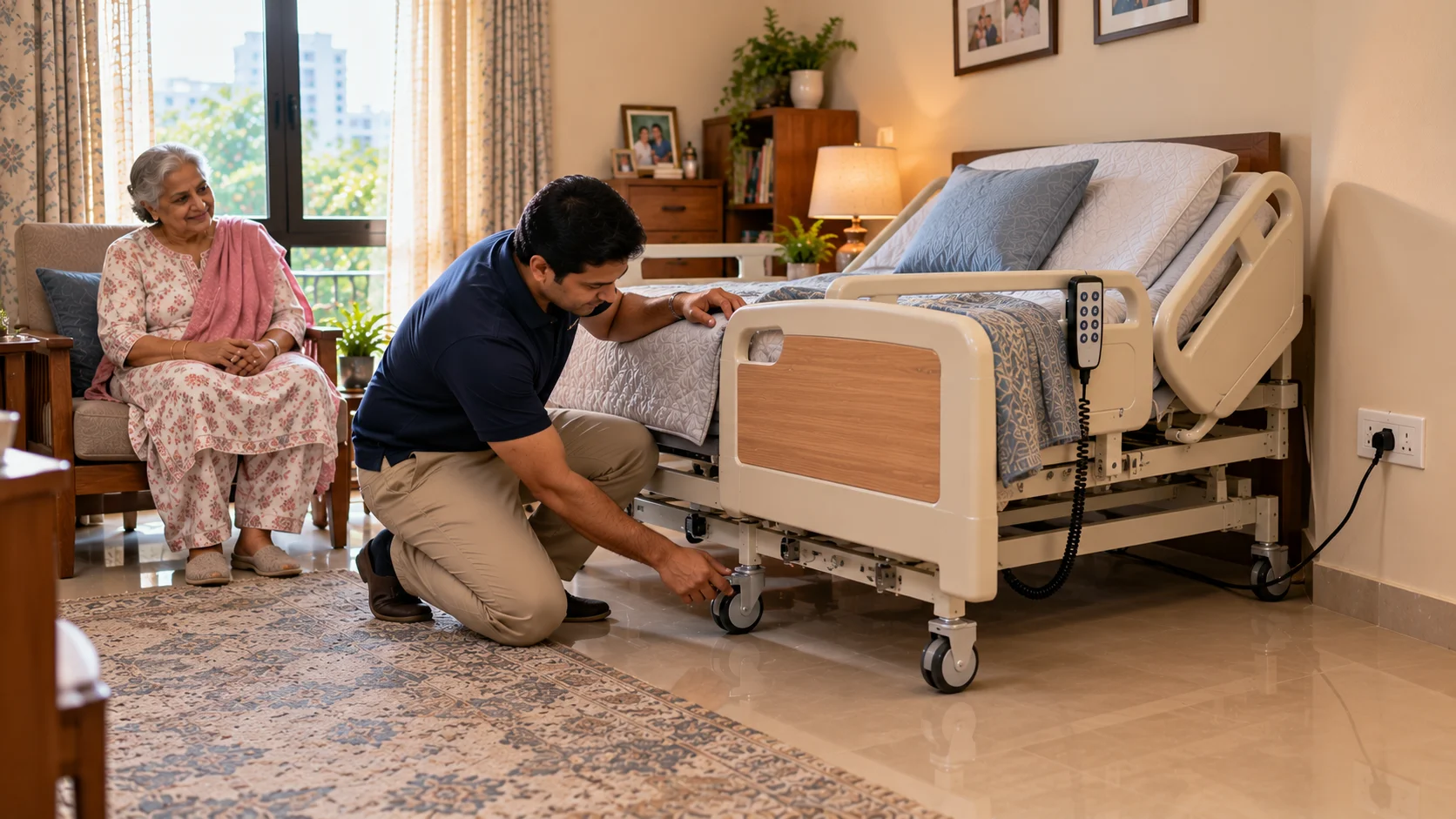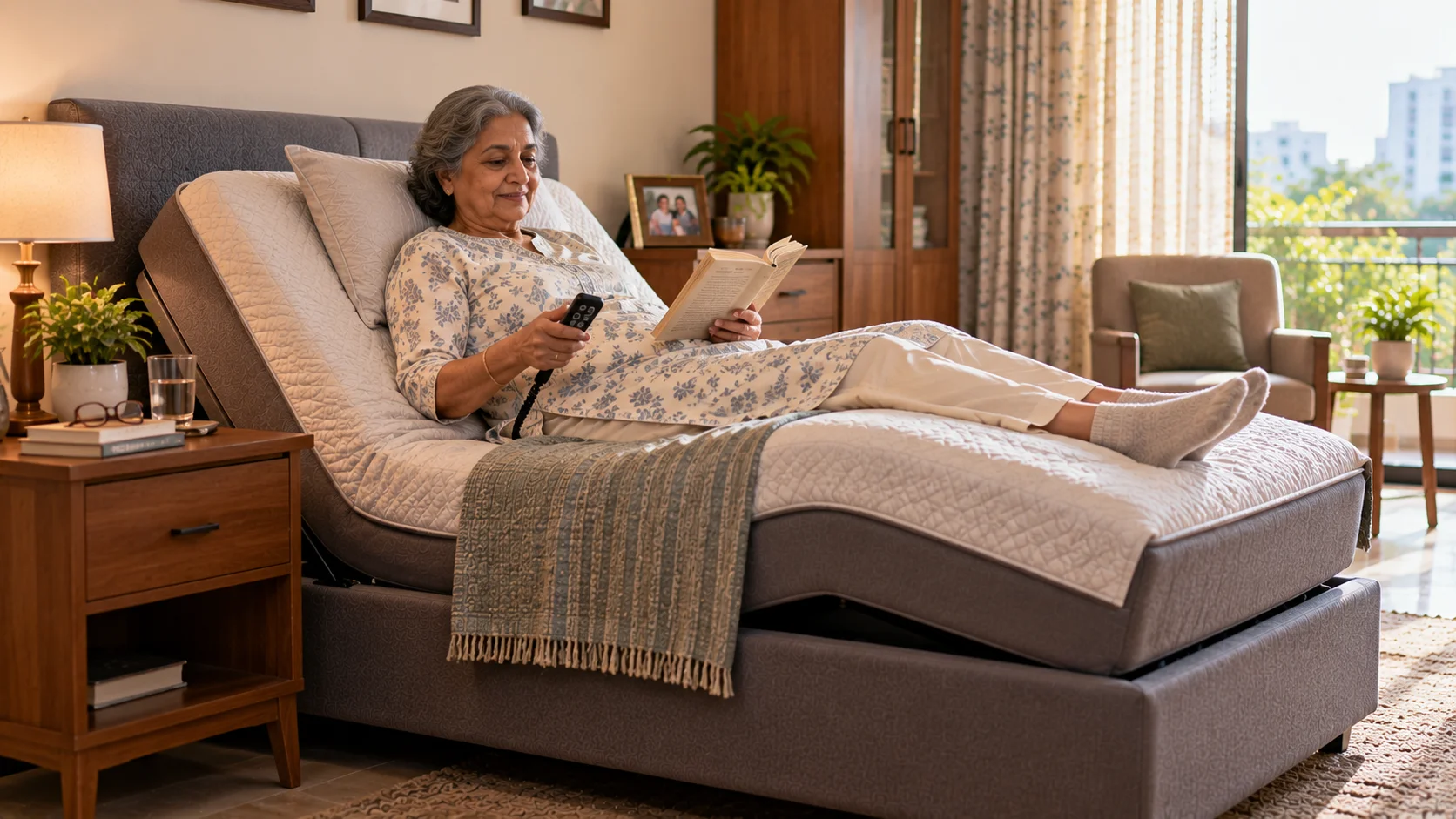
A recliner bed for patients is a bed whose head and leg sections rise by motor, so the person can sit up, recline or lie flat without leaving the bed. It suits elderly parents and people recovering at home who want comfort without a clinical look. Check mattress flexibility, clearance and power-cut behaviour before buying.
What is a recliner bed, and how is it different from a recliner chair?
A recliner chair holds you in one seat. A Recliner Bed is a full-length bed where you can raise the upper half, the lower half, or both together. Raising both gives the zero gravity position, with the head and legs lifted so the body feels evenly supported.
Searches for a Reclining Bed For Elderly India usually mean this: a bed that lifts for meals and lowers for sleep. Zero G’s recliner bed page describes exactly this: lie down, and use a remote to lift the upper half, lower half or both at once.
Who benefits from recliner beds for elderly people?
Older adults often struggle to sit up from a flat mattress, and pillow stacks slip by midnight. Recliner beds for elderly care replace the pillows with a motor.
- People who eat, read or watch TV in bed.
- Those with tight hips, knees or lower back who need leg support.
- Patients recovering at home who spend long hours in bed.
- Families who want a normal-looking bedroom, not a ward.
For a wider view of senior-friendly features, read best adjustable beds for seniors in India.
Is a reclining bed for patients the same as a hospital bed?
No. A reclining bed for patients focuses on positioning and comfort. A hospital bed is built around clinical care and may add features such as rails and height control. Zero G’s own FAQ draws the same line: a recliner bed is for comfort at home, while an electric hospital bed is designed around patient care.
| Question | Recliner bed | Electric hospital bed |
| Main purpose | Comfort, rest, positioning | Patient care |
| Look | Furniture style | Clinical |
| Typical user | Elderly, light recovery | Long-term or heavier care |
| Side rails | Check per model | Usually part of the design |
If the patient needs rails, frequent repositioning by a caregiver, or has pressure sores, look at the hospital bed first. Our post on adjustable bed vs hospital bed for home recovery helps you decide.
What should you check in a motorised recliner bed?
A motorised recliner bed for patients needs a closer look than one bought for relaxing.
- Weight capacity. Zero G lists 350 kg on its recliner page.
- Motor noise at night.
- Remote design: large buttons help shaky or arthritic hands.
- Clearance around the bed so the sections can move freely.
- What happens in a power cut.
- Installation and who services the bed.
On point five: Zero G’s own FAQ says a powered bed cannot adjust without electricity and that the bed stays in its last position. If backup or emergency lowering matters to you, ask whether the specific model has it before you pay.
Which mattress works as a recliner mattress for patients?
A recliner mattress for patients must bend with the bed and keep its shape. Zero G advises checking flexibility, thickness and construction before reusing an old mattress. Thick coir and rigid spring mattresses tend to crease at the hinge.
Latex is a common choice for adjustable beds, and Zero G offers a 7 zone latex mattress that can be made to your size and firmness. If you have long periods in bed, ask your doctor about pressure-relief surfaces too.
Can a reclining bed for home be fitted to an existing bed?
Zero G says it can convert certain existing beds into an adjustable system, depending on the bed’s design and dimensions. This is useful if the family likes the current bed and storage. See our walkthrough on converting a standard bed into an adjustable bed for home care to know what to expect.
How much room does a reclining bed for home need?
A reclining bed for home needs space for the bed itself plus the sections that move, and room for a person to get in and out. Zero G’s FAQ advises measuring the bedroom and the intended bed area first.
- Leave clear space on at least one long side for easy access.
- Keep curtains, side tables and cables away from the moving sections.
- Place the bed near a socket so the cable does not cross the walking path.
Which positions are most useful?
| Position | When to use |
| Head up | Meals, medicines, reading |
| Legs up | Resting tired legs, short breaks |
| Head and legs up (zero gravity) | Relaxing, taking weight off the lower back |
| Flat | Sleeping, if the doctor allows |
Our explainer on the zero gravity position covers it in depth.
Caution: this is general information, not medical advice. Ask the doctor which angles are safe, especially after surgery or with heart or breathing conditions.
To compare models, see the Zero G recliner beds.