
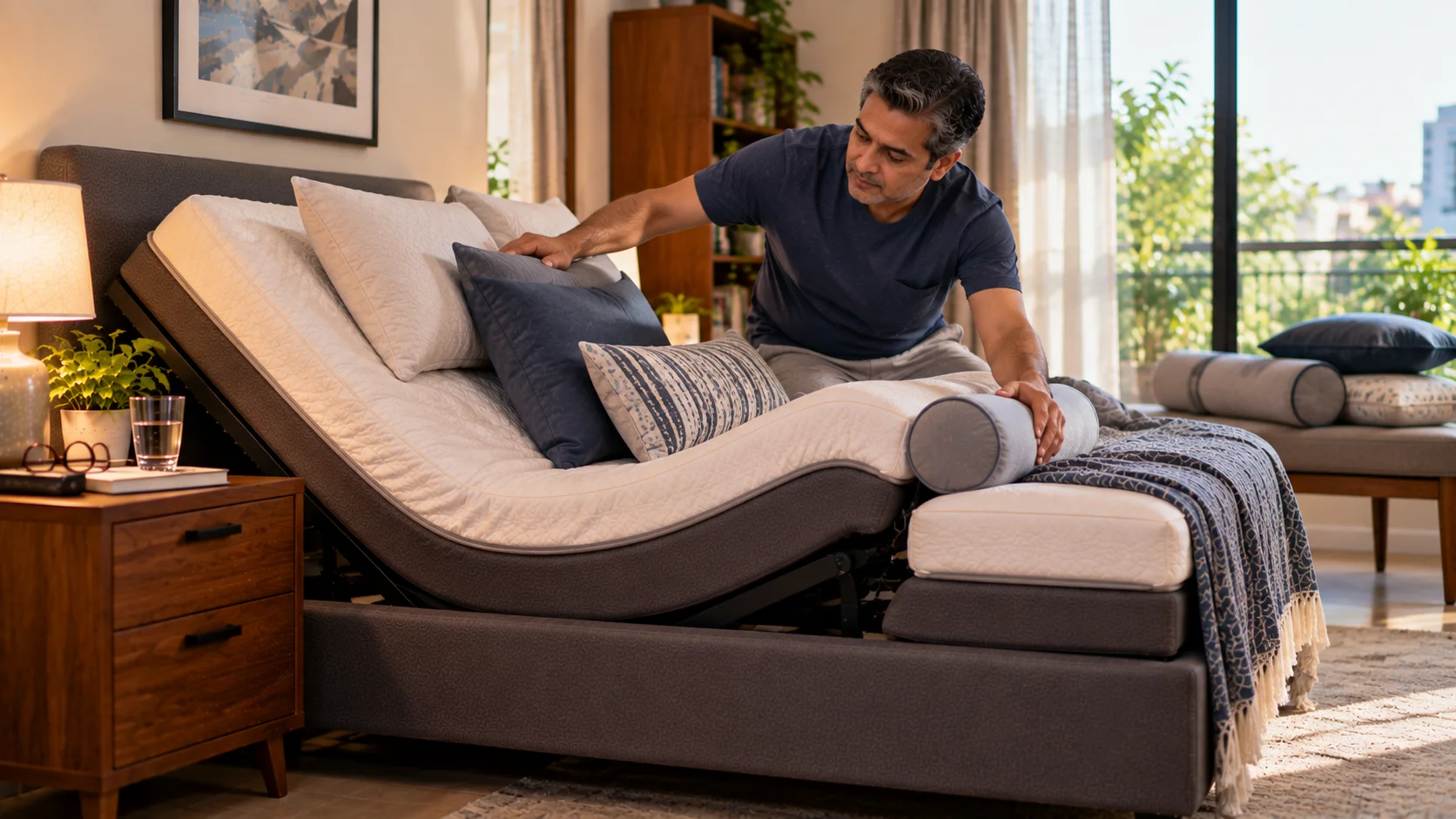
A great adjustable bed frame can still feel wrong if the pillow setup doesn’t match the angle. As a general rule, the more your head section is elevated, the slimmer your head pillow needs to be, while a bolster or pillow under the knees and between the knees (for side sleepers) adds real support almost regardless of angle. Here’s exactly how to set it up by sleep position and incline.
Pillows are the most overlooked part of an adjustable bed setup, and also the cheapest to fix. A frame set at the perfect angle can still leave you with neck strain or an unsupported lower back if the pillows around you weren’t adjusted to match. This is a genuine do-it-yourself project -no tools, no spending required beyond what you may already own.
The Core Principle: Pillow Height Should Shrink as Elevation Grows
A pillow that’s the right thickness for flat sleeping becomes too tall once your head section is reclined, since the angle itself is already doing some of the work a thick pillow would do on a flat bed. Keeping the same flat-sleeping pillow at an elevated angle pushes the chin toward the chest and creates exactly the kind of neck strain that undoes a good lower-back setup.
Pillow Setup by Incline Angle
| Head Elevation | Recommended Pillow Thickness | Why |
| 0–10° (nearly flat) | Standard thickness, as used for flat sleeping | Minimal elevation needs normal support |
| 10–20° (gentle recline, most back pain setups) | Slightly slimmer than your usual pillow | Prevents the neck from being pushed forward |
| 20–35° (fuller Zero Gravity, reflux or snoring setups) | Slim, low-profile pillow or a folded towel | A tall pillow at this angle bends the neck sharply forward |
| 35°+ (upright reading or eating position) | Minimal to no head pillow; rely on the frame’s support | At this angle the frame itself supports the head and neck |
Setting Up for Back Sleepers
- Match your head pillow to the table above based on your current incline.
- Add a slim pillow or rolled towel under the knees, even on an adjustable bed, for extra comfort once the leg section is raised.
- Check for a gap at the small of your back. If one remains even with the frame’s lumbar support, a slim rolled towel tucked there closes it.
Setting Up for Side Sleepers
- Use a firmer, slightly thicker head pillow than a back sleeper would, since side sleeping needs to fill the gap between your ear and shoulder.
- Place a pillow between your knees, which keeps your hips level and prevents the top leg from pulling your spine out of alignment.
- Use a milder incline than a back sleeper, typically 10 to 15 degrees, since side-lying changes how the spine responds to elevation. Our guide on adjustable beds for side sleepers with back pain covers this in more depth.
Budget Bolster Options You Can DIY Tonight
- A rolled bath towel, secured with an elastic band, makes a perfectly serviceable knee or lumbar bolster at zero extra cost.
- A firm cushion from another room, repurposed under the knees, works as well as a purpose-made wedge for most people.
- A folded blanket, placed lengthwise, can substitute for a body pillow for side sleepers who don’t already own one.
- An old pillow, folded in half and placed inside a pillowcase, creates an improvised slim pillow for a steep recline angle without buying anything new.
Signs Your Pillow Setup Needs Adjusting
| What You’re Feeling | Likely Pillow Issue | The Fix |
| Neck stiffness despite good back support | Head pillow too thick for your current angle | Switch to a slimmer pillow or remove a layer |
| Waking with your chin tucked to your chest | Pillow stacking is too tall at a steep incline | Reduce to a single slim pillow or a folded towel |
| Lower back still feels unsupported | No lumbar or knee bolster in use | Add a rolled towel at the small of the back or under the knees |
| Shoulder or hip ache (side sleepers) | No pillow between the knees | Add a pillow between the knees to keep hips level |
When to Consider a Purpose-Made Pillow
DIY solutions work well for testing and for occasional use, but if you’re using your adjustable bed every night for a specific condition, a contoured cervical pillow or a wedge-shaped knee bolster designed for adjustable frames tends to hold its shape better over months than a folded towel. This is a reasonable upgrade once you know exactly what thickness and shape works for your angle, since the DIY phase will have already told you precisely what to look for.
A correctly angled adjustable bed frame is only half the setup -pillow thickness and placement finish the job, and nearly all of it can be tested for free with items you already own. Match your pillow to your incline, add a knee or lumbar bolster, and revisit the setup any time you change your angle.
Explore our Natural Latex Mattress range for a surface that works well alongside the right pillow setup.
Related Reading: