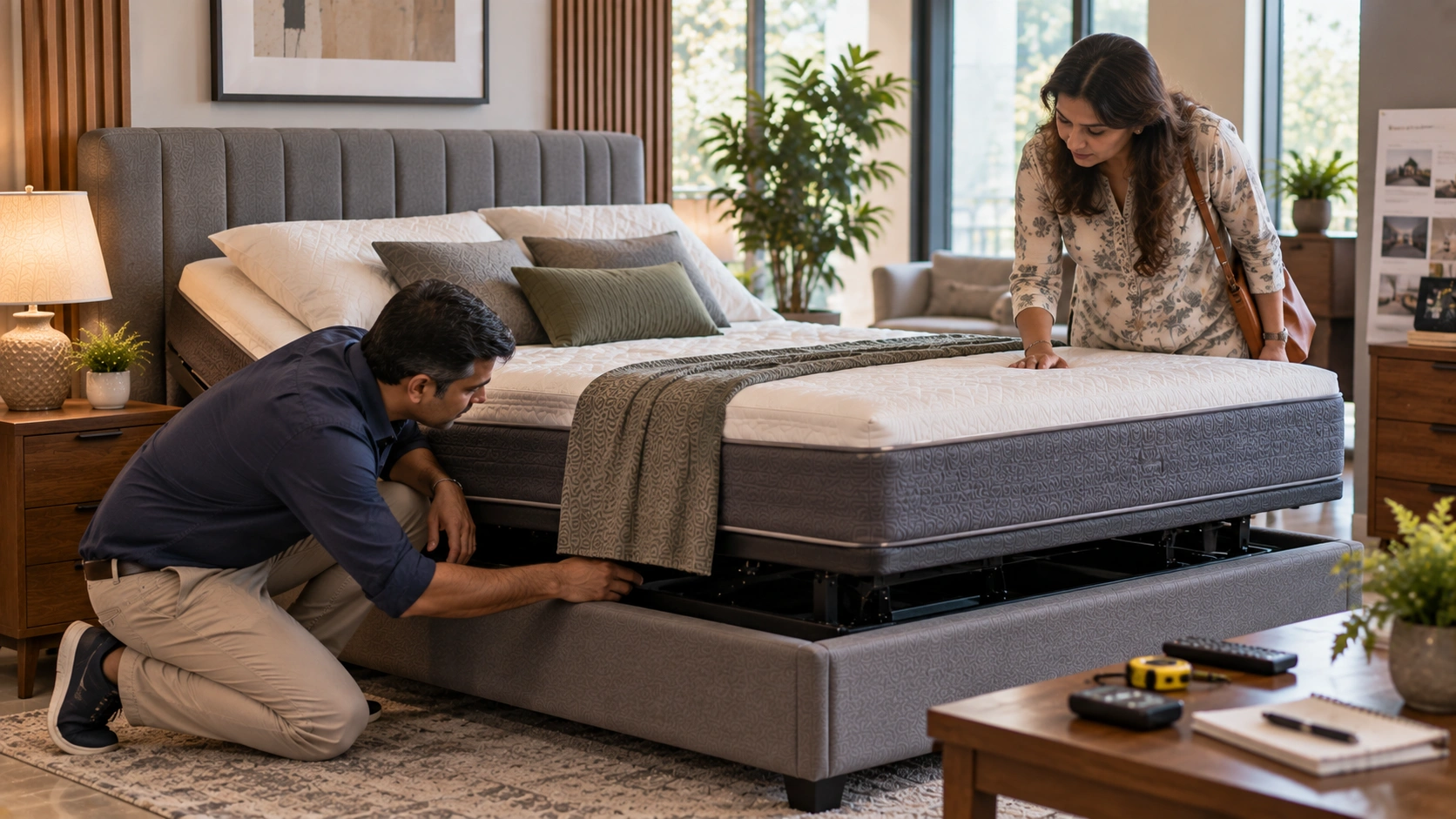

Keeping an adjustable bed clean is about more than making it look good. Regular cleaning helps maintain mattress hygiene, protects electrical components from moisture and dust, and gives you an opportunity to notice loose parts, damaged cables, unusual sounds or other issues before they become bigger problems. This guide explains what to clean, what to avoid, how often to inspect different parts and how caregivers can maintain a bed used every day.
This guide is for general adjustable-bed care and maintenance.
Always follow the cleaning, inspection and servicing instructions supplied with your specific bed and contact the manufacturer or a qualified technician if an electrical or mechanical component requires attention.
An adjustable bed has more components than a conventional bed. Along with the mattress and frame, there may be motors, actuators, electrical cables, a control box and a remote.
That means cleaning should not simply mean wiping the visible surfaces.
A good maintenance routine should protect three things at the same time:
- Hygiene — keeping the mattress, bedding and accessible surfaces clean
- Function — keeping the moving sections and controls working properly
- Safety — identifying damaged wires, loose parts or unusual movement early
If the bed is being used by a patient, senior or someone who spends many hours in bed, this routine becomes even more important.
Need help with your adjustable-bed requirements? Call or WhatsApp +91 9820138189. You can also email info@zerogbeds.com for guidance.
Why Does an Adjustable Bed Need Regular Maintenance?
A conventional bed has relatively few moving or electrical components.
An adjustable bed is different.
The frame may move repeatedly throughout the day as the user changes between sleeping, reading, resting and sitting positions. Electric models use motors and control systems to move the sections of the bed.
Dust can collect underneath the bed and around accessible components. Bedding can trap moisture against the mattress. Remote controls are handled frequently.
Cables can become displaced when the bed is moved or adjusted.
Zero G Beds’ existing guidance on how to take care of an adjustable bed also highlights regular cleaning, bedding changes, care around electrical components and checking the mattress and remote.
The objective is not to perform complicated mechanical servicing yourself.
It is to create a simple routine that helps you identify problems early and keeps the bed clean and ready for everyday use.
How Often Should You Clean and Inspect an Adjustable Bed?
There is no single maintenance schedule that applies to every model. The manufacturer’s instructions should always take priority.
As a practical home-care routine, you can divide maintenance into three levels.
Every day
Check:
- Bedding is dry and clean
- The remote is accessible
- There are no visible spills
- The bed is moving normally
- Nothing is trapped underneath the moving sections
Every week
Check:
- Mattress surface
- Bed frame
- Remote control
- Visible cables
- Dust around accessible areas
- Bedding condition
Every few months
Check:
- Moving sections
- Screws and visible fittings
- Cable routing
- Motor operation
- Unusual sounds
- Mattress wear
- Remote batteries, where applicable
This does not mean you should dismantle the bed.
Routine maintenance should be limited to safe, user-accessible checks. Electrical repairs, motor servicing and internal mechanical repairs should be handled by the manufacturer or an appropriately qualified technician.
How to Clean an Adjustable Bed Safely
Before cleaning, put the bed in a stable position and follow the manufacturer’s instructions.
For an electric bed, disconnect the power before performing cleaning around electrical components, unless the manufacturer specifically provides another procedure.
Step 1: Remove Bedding
Remove:
- Bedsheets
- Blankets
- Pillow covers
- Mattress protectors
- Other loose bedding
Wash these according to their individual care instructions.
If bedding becomes wet because of a spill, sweat or another source of moisture, don’t simply cover it with another sheet.
Remove it and allow the affected area to dry properly.
Step 2: Inspect the Mattress
Look for:
- Stains
- Moisture
- Tears
- Sagging
- Unusual odours
- Signs of mould
- Damage around edges
Don’t automatically assume that every mattress can be cleaned with water or household disinfectant.
The correct cleaning method depends on the mattress material and manufacturer’s instructions.
If the mattress has a removable cover, check whether that cover is machine washable before putting it into a washing machine.
Step 3: Clean the Frame
Use a soft, dry cloth to remove dust from accessible frame surfaces.
For marks that require additional cleaning, use only a small amount of a mild cleaning solution if permitted by the manufacturer’s care instructions.
The important rule is:
Don’t allow liquid to enter motors, control boxes, connectors or electrical components.
Avoid spraying cleaning products directly onto the bed.
Instead, if the material permits damp cleaning, apply a small amount to the cloth rather than flooding the surface.
Step 4: Clean Around the Base
Dust can collect beneath the bed, particularly around areas that are difficult to reach.
Use a vacuum cleaner carefully around accessible areas.
Do not force the vacuum attachment into motor housings, wiring connections or moving mechanisms.
The purpose is to remove loose dust and debris, not to dismantle or service the mechanism.
How to Clean an Adjustable Bed Remote
The remote is one of the most frequently touched parts of the bed.
It can collect dust, skin oils and other residue through everyday use.
But it is also an electronic component.
Never spray water, disinfectant or cleaning solution directly onto the remote.
Instead:
- Disconnect or remove the batteries if the manufacturer’s instructions allow it.
- Wipe the exterior with a soft, dry cloth.
- Carefully clean around the buttons.
- Check the battery compartment for corrosion.
- Replace batteries when required.
- Make sure the remote is completely dry before use.
If a remote becomes wet, don’t continue pressing buttons to see whether it works.
Allowing liquid to enter the electronics can cause damage.
If the remote continues to malfunction after basic checks, contact the manufacturer or service provider rather than opening it yourself.
What About the Adjustable Bed Motor?
The motor is one of the most important components of an electric adjustable bed.
However, it is also one of the components you should not attempt to clean internally.
You can inspect the accessible area around the motor for:
- Excessive dust
- Objects trapped in the mechanism
- Damaged cables
- Unusual movement
- Unusual sounds
- Signs of physical damage
You should not open the motor housing or apply lubricant unless the manufacturer specifically instructs you to do so.
Different mechanisms have different maintenance requirements.
If the bed suddenly becomes noisy, moves unevenly or stops at a particular position, treat that as a service issue rather than trying to repair the motor yourself.
Our guide on top tips to keep a motorised hospital bed healthy also explains why regular checks of motors, moving components and general bed condition matter for long-term use.
How to Keep the Mattress Clean
The mattress deserves particular attention because it has direct contact with the user.
Use a mattress protector that is compatible with the adjustable-bed design where appropriate.
A good protector can help reduce the amount of sweat, spills and everyday dirt that reaches the mattress.
However, avoid adding excessive layers.
A thick or unsuitable protector can affect how the mattress flexes when the adjustable bed changes position.
Clean the mattress according to its manufacturer’s instructions.
Don’t saturate the mattress with water.
If liquid has penetrated deeply into the mattress, the appropriate response depends on the mattress construction and care instructions.
Watch for these warning signs
Consider professional assessment or replacement when you notice:
- Persistent unpleasant odour
- Deep or recurring stains
- Visible mould
- Damaged cover
- Significant sagging
- Broken seams
- Loss of structural support
For users who spend long periods in bed, mattress condition is especially important because comfort and support can affect everyday use.
Should You Use Disinfectant on an Adjustable Bed?
Not automatically.
This is one area where more cleaning is not necessarily better.
Strong chemicals can damage finishes, fabrics, plastics or other materials.
Some disinfectants can also damage electrical components if they enter the wrong area.
Before using any disinfectant, check the manufacturer’s instructions for:
- Mattress material
- Upholstery
- Metal surfaces
- Plastic components
- Remote control
- Other accessories
If infection-control cleaning is required because the bed is being used in a medical or caregiving environment, follow the relevant healthcare or manufacturer guidance rather than choosing a strong household chemical at random.
What Should You Never Do While Cleaning an Adjustable Bed?
Avoid these common mistakes:
Don’t pour water over the frame
An adjustable bed contains electrical components. Water should never be allowed to enter the motor, control box or connections.
Don’t spray cleaner directly onto the remote
Spray can enter through buttons and seams.
Don’t open the motor yourself
Internal components may require specialist servicing.
Don’t lubricate moving parts without checking the instructions
Not every adjustable-bed mechanism needs user-applied lubrication.
Using the wrong lubricant can potentially create additional problems.
Don’t use abrasive cleaners
They can damage surfaces and finishes.
Don’t force a moving section
If the bed doesn’t move normally, stop using the movement function and investigate the issue according to the manufacturer’s troubleshooting instructions.
Don’t ignore damaged cables
A damaged power cable or exposed wiring should be treated as a safety concern.
How to Check the Bed’s Moving Parts
Cleaning is also a good opportunity to observe how the bed operates.
With nobody on the bed, if permitted by the manufacturer’s instructions, test the normal adjustment functions.
Listen for:
- New grinding sounds
- Clicking
- Repeated knocking
- Unusual buzzing
- Jerky movement
Also watch for:
- Uneven movement
- Delayed response
- A section stopping unexpectedly
- The bed moving differently from before
A small change does not necessarily mean the motor has failed.
However, a new or worsening change should not be ignored.
If the bed is used by a patient every day, it is better to investigate unusual behaviour early rather than wait until the bed stops working completely.
How to Check Cables and Connections
Look at the accessible cables around the bed.
Make sure they are:
- Not trapped beneath moving sections
- Not stretched tightly
- Not visibly damaged
- Not being crushed against the wall
- Not creating a trip hazard
When the bed moves, cables should have enough clearance to accommodate the movement.
Never pull the bed by its electrical cable.
If a connector becomes loose or a cable is damaged, follow the manufacturer’s service instructions.
Don’t use damaged electrical equipment simply because the bed still appears to operate.
What Should Caregivers Check on a Patient’s Bed?
If an adjustable bed for patients at home is being used by someone who depends on it every day, caregivers can perform a quick visual check as part of the normal care routine.
Before the patient uses the bed, check:
- Mattress is clean and dry
- Sheets are properly fitted
- Remote is accessible
- Power cable is secure
- No object is trapped under moving sections
- Bed moves normally
- Rails or other accessories are correctly positioned if supplied
- There are no visible damaged components
Caregivers should also know which functions the patient is supposed to use.
This is especially important if the person has limited mobility or cannot operate the remote independently.
For broader patient-safety considerations, Zero G Beds’ guide on how to ensure patient safety with electric adjustable beds covers remote use, bed placement, maintenance and caregiver awareness.
How to Maintain an Adjustable Bed Used by a Bedridden Patient
A bed used for long periods requires more attention to hygiene and positioning than a bed used occasionally.
Caregivers should establish a routine for:
- Changing bedding
- Cleaning spills immediately
- Checking mattress condition
- Inspecting skin-contact surfaces
- Checking the remote
- Observing motor movement
- Keeping the area underneath the bed clear
If the user spends most of the day in bed, cleanliness should be part of the daily care routine rather than something done only during weekly cleaning.
Our guide on how to care for a bedridden patient at home covers broader home-care practices including hygiene, bedding changes and pressure-related concerns.
How Does Cleaning Affect Adjustable Bed Longevity?
Cleaning itself does not guarantee that an adjustable bed will last a particular number of years.
However, regular care can help prevent avoidable problems.
For example:
Regular dust removal can keep the area around the bed cleaner.
Prompt spill cleaning can prevent moisture from remaining against the mattress.
Cable checks can identify visible damage before it becomes a larger issue.
Remote care can reduce avoidable electronic damage.
Early inspection can identify unusual movement before a small issue becomes a major inconvenience.
The goal is not to make maintenance complicated.
It is to prevent small problems from being ignored.
A Simple Adjustable Bed Cleaning Schedule
| Task | Suggested Frequency |
| Change bedding | According to normal household/care routine |
| Clean visible frame surfaces | Weekly or as needed |
| Inspect mattress | Weekly |
| Clean remote | Weekly or as needed |
| Check cables | Monthly or whenever the bed is moved |
| Vacuum accessible areas underneath | Monthly or as needed |
| Test normal movement | Monthly or according to manufacturer guidance |
| Check for unusual sounds | During normal operation |
| Professional inspection/service | According to manufacturer guidance or when a problem appears |
These are practical guidelines rather than universal manufacturer requirements.
Your specific bed’s manual should always take priority.
What If the Adjustable Bed Becomes Noisy?
Don’t immediately assume that the motor has failed.
First check:
- Is anything trapped underneath the bed?
- Has the bed been moved recently?
- Is there visible debris around accessible moving sections?
- Is the sound new?
- Does it happen during one particular movement?
- Does the bed still move normally?
If the noise continues or the bed moves irregularly, stop unnecessary use of the affected function and contact the manufacturer or service provider.
Avoid dismantling the mechanism just to identify the noise.
A technician can determine whether the issue involves a motor, fitting, connection or another component.
When Should You Call a Technician?
Professional service is appropriate when:
- The motor stops working
- The bed moves unexpectedly
- A section becomes stuck
- The remote stops responding after basic checks
- There is damaged wiring
- You smell burning
- There is visible electrical damage
- The bed makes persistent abnormal noises
- The frame becomes unstable
- A mechanical component appears broken
If you notice smoke, burning smell or obvious electrical damage, disconnect power where it is safe to do so and seek professional assistance.
Do not continue operating the bed to see whether the problem disappears.
Common Maintenance Mistakes
Cleaning only the mattress
The frame, remote, cables and accessible areas also require attention.
Using too much water
Moisture and electrical components are a poor combination.
Ignoring the underside of the bed
Dust and objects can accumulate underneath.
Treating every noise as normal
A new noise deserves attention.
Using unsuitable mattress protectors
Excessive thickness or unsuitable materials can interfere with adjustable movement.
Forgetting the remote
The remote is used frequently and should be kept clean and protected.
Trying DIY electrical repairs
Electrical and motor components should be handled by qualified professionals.
Why Choose Zero G Beds for Long-Term Adjustable Bed Support?
An adjustable bed is a long-term purchase, particularly when it becomes part of home care.
Zero G Beds provides adjustable-bed solutions for home comfort, senior care and patient requirements, with support extending beyond the initial purchase.
Depending on the selected configuration, customers can benefit from:
- Remote-controlled adjustable positioning
- Home-care and patient-bed solutions
- Mattress and configuration guidance
- Professional delivery and installation
- Product demonstration by trained technicians
- After-sales support
- 15-year warranty
- CE-certified adjustable bed systems
- Support for families across India
Zero G Beds has been serving families in India since 2003.
If you are unsure how to maintain your existing bed or are considering a new Adjustable Bed For Patient use, speak with the team about the appropriate configuration and care requirements.
Call or WhatsApp +91 9820138189
Email: info@zerogbeds.com
Quick Adjustable Bed Maintenance Checklist
Keep this checklist somewhere accessible if the bed is used every day.
Mattress
- Clean and dry
- No major tears
- No mould or persistent odour
- Compatible with the adjustable mechanism
Frame
- Surfaces clean
- No visible damage
- No objects trapped underneath
Remote
- Buttons working
- Clean and dry
- Batteries checked where applicable
Motor
- Smooth movement
- No unusual sounds
- No visible damage
Cables
- No exposed wires
- No crushing or pinching
- Correctly positioned
Safety
- Bed remains stable
- Moving sections operate normally
- Caregiver knows how to use the controls
- Problems are reported promptly
Get Help With Your Adjustable Bed
Maintaining an adjustable bed does not need to become a complicated technical job.
Most routine care is simple: keep the bedding clean, wipe accessible surfaces appropriately, protect the remote, keep the area around the mechanism clear and pay attention to changes in movement or sound.
The important distinction is knowing what you can safely maintain yourself and what requires professional service.
Cleaning a remote is one thing.
Opening a motor housing is another.
For families using an Adjustable Bed For Patients, especially as part of everyday home care, that distinction matters.
If you need help choosing, maintaining or understanding an adjustable bed, speak with Zero G Beds.
Call or WhatsApp +91 9820138189
Email: info@zerogbeds.com
The Bottom Line
The best way to maintain an adjustable bed is to combine regular cleaning with simple visual and functional checks.
Keep bedding and mattress surfaces clean and dry. Remove dust from accessible areas. Keep liquids away from electrical components. Protect the remote. Check cables and observe the bed whenever it moves.
Most importantly, don’t attempt to repair motors, control boxes or electrical components yourself unless the manufacturer specifically provides a safe user-service procedure.
An adjustable bed is designed to make everyday positioning easier. A simple maintenance routine helps keep that convenience reliable for the people who depend on it.
Need advice about an adjustable bed for your home or patient-care requirements? Call/WhatsApp +91 9820138189 or email info@zerogbeds.com.
References
Zero G Beds — How to Take Care of an Adjustable Bed.
Zero G Beds — Top 5 Tips to Keep Motorised Hospital Bed Healthy for the Best Patient Care.
Zero G Beds — How to Ensure Patient Safety with Electric Adjustable Beds.
Zero G Beds — How to Care for a Bedridden Patient at Home.
Mattress Miracle — How to Clean and Maintain Your Adjustable Bed: Remote, Motor and Frame Care Guide.
Blissful Nights — Adjustable Bed Frame Maintenance and Cleaning Tips.