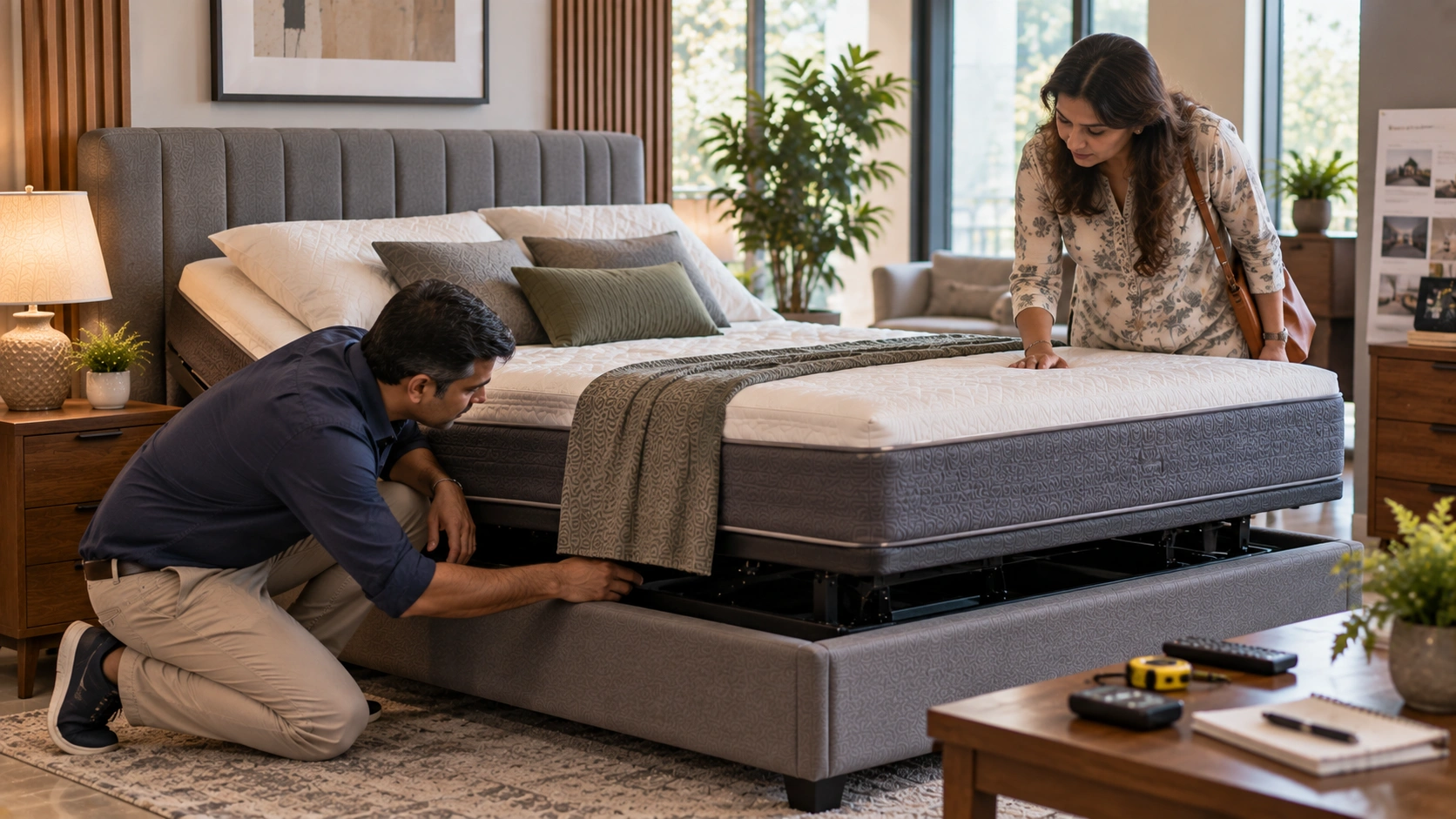

Understanding adjustable and hospital-bed terminology can make it much easier to compare beds for patients, home-care beds and electric adjustable beds. This guide explains common bed types, positioning terms, features, safety specifications, mattress compatibility and buying terminology in simple language so families and caregivers can make a more informed decision.
This guide is general information to help you understand adjustable and hospital-bed terminology. It is not medical advice and should not replace recommendations from a doctor, nurse or qualified healthcare professional.
When families start researching a bed for patients, they often encounter terms such as electric hospital bed, adjustable bed frame, motorised bed, Zero Gravity, side rails, weight capacity and mattress compatibility.
Some of these terms describe the bed itself. Others describe a particular movement, safety feature or specification.
Understanding the difference matters because two beds can look similar but be designed for very different users.
This guide explains the most important terms you are likely to encounter when comparing adjustable beds, hospital beds and home-care solutions.
Talk to a comfort advisor — free, no obligation. Call or WhatsApp: +91 9820138189. Tell us what type of bed you are considering and we’ll help you understand the right options. Email: info@zerogbeds.com
What Is an Adjustable Bed?
An adjustable bed is a bed with a movable sleeping surface that allows different sections to be raised or lowered.
Unlike a traditional flat bed, an adjustable bed can change the position of the upper body, legs or both, depending on the model.
Adjustable beds are commonly considered for:
- Everyday sleeping comfort
- Seniors
- People with mobility limitations
- Home recovery
- Reading and resting
- People who prefer elevated sleeping positions
- Patients requiring easier positioning at home
An adjustable bed is primarily a positioning and comfort solution. It should not automatically be considered a medical treatment for a health condition.
The exact functions vary significantly between models, so buyers should always check the specifications rather than assuming every adjustable bed works in the same way.
What Is a Hospital Bed?
A hospital bed is designed around patient-care and caregiving requirements.
Depending on the model, a hospital bed may offer:
- Adjustable backrest
- Leg or knee elevation
- Overall bed-height adjustment
- Side rails
- Wheels or castors
- Remote-controlled operation
- Patient-care accessories
Hospital beds are traditionally associated with hospitals and healthcare facilities, but they are also widely considered for home care.
They can be useful when a patient requires frequent repositioning, caregiver assistance or easier access to the bed.
If you are trying to understand which type of hospital bed may be appropriate for home use, Zero G Beds’
Which Hospital Bed Is Best for Home Care Patients? provides a more detailed look at bed types, home-care requirements and factors that influence selection.
Adjustable Bed vs Hospital Bed: What Is the Difference?
The terms are sometimes used interchangeably, but an adjustable bed and hospital bed are not necessarily the same.
An adjustable bed generally focuses on positioning and comfort.
A hospital bed usually combines positioning with additional patient-care features.
| Feature | Adjustable Bed | Hospital Bed |
| Head elevation | Usually available | Usually available |
| Leg elevation | Often available | Often available |
| Height adjustment | Model dependent | Common |
| Side rails | Model dependent | Common |
| Residential appearance | Usually higher | Usually more clinical |
| Caregiver-focused design | Moderate | High |
| Everyday comfort | High | High |
| Patient-care functions | Model dependent | Usually greater |
The right choice depends on who will use the bed and how much assistance they require.
A person looking for improved sleeping comfort may not need every feature found on a hospital bed.
A patient requiring regular caregiver assistance may benefit from a more patient-focused design.
What Is an Electric Hospital Bed?
An electric hospital bed uses motors to operate one or more sections of the bed.
Instead of manually turning a crank, the patient or caregiver can use a remote control to change the bed position.
An Electric Hospital Bed may provide:
- Backrest adjustment
- Knee adjustment
- Leg elevation
- Height adjustment
- Remote-controlled movement
- Additional positioning functions on selected models
The exact functions depend on the design.
For example, one electric bed may only adjust the backrest and leg sections, while another may also provide complete height adjustment.
Therefore, the term “electric” describes how the bed operates, not necessarily how many functions it provides.
What Is a Motorised Hospital Bed?
A motorised hospital bed is a bed that uses electric motors to control its movement.
The terms “electric,” “motorised” and “automatic” are often used in product descriptions.
However, buyers should look beyond the terminology and ask what the motors actually control.
Before buying, ask:
- How many motors does the bed have?
- Which sections does each motor operate?
- Is height adjustment available?
- Is the remote easy to operate?
- What happens if the power supply is interrupted?
- What is the rated weight capacity?
- What warranty applies to the motors?
More motors do not automatically mean a better bed.
The useful question is whether the available movements solve the user’s actual requirements.
For a detailed comparison of electric and manual options, read Zero G Beds’ Electric Patient Bed vs Manual Hospital Bed: Which One Should You Buy?. It explains how adjustment method, caregiver effort, convenience and cost can affect the decision.
What Is an Adjustable Bed Frame?
An Adjustable Bed Frame is the structural base that supports an adjustable mattress and allows the sleeping surface to move.
Depending on the design, it can include:
- Hinged sections
- Electric motors
- Remote controls
- Mattress retainers
- Structural supports
- Safety mechanisms
The frame is one of the most important components because it determines how the mattress moves.
A mattress should always be compatible with the adjustable mechanism.
If the mattress is too rigid, too thick or otherwise unsuitable, it may restrict movement or affect comfort.
What Is Zero Gravity Position?
Zero Gravity is a popular adjustable-bed position in which the upper body and legs are elevated to create a supported reclined posture.
The position is primarily associated with comfort and body positioning.
However, Zero Gravity should not automatically be considered the “best” position for everyone.
Different users may prefer different angles depending on their comfort, body type and individual requirements.
The important point is that Zero Gravity is a positioning feature, not a universal medical treatment.
What Does Head Elevation Mean?
Head elevation means raising the upper section of the bed.
This can be useful for:
- Reading
- Watching television
- Resting
- Sleeping in an elevated position
- Changing body position
- Supporting certain comfort preferences
Head elevation is one of the most frequently used adjustable-bed functions.
For many users, a simple remote-controlled head adjustment may be more valuable than advanced features that are rarely used.
What Is Leg Elevation?
Leg elevation means raising the lower portion of the bed.
Depending on the design, the bed may raise the knees, thighs or lower legs in different ways.
Leg elevation can contribute to a more supported reclining position.
It can also be combined with upper-body elevation to create positions such as Zero Gravity.
The exact movement should always be checked on the specific model.
What Is a Remote-Control Bed?
A remote-control bed allows the user or caregiver to operate the bed electronically.
Basic remote controls may include buttons for:
- Head up
- Head down
- Feet up
- Feet down
- Bed up
- Bed down
- Preset positions on selected models
A simple remote can be particularly useful for seniors and people with limited mobility.
The remote should be easy to understand, easy to reach and responsive.
A complicated control system can actually reduce usability for someone who needs frequent adjustments.
What Does Weight Capacity Mean?
Weight capacity refers to the manufacturer’s rated maximum load for a bed.
This is an important specification when choosing a bed for patients.
Do not assume that the weight capacity only refers to the patient’s body weight.
Depending on the manufacturer’s specifications, the total load may also need to account for the mattress and other items placed on the bed.
Always check the rated capacity of the exact model.
Two beds that look almost identical may have different structural ratings.
What Is Mattress Compatibility?
Mattress compatibility means whether a mattress is suitable for use with a particular adjustable bed.
An adjustable mattress must be flexible enough to follow the movement of the bed platform.
Depending on the manufacturer’s recommendations, suitable options may include certain:
- Memory foam mattresses
- Latex mattresses
- Flexible foam mattresses
- Adjustable-compatible hybrid mattresses
Not every mattress is suitable for every adjustable bed.
Before purchasing a mattress separately, check:
- Mattress thickness
- Flexibility
- Construction
- Weight
- Manufacturer compatibility
- Recommended mattress type
This can prevent problems with movement and comfort later.
What Are Side Rails?
Side rails are structures positioned along the sides of some hospital or patient beds.
They may be designed to:
- Provide a handhold
- Assist with repositioning
- Create a boundary around the mattress
- Support certain caregiving activities
However, side rails should not automatically be considered a guarantee against falls.
Their suitability depends on the individual patient’s mobility, physical condition and care requirements.
For patients with specific safety concerns, professional guidance should be considered before relying on side rails as a protective measure.
What Is a Height-Adjustable Bed?
A height-adjustable bed allows the overall bed platform to move upward or downward.
This feature can be useful for both patients and caregivers.
For caregivers, adjusting the bed height can make certain care activities more convenient.
For patients, an appropriate bed height may make getting into or out of bed easier.
However, the correct height depends on the user’s mobility, physical ability and care environment.
What Is a Patient Bed for Home?
A patient bed for home is selected specifically for someone receiving care in a residential environment.
It may be required temporarily or for longer-term care.
Common situations include:
- Post-surgery recovery
- Elderly care
- Reduced mobility
- Stroke recovery
- Long-term illness
- Rehabilitation
- Bedridden care
The right patient bed for home should be selected according to the user’s actual requirements.
A bed with the largest number of functions is not necessarily the best choice.
What Is a Home Care Bed?
A home care bed is designed or selected to support patients or elderly users in a residential environment.
It can include adjustable beds, electric patient beds and hospital-style beds.
A complete home-care setup should consider more than the bed itself.
Think about:
- Room size
- Caregiver access
- Patient mobility
- Mattress
- Transfer requirements
- Electrical access
- Cleaning
- Maintenance
- Future care requirements
Zero G Beds’ Complete Guide to Buying a Home Care Bed in India goes deeper into these practical considerations and is useful for families who are still deciding what type of home-care bed they need.
What Does Manual Hospital Bed Mean?
A manual hospital bed uses mechanical controls instead of electric motors.
The caregiver usually operates a crank or lever to change the position.
Manual beds may be suitable when:
- Adjustments are infrequent
- A caregiver is available
- Budget is an important consideration
- Electrical operation is not required
- The patient’s positioning needs are relatively simple
The main limitation is the physical effort required for repeated adjustments.
What Is an Electric Patient Bed?
An electric patient bed uses powered motors to adjust one or more sections of the bed.
The major advantage is convenience.
Instead of manually turning a crank, the user or caregiver can operate the bed using a remote.
An electric patient bed may be useful when:
- Frequent repositioning is required
- The patient has limited mobility
- A caregiver assists with daily care
- Independent adjustment is important
- The bed is used for long periods
However, buyers should also consider motor reliability, remote quality, power requirements and after-sales support.
What Is a Recliner Bed?
A recliner bed combines sleeping functionality with a reclining position.
It can be useful for people who spend considerable time:
- Reading
- Watching television
- Resting
- Sitting in bed
- Reclining during the day
Some recliner beds are designed to look more like residential furniture than traditional hospital beds.
Whether a recliner bed is appropriate depends on whether the user needs basic comfort positioning or more extensive patient-care functions.
What Does Motor Warranty Mean?
A motor warranty defines the manufacturer’s coverage for the bed’s motor components.
Don’t simply ask:
“How many years is the warranty?”
Also ask:
- Are all motors covered?
- Is the remote covered?
- Are electrical components covered?
- Is the frame covered?
- Is labour included?
- What is excluded?
- Where is service available?
- What happens after the warranty expires?
A long warranty can be valuable, but the actual terms are more important than the number of years advertised.
What Is Mattress Retainer?
A mattress retainer is a component designed to help prevent the mattress from sliding when the adjustable platform moves.
Because an adjustable bed changes angle, the mattress needs to remain correctly positioned.
Depending on the design, the bed may use:
- Foot retainers
- Side retainers
- Other mattress-stabilising mechanisms
The exact design varies by manufacturer.
What Is Bed Articulation?
Articulation refers to the movement of different sections of an adjustable bed.
For example, a bed may have separate articulation for:
- Upper body
- Knees
- Legs
A more articulated bed provides greater positioning flexibility, but that does not necessarily mean every user needs it.
The important consideration is whether the available articulation matches the user’s requirements.
What Is a Programmable Position?
A programmable position is a saved bed setting that can be activated using a button or remote.
For example, a bed may allow users to save:
- Sleeping position
- Reading position
- TV position
- Zero Gravity position
This can make repeated positioning easier.
Programmable settings are especially convenient when a user returns to the same position several times each day.
What Is a Dual-Zone Adjustable Bed?
A dual-zone adjustable bed allows two sides of a bed to be adjusted independently.
This can be useful for couples who have different comfort preferences.
For example:
One person may prefer a flatter sleeping position while the other prefers greater upper-body elevation.
Instead of forcing both users into the same position, independent zones allow each side to be adjusted separately.
What Is an Adjustable Bed Conversion?
An adjustable bed conversion means modifying an existing bed setup so that it can accommodate an adjustable mechanism.
This can be useful when a family likes its existing furniture but wants adjustable functionality.
However, not every bed frame is compatible with an adjustable mechanism.
The construction, internal dimensions and structural support should be checked before attempting a conversion.
What Should You Ask Before Buying an Adjustable or Hospital Bed?
Before buying, ask the supplier:
- What movements does this model provide?
- What is the exact weight capacity?
- Which mattress is compatible?
- Is the bed height adjustable?
- Does it have side rails?
- How easy is the remote to operate?
- What happens during a power failure?
- What is included in the quoted price?
- Is installation included?
- Is a product demonstration provided?
- What does the warranty cover?
- Is after-sales service available?
- Are spare parts available?
- Is the bed suitable for the intended user?
These questions are often more useful than simply comparing patient bed price.
15 Important Terms to Know Before Buying
| Term | Simple Meaning |
| Adjustable Bed | Bed with a movable sleeping surface |
| Hospital Bed | Bed designed around patient-care requirements |
| Electric Bed | Bed operated using electric motors |
| Manual Bed | Bed operated using mechanical controls |
| Motorised Bed | Electrically powered adjustable bed |
| Head Elevation | Raising the upper body |
| Leg Elevation | Raising the lower section |
| Zero Gravity | Reclined position with upper body and legs elevated |
| Weight Capacity | Manufacturer’s rated load |
| Side Rails | Structures positioned along the sides of the bed |
| Remote Control | Device used to operate the bed |
| Mattress Compatibility | Suitability of a mattress for the adjustable mechanism |
| Height Adjustment | Raising or lowering the overall bed |
| Articulation | Movement of different bed sections |
| Dual Zone | Independent adjustment on two sides |
| Mattress Retainer | Component that helps keep the mattress in position |
| Programmable Position | Saved bed position activated by a control |
| Home Care Bed | Bed used to support care at home |
Why Understanding These Terms Matters
Buying an adjustable or hospital bed is not simply about finding the lowest price.
A cheaper bed may have fewer adjustment functions.
A more expensive bed may include features that the user never needs.
A hospital-style bed may provide excellent caregiver functionality but may not have the residential appearance someone wants.
An adjustable bed may provide excellent comfort but may not offer every patient-care feature.
Understanding the terminology helps you compare the products based on function rather than marketing language.
Why Choose Zero G Beds?
Zero G Beds provides adjustable-bed solutions for home comfort, senior care, patient positioning and home-care requirements.
The right configuration depends on whether you need an everyday adjustable bed, an electric patient solution or a more specialised hospital-style bed.
Zero G Beds provides:
- Adjustable positioning
- Remote-controlled operation
- Home-care solutions
- Mattress and configuration guidance
- Professional delivery and installation
- Product demonstration
- After-sales assistance
- 15-year warranty
- CE-certified adjustable bed systems
- Experience serving families in India since 2003
If you are unsure which type of Electric Hospital Bed, adjustable bed or patient-care solution is suitable, call or WhatsApp +91 9820138189.
You can also email info@zerogbeds.com with the user’s requirements and preferred features.
Quick Bed Terminology Checklist
Before making a purchase, make sure you understand:
- The difference between an adjustable bed and hospital bed
- Manual versus electric operation
- Head and leg elevation
- Zero Gravity positioning
- Weight capacity
- Mattress compatibility
- Remote-control functions
- Height adjustment
- Side rails
- Motor warranty
- Installation
- After-sales support
If you understand these points, comparing different models becomes significantly easier.