
This guide is general information to help families make informed decisions. It isn’t medical advice — please check anything specific to the patient with their doctor, physiotherapist or nurse, and confirm the rated specifications of any bed before you buy.
Bringing a patient home is usually a relief — but it also means turning a bedroom into somewhere care can actually happen, often within a matter of days. A hospital bed for patients at home is typically the centrepiece of that change, and getting the setup, safety, and cost side of an electric hospital bed for home use right the first time saves a lot of stress during an already stretched week.
This guide walks through exactly what preparing a room for a hospital bed for patients at home involves, the safety details that matter most for bedridden and respiratory care, and what the whole setup realistically costs — so you know what to expect before delivery day arrives.
Talk to a care advisor — free, no obligation. Call or WhatsApp: +91 9820138189 Tell us the patient’s condition and timeline and we’ll help you plan the setup.
How to Prepare Your Home for an Electric Hospital Bed
A little planning before delivery day makes the actual setup far smoother — and avoids discovering a problem after a hospital bed for patients at home is already in place.
- Check the space and access route
Measure the doorway, hallway, and staircase (if relevant) the bed needs to pass through — fully electric beds are bulkier than they look in photos. Also measure the room itself: a hospital bed needs clearance on at least one side for a caregiver to work, and ideally both sides if repositioning or transfers will involve two people.
- Plan the electrical setup
Fully electric beds need a nearby power outlet — ideally one that doesn’t require a trailing extension cord across a walkway, which becomes a fall hazard for anyone assisting the patient. If the patient’s care involves other equipment (oxygen concentrator, suction machine, monitoring devices), plan the outlets for all of it together rather than bed by bed.
- Think about sightlines and daily life
Position the bed so the patient can see a window or the door, rather than facing a blank wall — this matters more for mood and orientation than it might seem, especially for patients spending most of the day in bed. If possible, keep the bed within reach of natural light and, where relevant, a view of a television or the rest of the house.
- Clear a caregiver working zone
Around 90 cm (about 3 feet) of clear space on the primary working side is generally enough for safe transfers, dressing changes, and repositioning without a caregiver having to work at an awkward angle.
- Decide on flooring and rugs
Loose rugs near the bed are a fall risk for both the patient and any caregiver moving quickly during care. If the bed has castors, check that the flooring allows smooth, controlled movement without unexpected sliding.
Not sure your room will work? Book a free home demo — Call/WhatsApp: +91 9820138189 Send us a photo and rough dimensions and we’ll confirm what fits.
Electric Hospital Bed Setup: What Actually Happens
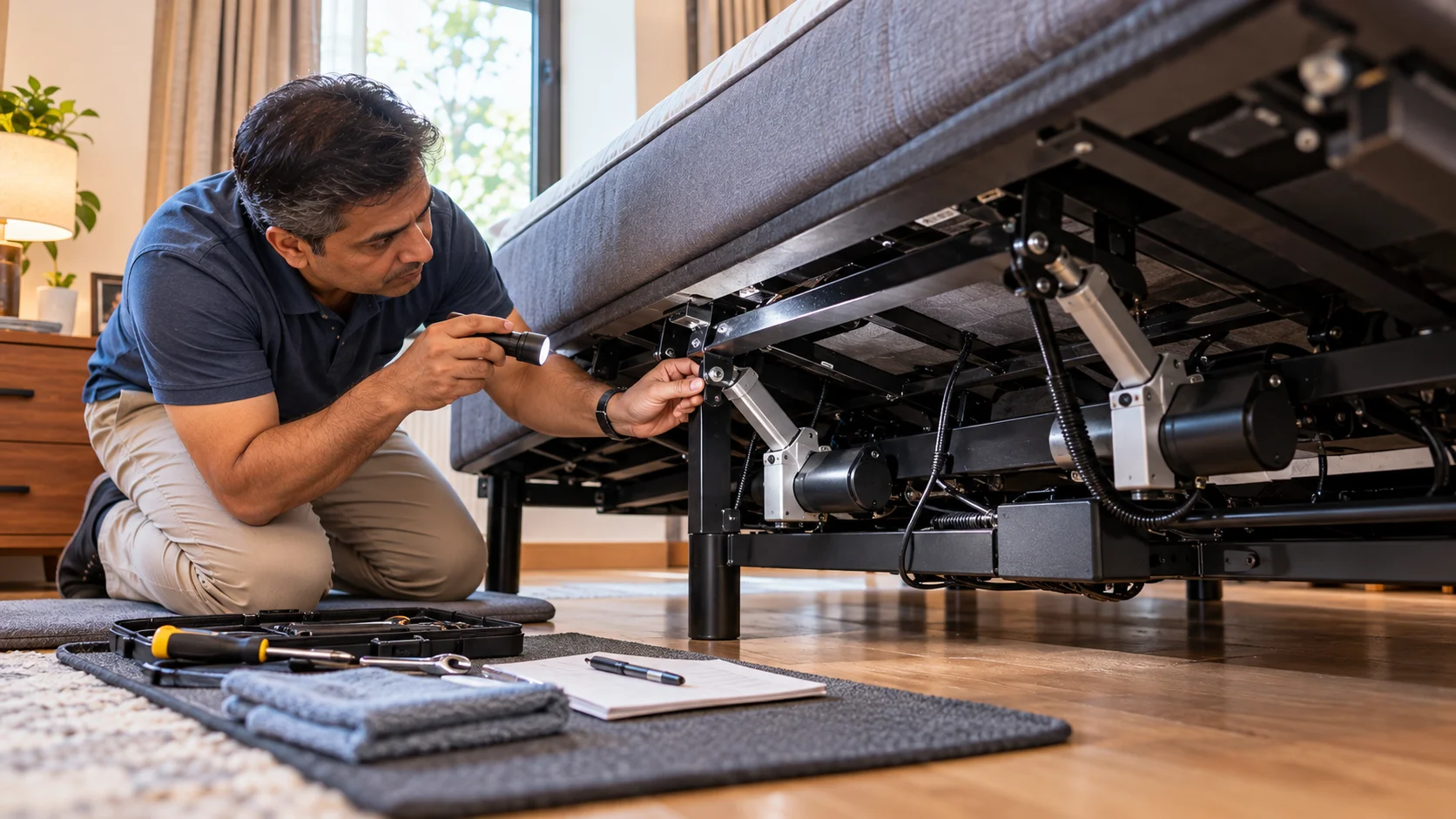
Once the bed arrives, setup typically follows a consistent sequence:
Unpack and check every part against the delivery checklist before assembly begins.
- Assemble the frame or, for retrofit systems, fit the motorised mechanism into your existing wooden bed.
- Attach mattress stoppers, so the mattress doesn’t slide as the bed adjusts.
- Connect and pair the motors with the remote or app, and test the wireless or wired connection.
- Run the head, legs, and height through their full range to confirm smooth, quiet movement before the patient uses the bed.
- Position side rails or assist handles, if included, and confirm they lock securely.
- Do a final safety check — cords tucked away from walkways, wheels locked if the bed isn’t meant to move, and the remote within easy reach.
Safety Tips for Bedridden and Respiratory Care at Home
For patients who are largely bedbound, or managing a respiratory condition, a few safety details matter more than they might for a shorter, more mobile recovery.
Safety Tips for Bedridden Patients at Home
- Confirm the rated weight capacity for the specific model, including the mattress and any bedding — don’t rely on a general figure. (Zero-G Beds’ standard electric beds are rated up to 175 kg — confirm this against the specific model and the patient’s needs.)
- Check side rail height and locking mechanism, since these matter daily for a patient who spends most of their time in bed.
- Position the bed for easy repositioning access from both sides, if the caregiving involves more than one person, since consistent repositioning is central to comfort and pressure-injury prevention.
- Plan for a pressure-relieving mattress from the outset, rather than adding one later — a mismatched mattress both reduces comfort and can strain the bed’s motor mechanism over time.
Safety Tips for Respiratory Care at Home
- Prioritise reliable, smooth head elevation — raising the upper body is a straightforward, non-drug way many patients with breathing difficulty find helpful for comfort.
- Keep any respiratory equipment (oxygen concentrator, nebuliser) within reach of the bed, with cords routed safely away from the caregiver’s working zone.
- A quiet motor matters more here than usual — patients managing breathing difficulty are often more sensitive to sleep disruption, and small, frequent adjustments should be possible without significant noise.
Does an Electric Hospital Bed Prevent Bedsores?
It’s worth being precise: an electric hospital bed supports pressure-injury prevention, but doesn’t prevent bedsores by itself. Regular repositioning and skin care, following a schedule set by the patient’s care team, remain the primary prevention method, particularly for anyone assessed as high-risk.[¹] What the bed genuinely contributes is making that repositioning far easier and more consistent to carry out — which is exactly what prevention depends on.
Tell us the condition, get a matched recommendation. Call/WhatsApp: +91 9820138189 We’ll suggest the exact bed, mattress, and setup plan for your space.
Electric Hospital Bed for Home Use: Cost Breakdown
Cost tends to break down across a few clear factors:
| Cost Factor | What It Affects |
| Type of adjustment | Semi-electric costs less than fully electric |
| Motor quality | Quieter, more durable motors cost more |
| Weight capacity / frame strength | Bariatric frames cost more than standard |
| Mattress | Basic foam is far cheaper than alternating-pressure air |
| Design and finish | Retrofit/wood-finish options often cost more than plain metal |
| Accessories | Rails, overbed table, waterproof cover add to the total |
| Installation | Professional setup may be included or charged separately |
| Warranty length | Extended coverage on motor and electronics may cost more |
A note on total cost: The bed’s sticker price is rarely the full picture for a hospital bed for patients at home. Factor in the mattress (if not bundled), accessories like rails and an overbed table, and delivery/installation charges, so you’re comparing full setup costs between suppliers — not just frame prices.
Get a personalised quote! Call/WhatsApp: +91 9820138189 Share the patient’s condition and your room dimensions and we’ll send exact pricing and a setup plan.
How to Maintain Your Electric Hospital Bed Safely at Home
- Wipe surfaces regularly with a mild antibacterial wipe, particularly touchpoints like the remote and rails.
- Check cords and cables every few months for pinching, fraying, or wear — stop using the bed and get it checked if anything looks damaged.
- Test the full range of motion periodically, not just when something feels off, so a developing issue is caught early.
- Keep the manufacturer’s service contact accessible, especially for motor or electronics issues that shouldn’t be handled without proper training.
Common Mistakes to Avoid When Setting Up a Home Hospital Bed
- Measuring the room but not the actual access route (doorways, hallways, stairs) the bed needs to travel through.
- Placing the bed without a nearby power outlet, leading to a trailing extension cord and a fall hazard.
- Underestimating total cost by comparing only the bed’s base price between suppliers, without accounting for mattress, accessories, and installation.
- Skipping a pressure-relieving mattress for a bedridden patient, assuming the frame alone is enough.
- Not confirming warranty coverage on the motor and electronics specifically, in writing, before paying.
Electric Hospital Bed Setup & Safety Checklist
- Access route measured (doorways, hallway, stairs)
- Room clearance confirmed for caregiver working zone
- Power outlet planned, without a trailing extension cord
- Rated weight capacity confirmed for the specific model
- Side rails and locking mechanism checked
- Mattress suited to bedridden or respiratory care needs
- Full range of motion tested before first use
- Warranty on frame, motor, and electronics in writing
- Installation and after-sales support confirmed
Why Choose Zero-G Beds for Your Home Hospital Bed
- 10,000+ families across India have set up home care with Zero-G Beds since 2003.
- Full home installation and demo included by a trained team.
- At Zero G Beds, we can convert your existing bed into a customised adjustable bed based on your comfort and support requirements—without replacing your current bed.
- 15-year warranty on frame and motors, in writing.
- CE-certified adjustable bed systems that meet internationally recognised European safety and quality standards.
- Professional delivery within 1 week, along with installation and a complete product demonstration by trained technicians.
- Transparent pricing — no hidden costs after delivery.
- Real after-sales service — reachable directly at +91 9820138189 or info@zerogbeds.com.
Bottom Line: Setting Up an Electric Hospital Bed for Home Use
Setting up a hospital bed for patients at home comes down to three things done properly: preparing the room and access route before delivery, confirming the safety standard and weight capacity for the specific model, and understanding the full cost — mattress, accessories, and installation included — rather than just the bed’s base price. Get those right, and the setup goes smoothly on a week that’s already asking a lot of your family.
Need help choosing the right electric hospital bed for home use? Talk to our care advisors today. Call/WhatsApp: +91 9820138189 or email info@zerogbeds.com
References
- NICE Quality Standard QS89 — Pressure ulcers: advice on repositioning. https://www.nice.org.uk/guidance/qs89/chapter/quality-statement-5-advice-on-repositioning
- IEC 60601-2-52:2009 — Medical electrical equipment, Part 2-52: basic safety and essential performance of medical beds. https://www.iso.org/standard/36067.html
- IEC 60601 vs. ISO 13485: Medical Device Risk Management. https://eureka.patsnap.com/article/iec-60601-vs-iso-13485-medical-device-risk-management