
This guide is general information to help families make informed decisions. It isn’t medical advice — please check anything specific to the patient with their doctor, physiotherapist or nurse, and confirm the rated specifications of any bed before you buy.
The phrase “hospital bed” tends to conjure a specific image — metal rails, a clinical frame, something that belongs in a ward, not a bedroom. But hospital beds for patients today cover a much wider range than that, from simple manual frames to fully electric, home-styled beds that support serious care without making a bedroom feel like a hospital. If you’re bringing a patient home, or setting one up for long-term care, understanding what actually distinguishes one hospital bed from another will save you both money and a fair amount of frustration.
This guide walks through the main types of hospital beds, how to choose between them based on the patient’s actual condition, the safety standards worth knowing, and what genuinely drives the price — in plain language, from people who set these beds up in real homes and facilities every week.
Talk to a care advisor — free, no obligation. Call or WhatsApp: +91 9820138189 Tell us the patient’s condition and we’ll recommend the right bed and mattress.
What Makes a Bed a Hospital Bed?
A hospital or medical bed is designed specifically to support patient care, with features such as positioning, patient support, mobility or transfer support, and safety features suited to its intended use. The defining features usually include:
- Adjustable head and leg sections, for sitting up, elevation, and positioning support.
- Adjustable overall height, so caregivers can work at a safe, comfortable level.
- Side rails or assist handles, for safety during transfers and repositioning.
- A frame built to support repeated, sustained use, often with a higher and more clearly rated weight capacity than standard furniture.
Beyond that baseline, hospital beds range enormously — from basic manual frames used for a short recovery, to fully electric, app-controlled systems designed for years of long-term home care.
Who Needs a Hospital Bed for Patients?
Not every recovery or care situation needs one, but a hospital bed earns its place quickly in a few common situations:
- Post-surgery recovery — hip, knee, spine, or abdominal surgery, where safe elevation and easy repositioning matter for the first weeks of healing.
- Long-term bedridden care — due to paralysis, advanced illness, or neuromuscular conditions, where the bed becomes the centre of daily life.
- Stroke recovery, where positioning support and safe transfers are critical in the early months.
- Elderly patients with fall risk or mobility limitations, where hi-low height and side rails add meaningful safety.
- Patients at risk of pressure injuries, where frequent, easy repositioning is part of the prevention plan.
- Chronic respiratory or cardiac conditions, where head elevation supports easier breathing.
- Bariatric patients, who need a reinforced frame and higher-rated weight capacity than a standard bed provides.
If any of this describes the person you’re caring for, the type of hospital beds for patients you choose should follow directly from their specific situation — not from whichever option happens to be cheapest or most familiar.
Types of Hospital Beds for Patients
Manual hospital beds
Adjusted entirely by hand crank — no motor involved. The lowest upfront cost, but every position change takes physical effort from the caregiver, repeated multiple times a day.
Semi-electric hospital beds
The head and leg sections are motorised and controlled by remote, while the overall height still adjusts by manual crank. A middle ground — less caregiver effort than fully manual, at a lower cost than fully electric.
Fully electric hospital beds
Every major adjustment — head, legs, and height — is motorised and controlled by remote, app, or sometimes voice. This can be particularly useful for longer-term care because it reduces the physical effort required for routine positioning.
Low / floor-level (safety) beds
Sit closer to the floor than a standard frame, specifically to reduce injury risk if a patient with memory issues, dementia, or significant balance problems gets out of bed unassisted or falls.
Bariatric hospital beds
Reinforced frames with a higher rated weight capacity and typically a wider sleeping surface, built for patients above the weight range standard frames are designed for.
Retrofit / convertible systems
Rather than a standalone clinical frame, these fit a motorised mechanism into your existing wooden bed, delivering the same functional adjustment while keeping the bedroom looking like a bedroom rather than a ward.
Manual vs. Semi-Electric vs. Fully Electric Hospital Beds: Comparison
| Feature | Manual | Semi-Electric | Fully Electric / Smart |
| Back-rest lift | Hand crank | Motor (remote) | Motor (remote / app / voice) |
| Leg lift | Hand crank | Motor (remote) | Motor (remote / app / voice) |
| Height adjustment | Hand crank | Hand crank | Motor (remote) |
| Caregiver effort | High | Medium | Low |
| Patient independence | None | Some | High — can self-adjust |
| Bedroom look | Clinical, metal | Semi-clinical | Can match home furniture (retrofit options) |
| Typical cost | Lowest | Mid-range | Higher |
| Best for | Very short-term recovery | Short-to-medium recovery | Long-term care, home living |
For care expected to run beyond a few weeks, the caregiver-effort savings of a fully electric bed tend to outweigh the higher upfront cost fairly quickly. For a short, defined recovery period, manual or semi-electric is often the more sensible spend.
Still weighing it up? Book a free home demo — Call/WhatsApp: +91 9820138189 See the bed in a real bedroom before you decide.
How to Choose the Right Hospital Bed for Patients
- Match the type to the patient’s condition and expected duration
A short post-surgery recovery has very different needs from long-term bedridden care. Work backward from the medical situation — and if the duration is uncertain, lean toward the option with more functional support, since it’s rarely a wasted investment.
- 2. Confirm the weight capacity for the specific model
Confirm the manufacturer’s rated safe working load for the specific model and check how that rating is defined, including whether it accounts for the patient, mattress, bedding and accessories.
- 3. Understand what the positioning features actually do
- Head elevation supports sitting up for meals and medicines, easier breathing, and is a commonly recommended, drug-free approach for easing night-time reflux — though clinical evidence for it remains moderate rather than definitive, so it works best alongside your doctor’s advice, not instead of it.
- Leg elevation supports circulation and helps with lower-limb swelling.
- Auto-contour moves the head and knee sections together so the patient doesn’t slide down the bed as the backrest rises.
- Hi-low height brings the bed to a safe working height for transfers, and lowers again to reduce fall risk when the patient is more independent.
- 4. Choose controls the patient and caregiver can genuinely use
A simple, large-button remote is often more practical than an app, especially for patients with limited hand strength or older caregivers less comfortable with phone-based controls.
- 5. Decide how clinical the bed needs to look
You’re not limited to a metal-frame, ward-style bed. Retrofit systems and wood-finish designs deliver the same functional adjustment while keeping a bedroom feeling like a bedroom.
Tell us the condition, get a matched recommendation. Call/WhatsApp: +91 9820138189 We’ll suggest the exact bed and mattress and send you the details.
What Is the Zero-Gravity Position in a Hospital Bed?
Zero-Gravity is a commonly used name for a reclined position that raises the upper body and bends or elevates the knees to distribute body weight more evenly. The exact position varies by bed. It’s a genuinely comfortable position that many patients find helpful for back comfort, circulation, and night-time reflux — but it’s worth being precise that it’s a comfort position, not a medical treatment, and works alongside the patient’s care plan rather than replacing any part of it.
Does a Hospital Bed Prevent Bedsores?
A hospital bed helps with pressure-injury prevention, but it doesn’t prevent bedsores by itself. Pressure injuries are prevented mainly through regular repositioning and skin care, following an individualised schedule set by the patient’s care team, particularly for anyone assessed as high-risk. What a good hospital bed genuinely does is make that repositioning far easier and more consistent to carry out — for both the caregiver and, in many cases, the patient themselves via self-adjustment.
Hospital Bed Features for Safe Patient Transfers
Safe transfers — getting a patient in or out of bed, or repositioning them for care — depend on a combination of features working together, not any single one:
- Hi-low height, so the caregiver isn’t bending or stooping during hands-on assistance.
- Side rails or assist handles, giving the patient something stable to hold during a transfer.
- A locking wheel base, if the bed is on castors, so it doesn’t shift mid-transfer.
- Sufficient bed width for the patient’s build, so transfers aren’t cramped or unstable.
Best Mattress for a Hospital Bed
A hospital bed’s frame only works properly with a mattress designed to bend at the same hinge points. A conventional mattress may not flex correctly with an adjustable frame, which can affect positioning and operation. Use a mattress that the bed manufacturer confirms is compatible with the specific model
Mattress options that suit an adjustable hospital bed:
- 7-zone latex — natural material with zoned support across the body.
- High-density medical foam — flexes cleanly at the bed’s hinge points.
- Memory foam — moulds to the body to relieve pressure at the hips and heels.
- Alternating-pressure air mattresses — alternating-pressure air mattresses may be appropriate for some patients at higher risk of pressure injuries, depending on their individual assessment and care plan.
Hospital Bed Accessories Worth Considering
- Side rails / assist handles — for safety during transfers and repositioning.
- Overbed table — for meals, reading, or medicines within easy reach.
- Waterproof mattress cover — protects the mattress from spills and fluids.
- Under-bed night light — for safer movement in the dark.
- IV pole attachment, if relevant to the patient’s care.
Quick Picks by Situation
The right pick among hospital beds for patients usually comes down to the situation:
- Post-surgery recovery: Semi-electric or fully electric, with smooth head elevation and knee support.
- Long-term bedridden care: Fully electric, with hi-low height and a pressure-relieving mattress.
- Elderly patients with fall risk: Low-profile frame, hi-low height, and side rails.
- Bariatric patients: Reinforced frame with confirmed, model-specific weight capacity.
- Families wanting a normal-looking bedroom: Retrofit or wood-finish designs.
Get a matched recommendation. Call/WhatsApp: +91 9820138189 Tell us the patient’s condition and we’ll suggest the right bed and mattress.
What Drives the Price of a Hospital Bed?
- Type of adjustment — manual is cheapest, semi-electric sits in the middle, fully electric costs more.
- Motor quality and functions — quieter, longer-lasting motors and extras like hi-low height and auto-contour add to the cost.
- Frame strength and weight capacity — reinforced and bariatric frames cost more.
- Mattress — basic foam is a fraction of the cost of an alternating-pressure air mattress.
- Design and finish — wood-finish and retrofit-into-your-own-bed options typically cost more than plain metal frames.
- Accessories, warranty, and installation — rails, tables, longer coverage, and professional setup all factor into the total.
Get a personalised quote! Call/WhatsApp: +91 9820138189 Share the patient’s weight and condition and we’ll send exact pricing, mattress options and delivery timelines.
Hospital Bed Delivery, Setup, and Maintenance
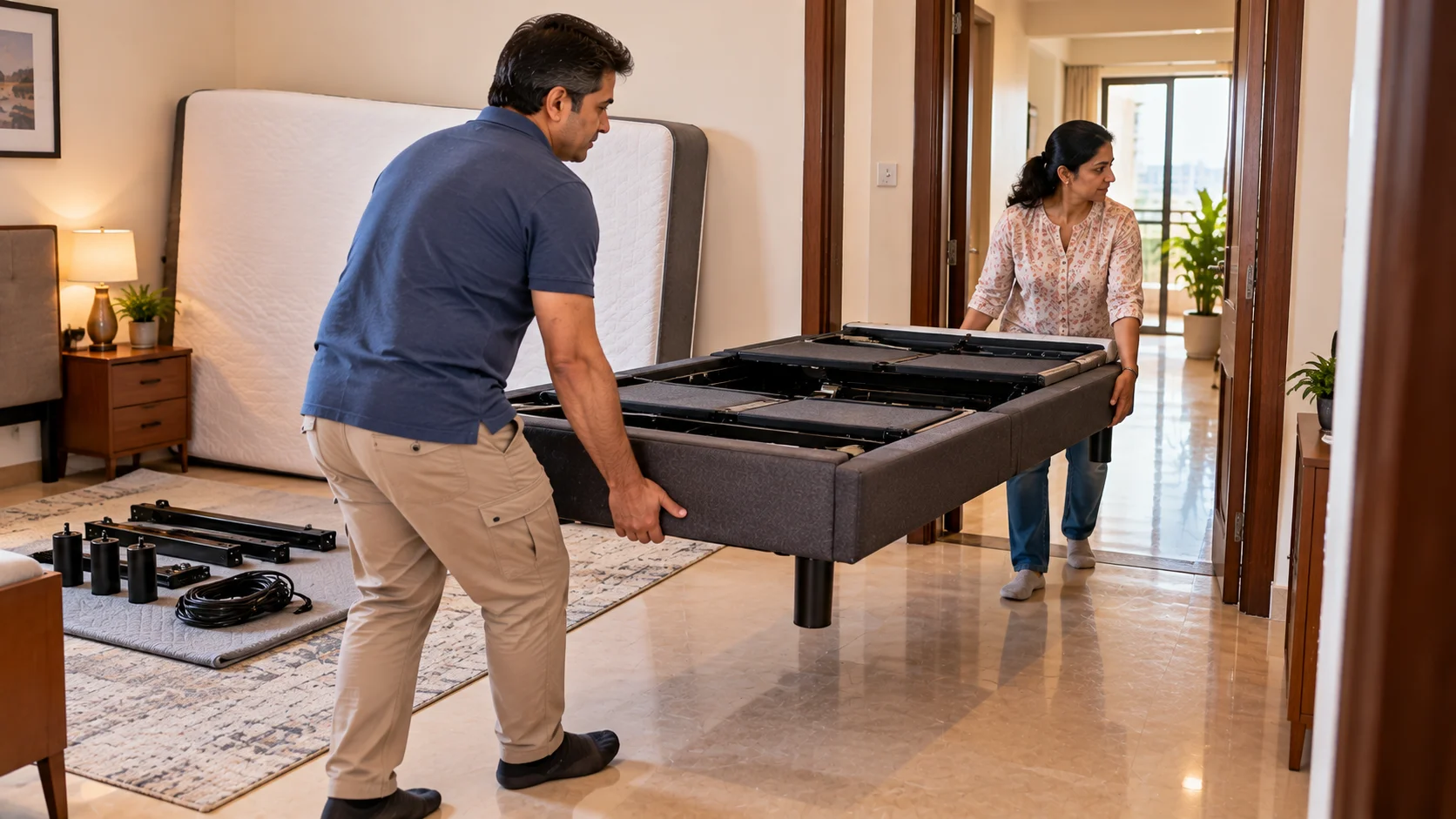
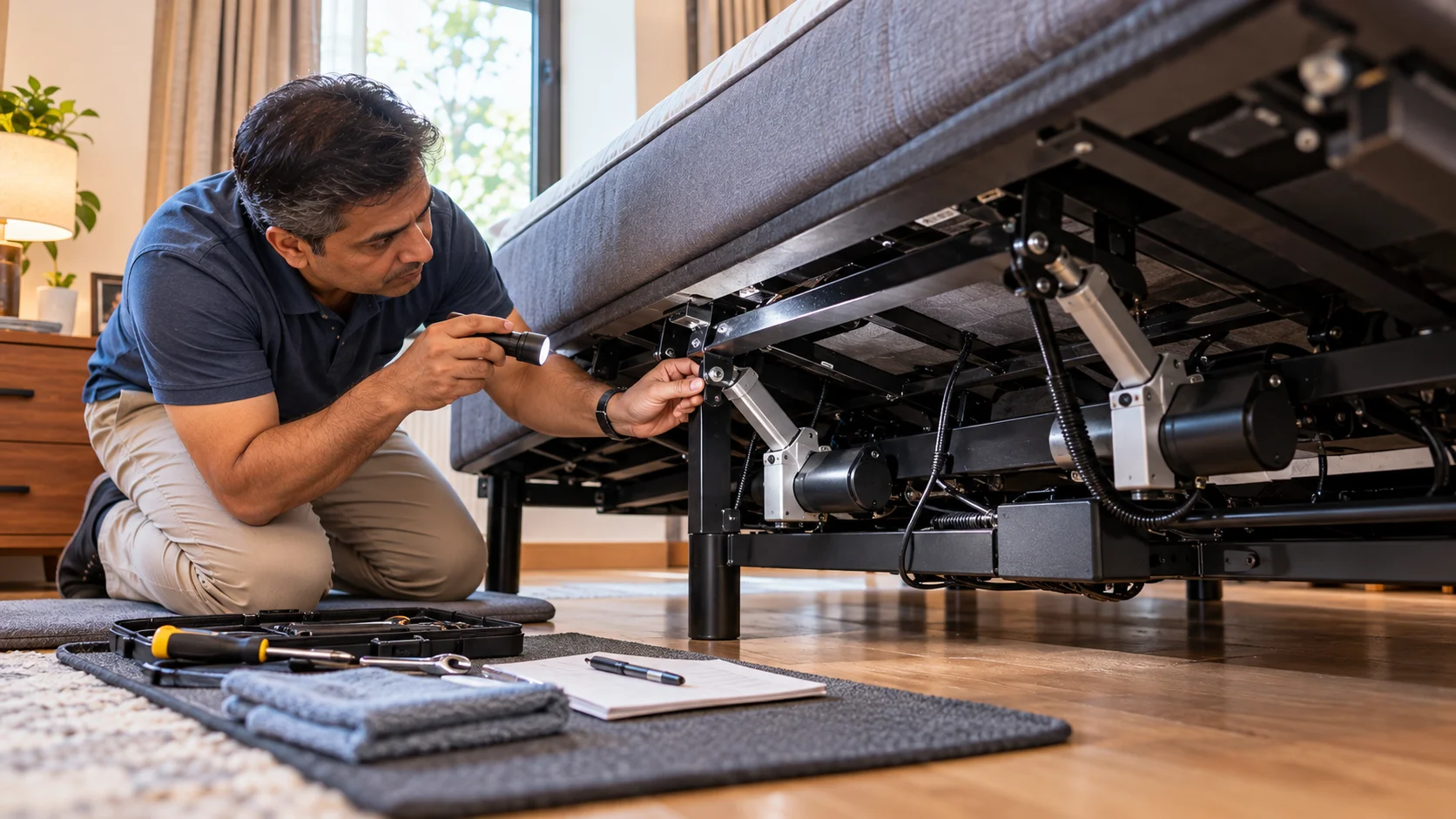
Setting it up: Follow the manufacturer’s installation instructions and use trained installation support where provided. Before patient use, check that the bed, controls, wheels and safety features operate correctly.
Zero-G Beds’ team sets the bed up and demonstrates every function in your home as part of installation, typically delivered within about a week.
Keeping it going: wipe surfaces regularly with a mild antibacterial wipe, and check cords and cables every few months for pinching or wear — if anything’s damaged, stop using the bed until it’s checked and repaired.
Common Mistakes to Avoid When Buying a Hospital Bed
- Choosing a bed based purely on lowest price, without checking safety certification or what’s actually included.
- Buying a clinical, metal-frame bed when a retrofit or wood-finish option would work just as well functionally, and feel far better in the room.
- Pairing the bed with an ordinary innerspring mattress that won’t flex at the hinge points.
- Trusting a general weight-capacity figure instead of the specific model’s rated limit.
- Skipping written warranty terms for the frame, motor, and electronics.
- Choosing controls too complicated for the patient or primary caregiver to use confidently.
- Overlooking fall-safety features — rails, height adjustment, and locking wheels matter most for the least steady patients.
Quick Buying Checklist
- Bed type matched to the patient’s condition and expected duration of care
- Rated weight capacity confirmed for the specific model
- Head and leg elevation suit the patient’s condition
- Hi-low height included for safe transfers
- Controls the patient and caregiver can actually use
- A mattress made for adjustable hospital beds
- Fall-safety features included (rails, locking wheels, low-profile option if needed)
- Warranty on frame, motor, and electronics in writing
- Delivery, setup, and after-sales support clarified
Why Families choose Zero G Beds
- 10,000+ families across India have chosen Zero-G Beds since 2003.
- Wide range of Single-Zone, Split and Split King adjustable bed frames for every bedroom.
- At Zero G Beds, we can convert your existing bed into a customised adjustable bed based on your comfort and support requirements—without replacing your current bed. adjustable bed based on your comfort and support requirements—without replacing your current bed.
- Compatible mattress options selected to properly flex with the frame’s movement.
- Professional delivery within 1 week, along with installation and a complete product demonstration by trained technicians.
- Dedicated after-sales support to assist with setup and servicing
- 15-year warranty for long-lasting performance and peace of mind.
- Easy assistance via Call/WhatsApp: +91 9820138189 for product guidance, pricing, and support.
- CE-certified adjustable bed systems that meet internationally recognised European safety and quality standards.
- Trusted by families and couples across India for comfortable, practical home upgrades.
Ready to make care easier at home? Talk to us: +91 9820138189 or email info@zerogbeds.com
The bottom line
Choosing the right hospital bed comes down to matching the type — manual, semi-electric, or fully electric — to the patient’s actual condition and how long you’ll likely need it, then confirming the safety standard and weight capacity for that specific model. Pair it with a mattress made to bend at the same points, and choose controls that both the patient and caregiver can genuinely use.
Whether it’s a short post-surgery recovery or long-term bedridden care, this is one of the highest-value decisions in setting up safe, comfortable care at home — and it’s worth taking the time to get right.
Tell us about your loved one’s needs and we’ll recommend the right bed today. Call/WhatsApp: +91 9820138189 or email info@zerogbeds.com
References
- IEC 60601-2-52:2009 — Medical electrical equipment, Part 2-52: basic safety and essential performance of medical beds. https://www.iso.org/standard/36067.html
- IEC 60601 vs. ISO 13485: Medical Device Risk Management. https://eureka.patsnap.com/article/iec-60601-vs-iso-13485-medical-device-risk-management
- Khan BA et al. Effect of bed-head elevation during sleep in nocturnal gastroesophageal reflux. PubMed. https://pubmed.ncbi.nlm.nih.gov/22098332/
- US Vein Clinics — Health benefits of elevating your legs. https://www.usaveinclinics.com/blog/health-benefits-of-elevating-your-legs/
- Sleep Advisor — How to get the Zero-Gravity position on an adjustable bed. https://www.sleepadvisor.org/how-to-get-zero-gravity-position-on-adjustable-bed/
- NICE Quality Standard QS89 — Pressure ulcers: advice on repositioning. https://www.nice.org.uk/guidance/qs89/chapter/quality-statement-5-advice-on-repositioning
- Central Drugs Standard Control Organisation (CDSCO), Ministry of Health & Family Welfare, Government of India — Medical Devices Rules, 2017 (governs hospital bed classification and registration in India). https://cdsco.gov.in/opencms/opencms/en/Acts-and-rules/Medical-Devices-Rules/