Adjustable Beds for Parkinson’s Disease: A Positioning and Safety Guide

Parkinson’s disease often makes turning over in bed, sitting up and standing from lying difficult, and can cause dizziness on standing. An adjustable bed helps mainly by making these transitions gradual and lower-effort: a raised head section to sit up without straining, a height-adjustable base for safer transfers, and slow, smooth motor movement. It supports […]
Adjustable Beds for Spinal Stenosis: Why a Slightly Flexed Position Often Helps
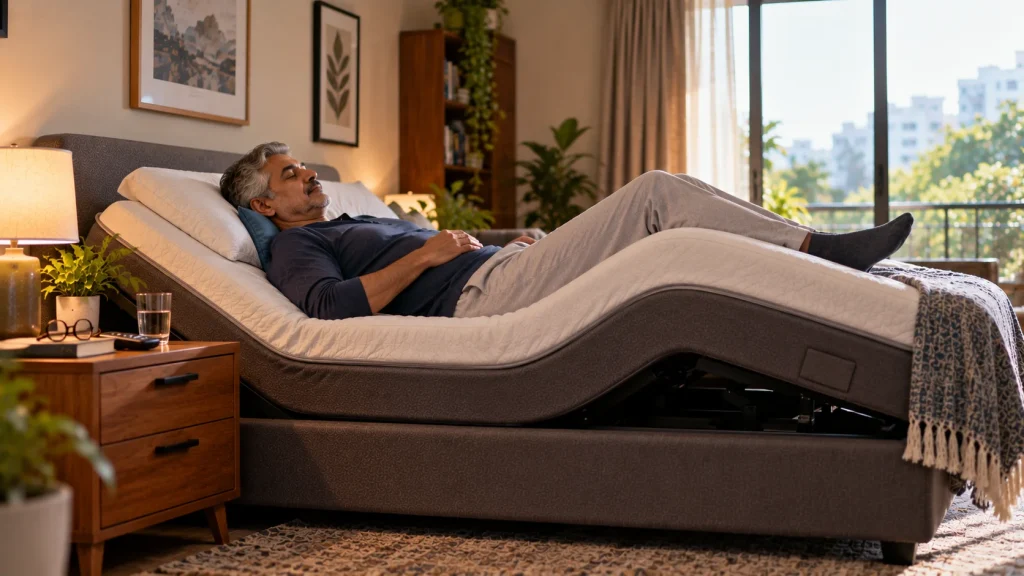
Spinal stenosis narrows the space around the spinal nerves, and lying flat or arching the lower back tends to narrow it further. A gentle knee-and-hip flexed position, like a mild Zero Gravity setting, opens that space slightly and often eases night-time leg pain, numbness and cramping. It manages symptoms, it does not widen the canal, […]
Which Is the Best Adjustable Bed for Elderly People at Home?

The best adjustable bed for elderly people at home prioritizes height adjustability for safer transfers, a simple large-button remote for limited dexterity, gentle and smooth motor movement, and confirmed weight capacity generally more important for this specific group than achieving the deepest possible Zero Gravity recline. Safety and ease of daily use should outweigh advanced […]
Which Is the Best Adjustable Bed for Snoring and Sleep Apnea?

The best adjustable bed for snoring and sleep apnea prioritizes a genuine, stable upper-body elevation preset (rather than a shallow generic incline), a very quiet motor so adjustments don’t wake a partner, and independent head control so the angle can be fine-tuned precisely. A mid-range frame with these specific features typically outperforms a premium frame […]
What Are the Long-Term Benefits of Using an Adjustable Bed?

The long-term benefits of an adjustable bed go beyond immediate comfort consistent use over months and years is associated with reduced chronic back pain severity, better circulation health, fewer sleep disruptions from snoring or reflux, and, for many people, reduced reliance on pain medication. Many of these benefits compound gradually rather than appearing overnight, which […]
Can an Adjustable Bed Help with Migraines and Tension Headaches?

An adjustable bed doesn’t directly treat migraines or tension headaches, but proper neck and head positioning can reduce a known trigger for many people poor sleep posture that strains neck muscles connected to headachegenerating pathways. For tension headaches specifically linked to neck tightness, correct positioning support tends to help more directly than for migraines, which […]
Adjustable Beds for PostHip and Knee Replacement Recovery: A Positioning Guide

After hip or knee replacement surgery, an adjustable bed helps most through height adjustability, which reduces strain during the frequent, carefully controlled transfers recovery requires, and through gentle elevation that can ease swelling without violating your surgeon’s specific movement restrictions. Always follow your surgeon’s exact postoperative positioning guidelines, since hip replacement in particular often involves […]
Adjustable Beds and Scoliosis: What Positioning Can and Can’t Do for Spinal Curvature

An adjustable bed cannot correct or reduce the structural spinal curvature involved in scoliosis, but it can genuinely help manage the secondary discomfort scoliosis often causes uneven pressure distribution, associated back pain, and difficulty finding a comfortable sleeping position due to the spine’s altered shape. Setting realistic expectations about what positioning can and can’t achieve […]
Adjustable Beds for Heart Failure Patients: Managing Orthopnea and Nighttime Breathlessness

Orthopnea breathlessness that occurs or worsens when lying flat is a wellrecognized symptom in heart failure, and elevating the head and upper body is a standard, widely recommended comfort measure for managing it. An adjustable bed provides stable, consistent elevation for this purpose, but positioning must always be guided by your cardiologist as part of […]
Adjustable Beds for COPD and Breathing Difficulties: How Elevation Helps You Breathe Easier

For COPD and other breathing difficulties, elevating the head and upper body reduces the effort your diaphragm and chest muscles need to expand your lungs fully, since lying completely flat allows abdominal organs to press upward against the diaphragm. Many people with COPD already sleep propped up on pillows for exactly this reason an adjustable […]