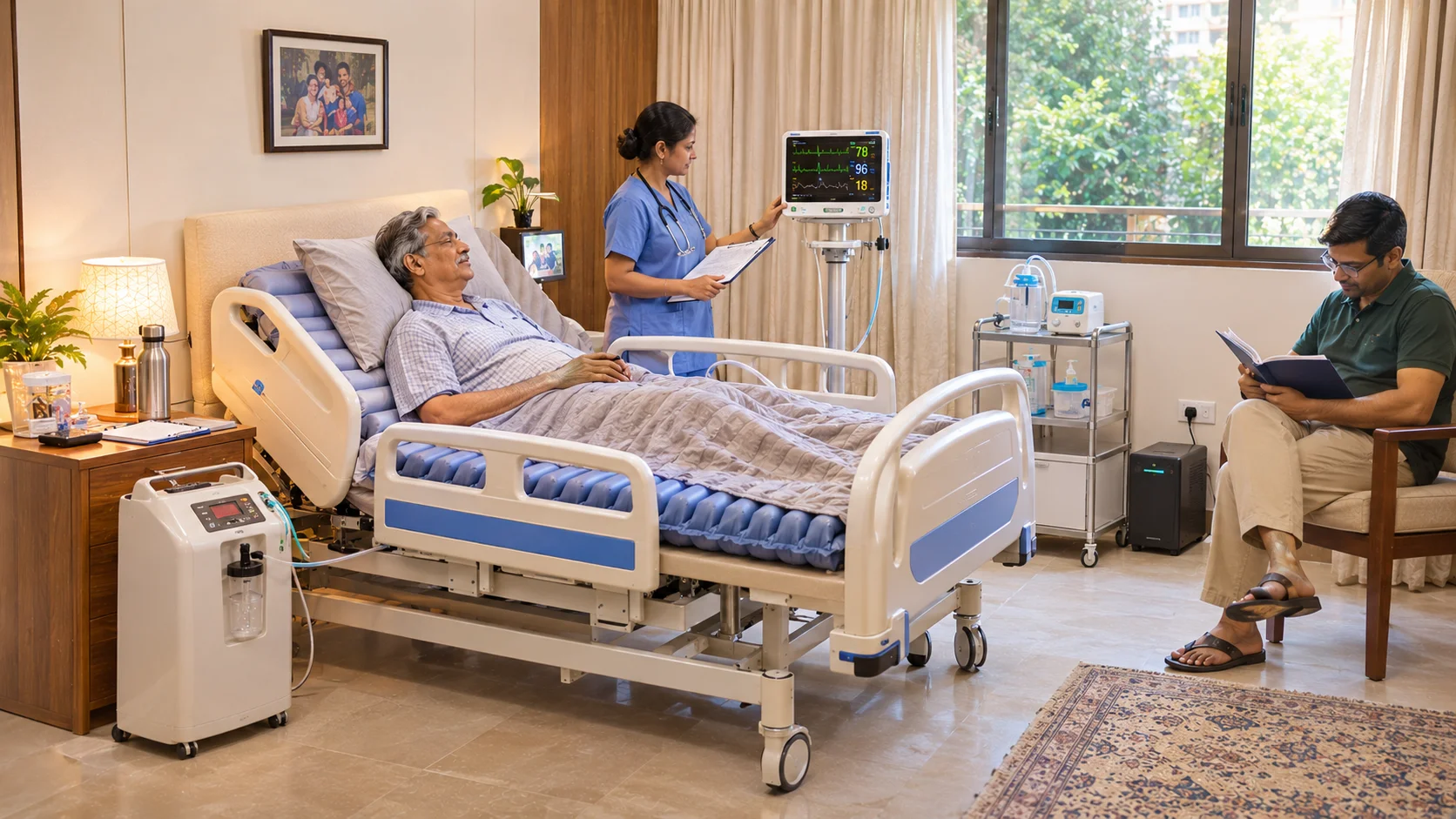
A home ICU recreates critical-care support at home after a hospital stay, and it must be planned with the treating doctor. The core items are an adjustable hospital or ICU bed, a pressure-relieving mattress, oxygen support, monitoring and suction as advised, a safe power supply with backup and trained staff.
After a serious illness, families are sometimes told that the patient can continue treatment at home with monitoring and equipment. A home ICU setup can be safer and more comfortable than a long hospital stay, but only if it is planned properly. The bed is the centre of the room, so it deserves careful thought. Here is a practical checklist, starting with the most important point.
IMPORTANT NOTE
A home ICU should only be arranged on the advice of the treating doctor, who will say what equipment, monitoring and nursing the patient needs. This guide is a planning aid and does not replace medical advice. Keep emergency numbers and the hospital’s contact details within reach at all times.
The Equipment Checklist
| Item | Purpose | Rent or Buy? |
| ICU or adjustable hospital bed | Positioning, comfort and easier care | Rent for short needs, buy for long ones. Supplier rentals of about Rs 7,500 a month are quoted for ICU beds |
| Pressure-relieving mattress | Reduces pressure on skin | Often an air or anti-sore foam mattress, see our guide on hospital bed mattresses |
| Oxygen concentrator | Continuous oxygen support | Frequently rented, with about Rs 4,500 a month quoted by one supplier |
| Patient monitor | Tracks heart rate, oxygen saturation and blood pressure | Examples reported: about Rs 26,000 to buy an ECG monitor vs Rs 4,000 a month to rent |
| Suction machine | Clears airways when needed | Examples reported: about Rs 4,400 to buy vs Rs 2,500 a month to rent |
| BiPAP, CPAP or ventilator | Breathing support as prescribed | Usually rented and set up by the provider |
| DVT pump and infusion pump | Circulation support and controlled medication delivery | Only if prescribed |
Figures come from supplier listings and a media report on home ICU costs, and they vary by city and provider. They show the rent-versus-buy pattern rather than a fixed price, so ask for itemised quotes.
The Bed and Mattress
An adjustable bed helps with breathing, feeding and repositioning, and an ICU-style bed adds height adjustment and tilt positions when the doctor advises them. Our guide to semi fowler, full fowler and ICU beds explains the differences. Pair the bed with a pressure-relieving mattress, and check that the mattress is the right size and bends with the sections.
Preparing the Room
- Choose a clean, well-ventilated room close to the bathroom, ideally on the ground floor.
- Leave space on all sides of the bed so caregivers and equipment can be placed without blocking each other.
- Plan power for every device, with earthed sockets, enough points and no overloaded extension boards.
- Arrange a backup such as an inverter, generator or battery, as the doctor or equipment provider advises. Read our guide on electric beds and power cuts for what to ask.
- Set up the bed first, test every movement and then place the other equipment.
- Mark emergency numbers on the wall and keep copies of reports and medicines nearby.
Staff and Training
Home ICU care usually needs trained nurses or caregivers, a doctor on call and a clear plan for emergencies. Make sure everyone who helps knows how to operate the bed, the equipment alarms and who to call. Our guide on electric beds for caregivers explains how powered positioning reduces strain.
Cost: What Drives It
- The patient’s condition, which decides the equipment and nursing needed.
- The duration of care, since renting suits weeks and buying suits long periods.
- The city and the provider.
- Staffing, which is often the largest ongoing cost.
- Backup power and consumables such as masks, tubing and linen.
Rather than looking for a single price, ask providers for itemised quotes and compare rent and purchase for each item. Our guide on renting, buying or converting a bed shows how to calculate break-even.
Where Zero-G Fits
Zero-G supplies beds, including electric hospital beds and bed for patients options, and not oxygen or monitoring equipment. Ask your doctor or home-care provider about the other items, and talk to us about the bed that suits your room and the patient’s needs.
Hygiene and Infection Control
- Keep the room clean and well ventilated.
- Wash hands before and after contact with the patient and equipment.
- Use disposable gloves and masks where the care team advises.
- Clean equipment surfaces with the recommended solution.
- Dispose of medical waste as advised, not with household rubbish.
Common Home ICU Mistakes
- Setting up before the doctor has confirmed the plan.
- Having no power backup, or one that has never been tested.
- Relying on one untrained caregiver for all shifts.
- Placing equipment so the bed cannot be reached from all sides.
- Not keeping the hospital’s emergency number where everyone can see it.
When Home Care Is Not Enough
Some patients need to return to hospital if their condition worsens or the home setup cannot meet their needs. Agree in advance with the doctor which warning signs mean a call or a return to hospital, and write them down for everyone who helps.
Keep a Simple Record
Keep a notebook for vital signs, medicines, equipment checks and any changes you notice, and share it with the doctor and nurse at each visit. A clear record helps the care team make decisions quickly, and it also helps family members who share shifts to stay informed.
A home ICU works when the plan comes from the doctor, the room is prepared, the bed and mattress suit the patient, power is backed up and trained people are on hand. Take it step by step, rent where it makes sense and keep emergency contacts close.
Explore our Electric Hospital Bed collection or the Bed for Patients range.
Related Reading