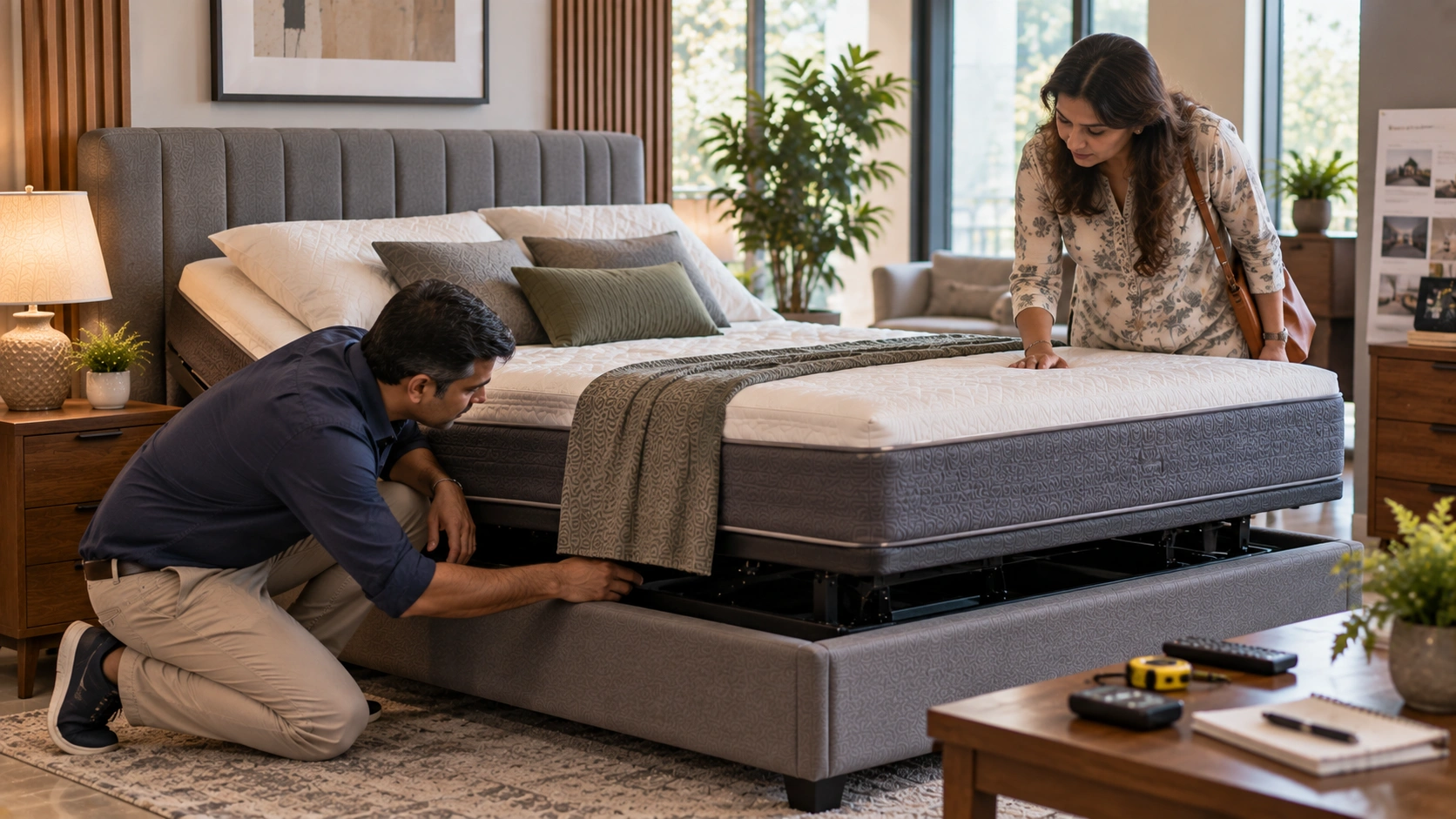

A home medical bed can become an important part of recovery, elderly care or long-term home care, but the total cost is not always limited to the bed itself. This guide explains what affects the medical bed price, whether health insurance may help with home-care expenses, what documents you may need, and how to estimate your actual out-of-pocket cost before buying.
This guide is for general information about home medical beds, pricing and insurance considerations in India.
Insurance coverage depends on the exact policy terms, exclusions, limits and claim conditions. Always confirm eligibility directly with your insurer before purchasing a bed.
If you are arranging care for a family member at home, the financial decision can feel complicated.
You may be comparing a patient bed price, hospital bed features, mattress requirements, delivery charges and long-term service costs at the same time.
The important point is that there is no single standard insurance rule saying that every hospital bed or adjustable bed purchased for home use will be reimbursed.
Instead, you need to look at why the bed is required, how the treatment is being provided at home, what your policy covers and whether the expense qualifies under the policy terms.
This guide explains what Indian families should check before spending money on a home medical bed.
Need help understanding which bed may suit your requirements? Call or WhatsApp +91 9820138189 or email info@zerogbeds.com.
Is a Home Medical Bed Covered by Health Insurance in India?
The short answer is: it depends on the policy.
Health insurance policies can differ significantly in what they cover, particularly when medical equipment is being used at home.
IRDAI explains that health insurance products can provide different types of coverage and that the actual healthcare costs covered are determined by the policy terms.
IRDAI also highlights the importance of checking exclusions, sub-limits, co-payments, waiting periods and other conditions before making a claim.
This means you should not assume that purchasing an Electric Hospital Bed For Home Use automatically makes the expense claimable.
Instead, ask your insurer specifically:
- Is a hospital bed or medical bed covered?
- Is home-care treatment covered under the policy?
- Does the policy cover medical equipment used at home?
- Is a doctor’s prescription required?
- Does the equipment need to be rented rather than purchased?
- Is pre-approval required?
- Is there a sub-limit for home-care expenses?
- Does the policy require treatment to qualify as domiciliary hospitalization?
Getting these answers before purchasing can prevent an unpleasant surprise during reimbursement.
What Is Domiciliary Hospitalisation?
One term that often causes confusion is domiciliary hospitalisation.
In simple terms, domiciliary hospitalisation generally refers to medical treatment provided at home when the treatment would ordinarily have required hospitalisation, subject to the conditions defined by the particular policy.
IRDAI’s health insurance guidance states that insurers are required to make products or add-ons available that can cater to situations including domiciliary hospitalisation and homecare treatment.
But this does not mean that every policy automatically covers every home-care expense. Policyholders need to check the specific product and available coverage.
This distinction is important.
Buying a medical bed because it makes home care more comfortable is not necessarily the same as receiving a covered domiciliary treatment.
Your insurer may therefore assess:
- The patient’s medical condition
- The doctor’s recommendation
- Whether hospital-level treatment was required
- Whether home treatment qualifies under the policy
- Whether the bed itself is an eligible expense
- Whether any sub-limit or exclusion applies
What Factors Determine the Cost of a Home Medical Bed?
The medical bed price can vary considerably depending on the type of bed and its features.
A basic manual bed may have a different price from a motorised bed with multiple adjustment functions.
Common factors include:
Bed Type
The first major factor is whether you need:
- Manual hospital bed
- Semi-electric bed
- Electric hospital bed
- Adjustable home-care bed
- Fully motorised hospital bed
- Recliner or comfort-focused adjustable bed
A family caring for someone temporarily after surgery may have very different requirements from a patient who needs long-term assistance.
Number of Motorised Functions
Electric beds may provide head elevation, leg elevation, height adjustment or other positioning functions.
More functions can increase the price, but more motors do not automatically mean the bed is better for every user.
The right question is: Which functions will actually be used every day?
Weight Capacity and Construction
Frame construction and rated weight capacity can influence the price.
For a patient requiring long-term use, durability should be considered alongside the initial patient bed price.
A cheaper bed may not necessarily represent better value if it does not suit the user’s requirements or has limited service support.
Mattress
The mattress may be purchased separately or supplied as part of a package.
Depending on the user’s needs, buyers may compare standard foam, pressure-relieving or other specialised mattress options.
Always confirm that the mattress is compatible with the specific adjustable mechanism.
Delivery and Installation
For a motorised bed, installation may be an additional consideration.
Ask whether the quoted price includes:
- Delivery
- Installation
- Demonstration
- Remote setup
- Mattress
- Warranty
- After-sales service
This helps you compare the hospital bed for home price more accurately.
What Additional Costs Should Families Budget For?
The purchase price is only one part of the total ownership cost.
Before buying, consider the following:
| Cost | What to Check |
| Bed | Exact model and configuration |
| Mattress | Included or additional |
| Delivery | Included or charged separately |
| Installation | Included or additional |
| Accessories | Rails, tables or other additions |
| Warranty | Motor, frame and electrical components |
| Service | Availability after installation |
| Repairs | What is covered and what is chargeable |
| Replacement parts | Availability and expected cost |
This is particularly important when comparing a cost of hospital bed for home across different suppliers.
A quote that looks cheaper initially may become more expensive if installation, mattress or service costs are excluded.
What Documents May Be Required for an Insurance Claim?
If your insurer indicates that the expense may be eligible, ask which documents are required before purchasing the bed.
Depending on the policy and claim process, you may be asked for documents such as:
- Doctor’s prescription or recommendation
- Medical diagnosis or treatment records
- Hospital discharge summary
- Home-care recommendation
- Original invoice
- Payment receipt
- Product details
- Bed model or equipment description
- Claim form
- Policy documents
- Any pre-authorisation approval
Do not assume that submitting an invoice alone will guarantee reimbursement.
The insurer may need evidence establishing the medical necessity and the relationship between the equipment and the covered treatment.
Should You Buy a Hospital Bed Before Checking Insurance?
Ideally, check first and purchase second.
If a family urgently needs a bed, waiting for a lengthy process may not always be practical. However, even in urgent situations, contacting the insurer and asking what documentation is required can be valuable.
For families still deciding which type of bed is appropriate, our guide on which hospital bed is best for home care patients can help you compare the practical requirements before making a purchase.
This is especially useful when the patient needs a bed for recovery, elderly care or long-term home support.
How Can You Reduce Your Out-of-Pocket Cost?
Insurance is not the only factor that can influence affordability.
Compare the complete package
Don’t compare only the headline patient bed price.
Ask for the total price including mattress, installation, delivery and warranty.
Choose only necessary features
If the user only needs head and leg elevation, paying for unnecessary functions may not provide meaningful additional value.
Consider long-term use
If the bed will be used for several years, durability and after-sales support become more important than finding the lowest initial price.
Ask about warranty coverage
A longer warranty can reduce the financial risk of motor or mechanical problems, although you should always check exactly what is covered.
Compare purchase and rental options
For short-term recovery, renting may sometimes be worth considering. For long-term care, buying may make more sense depending on the expected duration of use and total rental cost.
Why Medical Necessity Matters
Insurance companies generally distinguish between something that is medically necessary and something purchased primarily for convenience.
This does not mean a comfortable adjustable bed has no value.
It means that families should understand the difference between:
Medical requirement:
The bed is recommended as part of a defined treatment or home-care arrangement.
Comfort requirement:
The bed is purchased to make sleeping, reading, resting or everyday positioning more comfortable.
The second situation may still justify buying an adjustable bed, but it should not automatically be treated as an insurance-reimbursable medical expense.
This distinction is particularly important when comparing an adjustable bed for patients at home with a hospital-style medical bed.
What Should You Ask Your Insurance Company?
Before buying, keep this checklist ready:
Coverage
“Does my policy cover home medical equipment?”
Medical necessity
“Would a doctor-prescribed hospital bed qualify under my policy?”
Home treatment
“Does my policy include domiciliary hospitalisation or homecare treatment?”
Equipment
“Is the purchase of the bed itself covered, or only treatment expenses?”
Rental
“Is rental equipment covered if purchase is excluded?”
Limits
“Is there a specific sub-limit or deductible?”
Pre-approval
“Do I need written approval before purchasing?”
Documents
“What documents and invoices are required?”
Network
“Does the supplier need to meet any specific requirements?”
Getting these answers in writing can make the claim process easier to understand later.
Don’t Confuse Hospital Bed Cost With Total Care Cost
The price of the bed is only one part of home care.
Families may also need to budget for:
- Nursing support
- Physiotherapy
- Medicines
- Medical consultations
- Diagnostic tests
- Mobility aids
- Pressure-relief equipment
- Mattress replacement
- Maintenance
- Caregiver support
This is why the right bed should be selected based on the patient’s expected care requirements rather than simply searching for the lowest hospital bed for home price.
For additional context, Zero G Beds’ guide on adjustable beds for recovery at home explains how adjustable positioning can support comfort and day-to-day recovery at home.
How to Compare Two Medical Bed Quotes
Suppose Supplier A offers a lower price while Supplier B offers a higher price.
Don’t immediately choose Supplier A.
Create a simple comparison:
| Factor | Supplier A | Supplier B |
| Bed type | Check | Check |
| Motor functions | Check | Check |
| Weight capacity | Check | Check |
| Mattress | Included? | Included? |
| Delivery | Included? | Included? |
| Installation | Included? | Included? |
| Warranty | Check | Check |
| Service support | Check | Check |
| Spare parts | Check | Check |
| Final payable amount | Check | Check |
The final comparison should be based on total value, not just the first number you see.
What If Insurance Does Not Cover the Bed?
Don’t assume that means the bed is unaffordable.
You can still compare:
- Different bed configurations
- Essential versus optional features
- Purchase versus rental
- Mattress options
- Warranty periods
- Installation packages
- Long-term service support
For example, a family may discover that a simpler electric bed meets the patient’s actual positioning requirements without paying for advanced features that will rarely be used.
The goal should be to purchase the right bed, not necessarily the most expensive one.
Why Families Should Also Consider After-Sales Support
A medical or adjustable bed may become part of someone’s daily routine.
If the motor stops working, the remote fails or the bed develops a mechanical issue, quick service can become more important than a small difference in the original purchase price.
Zero G Beds’ existing guide on things to check before buying a hospital bed online covers practical buying checks such as features, safety and support that buyers should evaluate before placing an order.
This is especially relevant when the bed is being purchased for someone with limited mobility.
Why Choose Zero G Beds for Home-Care Bed Requirements?
Zero G Beds provides adjustable and home-care bed solutions designed for families looking for easier positioning and everyday comfort.
Depending on the user’s requirements, families can explore:
- Remote-controlled adjustable positioning
- Head and leg elevation
- Home-care bed configurations
- Mattress and configuration guidance
- Professional delivery and installation
- Product demonstration
- After-sales assistance
- 15-year warranty
- CE-certified adjustable bed systems
- Solutions designed for Indian homes
Zero G Beds has been serving families in India since 2003.
If you are comparing medical bed price, features or home-care requirements, speak with the team before choosing a configuration.
Call or WhatsApp +91 9820138189
Email: info@zerogbeds.com
Insurance and Home Medical Bed Buying Checklist
Before purchasing, confirm:
- Doctor’s recommendation if medically required
- Exact insurance coverage
- Whether homecare or domiciliary treatment is covered
- Whether the equipment itself is eligible
- Any sub-limits or exclusions
- Whether pre-authorisation is required
- Required claim documents
- Exact bed configuration
- Mattress compatibility
- Delivery and installation charges
- Warranty coverage
- After-sales service
- Final invoice amount
Most importantly, do not purchase a bed assuming that insurance will reimburse it. Get confirmation from your insurer first.
Get Help Choosing a Home Medical Bed
Choosing a home medical bed involves more than comparing one price against another.
You need to consider the patient’s mobility, expected duration of use, caregiver involvement, positioning requirements, mattress, room setup, warranty and service support.
Insurance may or may not contribute to the expense depending on the policy and circumstances. The safest approach is to confirm coverage directly with your insurer before purchasing and to keep all medical and purchase documentation.
If you are comparing a patient bed price, medical bed price or hospital bed for home price, Zero G Beds can help you understand the available configurations and what may suit your requirements.
Call or WhatsApp +91 9820138189
Email: info@zerogbeds.com
The Bottom Line
Health insurance coverage for home medical beds in India is not automatic. Whether a bed or related home-care expense is reimbursable depends on the policy wording, medical circumstances, coverage category, exclusions, limits and claim requirements.
Before buying, confirm whether your policy covers homecare or domiciliary treatment, whether the bed itself qualifies as an eligible expense and whether pre-approval or a doctor’s recommendation is required.
At the same time, don’t choose a bed based only on insurance eligibility or the lowest price.
Look at the complete cost, required features, mattress, installation, warranty and after-sales service.
A well-chosen home medical bed should fit the patient’s actual requirements and make daily care more manageable for both the user and caregiver.
Need help comparing home-care bed options? Call or WhatsApp +91 9820138189 or email info@zerogbeds.com.
References
IRDAI — Health Department and consumer guidance on health insurance, including exclusions, sub-limits, co-payments, domiciliary hospitalisation and homecare treatment.
IRDAI — Health Insurance Products and policy/product information.