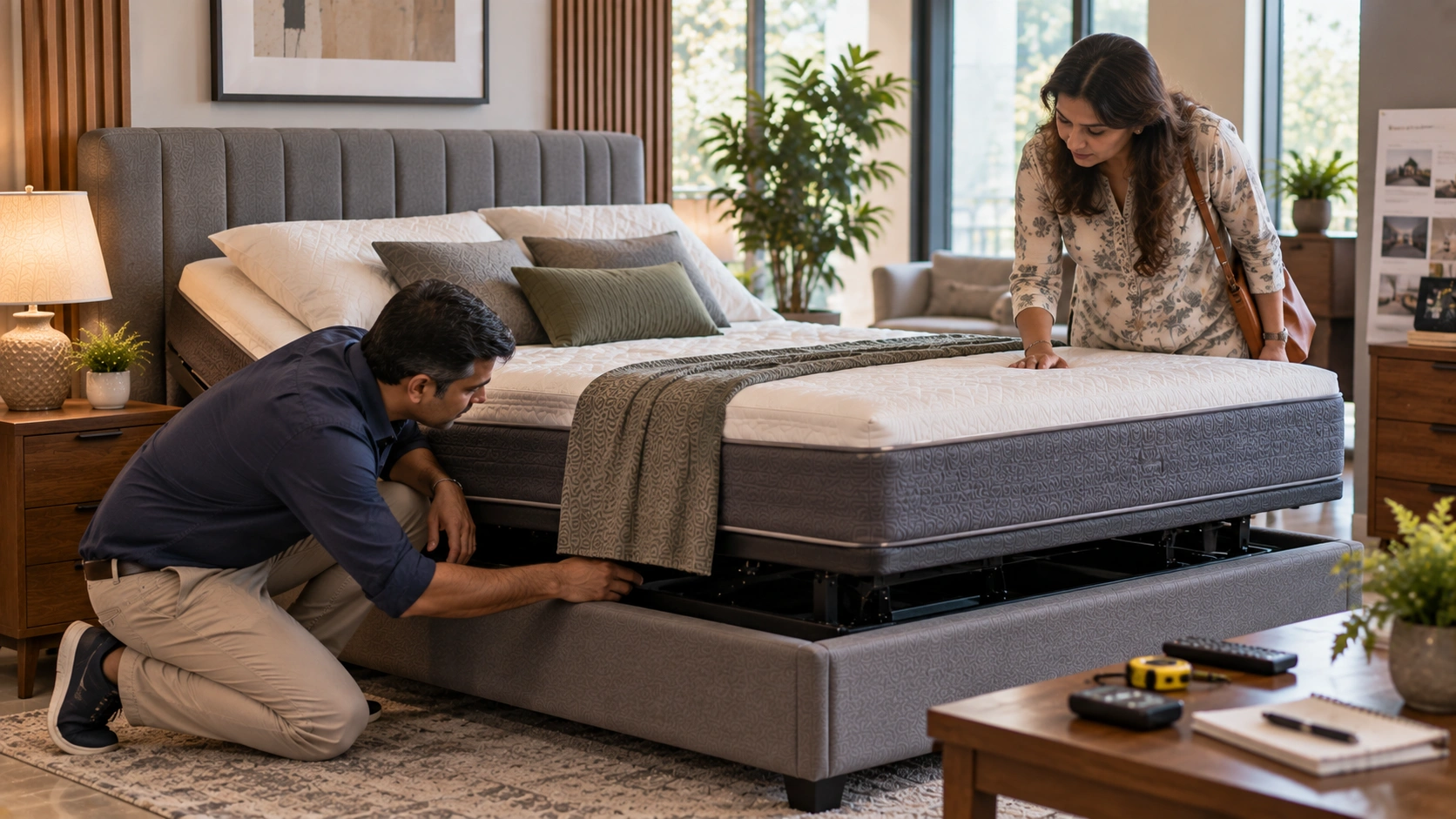

This blog explains the best sleeping positions for people with COPD and how raising the upper body may improve comfort. It also explains how adjustable beds can make sleeping easier and support better positioning.
This guide is general information about sleeping positions, breathing comfort and adjustable beds. It is not medical advice and should not be used to replace COPD treatment or a doctor’s recommendations.
If breathing difficulty is new, suddenly worse, or severe, seek medical attention rather than relying on a change in sleeping position.
If lying flat makes breathing feel uncomfortable, you may naturally find yourself adding pillows, sleeping partly upright or moving into a recliner.
This is not unusual in people who experience breathing difficulty while lying down. COPD can affect sleep quality, and nighttime symptoms can make finding a comfortable sleeping position particularly important.
So, what is the best bed position for COPD?
There isn’t one fixed angle that works for everyone. For many people, a comfortably elevated upper body can be preferable to lying completely flat, while some may be more comfortable on their side or in another supported position.
The key is finding a position that feels stable, keeps the body well supported and follows the individual’s medical advice.
This guide explains the practical positions worth trying, how an adjustable bed can make positioning easier, which features actually matter and the mistakes to avoid when choosing a bed for someone with breathing difficulty.
Talk to a comfort advisor — free, no obligation. Call or WhatsApp: +91 9820138189. Tell us what positioning or home-care requirements you have and we’ll help you understand the right adjustable-bed options. Email: info@zerogbeds.com
Why Can Lying Flat Feel Difficult for Someone With COPD?
COPD affects airflow and may cause symptoms such as breathlessness, coughing, mucus production and chest tightness.
Symptoms vary considerably from one person to another, so the sleeping position that feels comfortable for one person may not work for another.
When someone finds breathing harder while lying down, they may instinctively raise their head with pillows or move into a more upright position.
This is one reason people searching for an adjustable bed for patients at home often focus first on head elevation rather than on the number of features the bed offers.
The objective should be simple: find a supported position that makes resting comfortable without creating unnecessary pressure on the neck, hips or lower back.
An adjustable bed can help because the sleeping surface itself changes position. Instead of building an incline with several pillows, the head and upper-body section can be raised gradually using a remote.
What Is the Best Bed Position for COPD?
There is no universally prescribed “best” sleeping angle for every person with COPD.
A practical starting point for someone who finds lying flat uncomfortable is a gentle upper-body elevation.
Some clinical positioning guidance also notes that spontaneously breathing people with COPD may be positioned according to individual preference because the respiratory effects of a specific elevated angle are not sufficiently established to recommend one fixed position for everyone.
That distinction matters. An adjustable bed should allow the person to find and reproduce a comfortable position, rather than forcing everyone into the same preset.
- Slight Upper-Body Elevation
Start by raising the upper body slightly and allow the person to settle into the position.
If breathing feels more comfortable and the neck and shoulders remain relaxed, the position may be suitable for resting.
There is no need to immediately raise the bed to its maximum angle. A smaller elevation may be enough.
- Semi-Upright Position
Some people prefer a more noticeable elevation, particularly if lying flat consistently causes discomfort.
The torso should be supported rather than simply bending the neck forward. The pillow should complement the elevated mattress rather than create the entire incline.
- Side Sleeping With Support
Side sleeping may also be comfortable for some people. A pillow that keeps the head aligned with the spine can help, while a pillow between the knees may improve stability.
There is no need to force someone with COPD into a particular side if another position is more comfortable. Individual preference matters.
- Supported Sitting Position During Breathlessness
When someone is acutely breathless, an upright or forward-leaning position with the arms supported may sometimes feel easier.
Respiratory services commonly teach “positions of ease” that involve sitting upright and supporting the arms.
This is different from saying that a particular sleeping position treats COPD. These positions are simply ways of supporting the body during episodes of breathlessness.
How Can an Adjustable Bed Help With COPD Sleeping Position?
An adjustable bed’s biggest advantage in this situation is repeatable positioning.
With a conventional mattress, someone may need to arrange several pillows to create an incline.
The pillows can move during the night, compress under body weight or create an uneven transition between the head and shoulders.
An adjustable bed raises the supporting surface itself.
This makes it easier to:
- Raise the upper body without stacking pillows
- Change position during the night
- Move from sleeping to sitting or reading
- Adjust the bed without getting out
- Reproduce a comfortable position
- Assist someone who has limited mobility
Existing Zero G Beds content also explains how adjustable positioning can support different sleep preferences and comfort requirements.
Our guide on how adjustable beds can improve sleep quality provides additional information about positioning, support and everyday sleep comfort.
For someone who needs frequent positioning changes, Hospital Adjustable Beds can therefore be considered for convenience and accessibility, not because the bed itself treats the underlying lung condition.
Need help choosing the right configuration? Call or WhatsApp +91 9820138189 or email info@zerogbeds.com for guidance.
Should You Use Zero Gravity Position for COPD?
Zero Gravity position raises both the upper body and legs, creating a reclined posture rather than simply lifting the head.
It can be comfortable for some people, but it should not automatically be considered the best position for COPD.
A person who mainly wants upper-body elevation may prefer raising only the head section. Someone else may find that raising the legs as well provides better overall support.
The important question is: Does the position feel comfortable and allow the person to rest without creating other problems?
Zero G Beds already has detailed information explaining how the position works. Read about the Zero Gravity sleeping position if you want to understand the mechanics and intended comfort benefits of the position.
More recent Zero G Beds content also discusses the difference between genuine positioning benefits and exaggerated marketing claims around Zero Gravity, which is useful when comparing adjustable beds.
How Should You Adjust an Adjustable Bed for COPD?
Rather than choosing a position based on a number printed on the remote, use a gradual approach.
Start with a low elevation
Begin with the bed relatively close to flat and raise the upper body slowly.
Check breathing comfort
Ask the person whether breathing feels easier, the same or more difficult.
Check the neck and shoulders
The head should not be pushed sharply forward by an oversized pillow.
Adjust the legs if needed
A small amount of knee elevation can sometimes make an inclined position feel more stable.
Spend time in the position
Don’t judge a position after only a few seconds. Sit or rest in it long enough to determine whether it actually feels comfortable.
Save the setting if available
If the adjustable bed has programmable positions, saving a preferred resting position can make nighttime use easier.
The goal isn’t to find a “perfect COPD setting.” It is to create a comfortable, repeatable position that works for the individual.
Adjustable Bed vs. Pillows for Breathing Difficulty
Pillows are inexpensive and can be useful for testing whether elevation feels comfortable.
However, they have limitations.
A person may need several pillows to create enough elevation, and the arrangement can shift while sleeping. A large stack can also create excessive neck flexion rather than supporting the entire upper body.
An adjustable bed changes the angle beneath the body, allowing the torso to be elevated as a unit.
That does not mean everyone with COPD needs an adjustable bed. If a person sleeps comfortably with their existing setup, there may be no reason to change it.
The stronger case for an adjustable bed is when positioning needs to be changed frequently, pillows are difficult to manage or the person has mobility limitations.
What Features Matter When Choosing an Adjustable Bed for COPD?
Don’t choose a bed simply because it has the longest feature list.
Easy remote control
A simple remote is particularly valuable when the user is older or has limited hand strength.
Smooth motor movement
The bed should adjust steadily without abrupt movement.
Adequate upper-body elevation
The head section should offer enough adjustment range for the user’s preferred position.
Suitable mattress
The mattress must be designed or approved for use with the specific adjustable mechanism.
Correct weight capacity
Always confirm the rated capacity for the exact model rather than relying on a generic figure.
Appropriate bed height
Getting into and out of bed can be just as important as sleeping comfort, particularly for seniors and patients with limited mobility.
Reliable after-sales service
For a motorised bed, warranty and service support matter because the bed may become part of everyday home care.
If you’re comparing an adjustable bed for patients at home, these practical considerations should come before features such as massage, app connectivity or unnecessary smart functions.
Common Mistakes People Make When Choosing a Bed for COPD
Choosing the highest possible position
More elevation isn’t automatically better. The person may become uncomfortable or unstable.
Using too many pillows
A pillow should support the head, not create the entire incline.
Assuming Zero Gravity is medically required
Zero Gravity is a positioning feature, not a COPD treatment.
Buying based only on motor count
More motors don’t automatically mean a better bed. Ease of use, stability and appropriate positioning matter more.
Ignoring mattress compatibility
An incompatible mattress can restrict the movement of the adjustable platform.
Forgetting caregiver needs
If someone else will operate the bed, the controls should be simple and accessible.
Treating breathing problems as a bed problem
A bed can change positioning, but persistent or worsening breathlessness needs medical assessment.
Can an Adjustable Bed Replace COPD Treatment?
No.
This is one of the most important points when researching an Adjustable Bed For Patient use.
COPD requires appropriate medical assessment and management. Depending on the person, treatment can include prescribed medicines, inhalers, pulmonary rehabilitation, oxygen therapy and other interventions.
An adjustable bed only changes the person’s position.
It may help someone find a more comfortable sleeping or resting posture, but it should never be promoted as a cure for COPD.
People with COPD should also discuss persistent nighttime symptoms with their healthcare professional. Sleep problems and nighttime oxygen desaturation can be relevant parts of COPD management.
When Should You Consider an Adjustable Bed for Someone With COPD?
An adjustable bed may be worth considering if:
- Lying flat consistently feels uncomfortable
- The person prefers sleeping with the upper body raised
- Pillows keep moving or becoming uncomfortable
- The person changes position frequently
- Getting out of bed is difficult
- A caregiver needs to assist with positioning
- The bed will also be used for daytime resting
- The user wants easier control over head and leg elevation
If the family already owns a suitable bed frame, replacing the entire setup may not always be the only option.
Depending on the construction and compatibility of the existing furniture, an adjustable base or conversion solution may be possible.
For families exploring that route, our guide to converting a standard bed into an adjustable bed for home care explains the basic options and considerations.
Want to know whether an existing bed can be adapted? Call/WhatsApp +91 9820138189 or email info@zerogbeds.com.
What Should Caregivers Check Before Buying?
If the bed is being purchased for someone else, involve the caregiver in the decision.
Ask:
| Question | Why It Matters |
| Who will operate the remote? | Determines how simple the controls need to be |
| Does the person need help changing position? | May influence bed and remote features |
| How often will the position change? | Helps determine the importance of motorised adjustment |
| Will the bed be used during the day? | Reclining and sitting functions become more important |
| Can the person safely get in and out? | Bed height and accessibility matter |
| Is the mattress compatible? | Prevents poor movement and premature wear |
| Is the weight rating suitable? | Important for safe operation |
| What happens if the motor fails? | Warranty and service support become important |
For a patient receiving home care, the best bed is rarely the one with the most specifications. It is the one that fits the person, room, caregiver routine and positioning requirements.
Why Choose Zero G Beds for Adjustable Positioning?
Zero G Beds offers adjustable-bed solutions for home comfort, senior care and patient positioning.
When choosing a bed for someone with breathing difficulty, the configuration should be based on the person’s actual requirements rather than simply selecting a model because it has more functions.
Zero G Beds provides:
- Adjustable positioning for personalised comfort
- Remote-controlled operation
- Solutions for home-care and patient requirements
- Mattress and configuration guidance
- Professional delivery and installation
- Product demonstration by trained technicians
- After-sales assistance
- 15-year warranty
- CE-certified adjustable bed systems
- Experience serving families in India since 2003
If you’re unsure whether you need a simple adjustable bed, a patient-focused solution or a more advanced configuration, call or WhatsApp +91 9820138189.
You can also email info@zerogbeds.com with the user’s requirements, room situation and preferred features for guidance.
Quick Checklist for Choosing a COPD-Friendly Sleeping Setup
Before buying or changing the sleeping setup, check:
- Upper-body elevation is comfortable
- Neck remains properly supported
- The person can breathe comfortably in the selected position
- Mattress is compatible with the adjustable bed
- Remote control is easy to use
- Weight capacity is suitable
- Bed height works for the user
- Caregiver can operate the bed if necessary
- Preferred position can be reproduced easily
- Medical advice is followed for individual health needs
- The bed is being used for positioning and comfort, not as COPD treatment
Get Help Choosing the Right Adjustable Bed
The right adjustable bed for patients at home should make positioning easier without making the setup unnecessarily complicated.
For someone with COPD, start with comfort and practicality. A gently elevated upper body may be more comfortable than lying completely flat, but there is no single angle or configuration that applies to everyone.
Consider the person’s preferred position, mobility, mattress, room, caregiver requirements and ability to operate the remote.
And if breathing difficulty is new, worsening or severe, contact a healthcare professional rather than attempting to solve the problem by changing the bed position alone.
Talk to Zero G Beds for personalised bed guidance. Call/WhatsApp: +91 9820138189 | Email: info@zerogbeds.com
The Bottom Line
The best bed position for COPD is the position that allows the individual to rest comfortably while maintaining appropriate support and following their healthcare professional’s advice.
For people who find lying flat uncomfortable, upper-body elevation can be a practical starting point. Side sleeping or other supported positions may work better for others.
An adjustable bed makes these changes easier because the sleeping surface can be adjusted without repeatedly rebuilding a pillow arrangement.
The important thing is not to chase a particular angle or feature. Focus on comfortable positioning, simple controls, reliable movement, mattress compatibility and appropriate home-care support.
If you’re considering an adjustable bed for yourself or a family member, Call/WhatsApp +91 9820138189 or email info@zerogbeds.com for help choosing a configuration based on your requirements.
References
- American Lung Association — COPD Symptoms & Diagnosis.
- American Lung Association — COPD Action Plan & Management Tools.
- Indian Chest Society / National College of Chest Physicians — Guidelines for diagnosis and management of COPD in India.
- Mersey Care NHS Foundation Trust — Positions of ease and breathing techniques for COPD.
- Cambridge University Hospitals — Breathing techniques to ease breathlessness.
- MedlinePlus — Breathing difficulty when lying down.