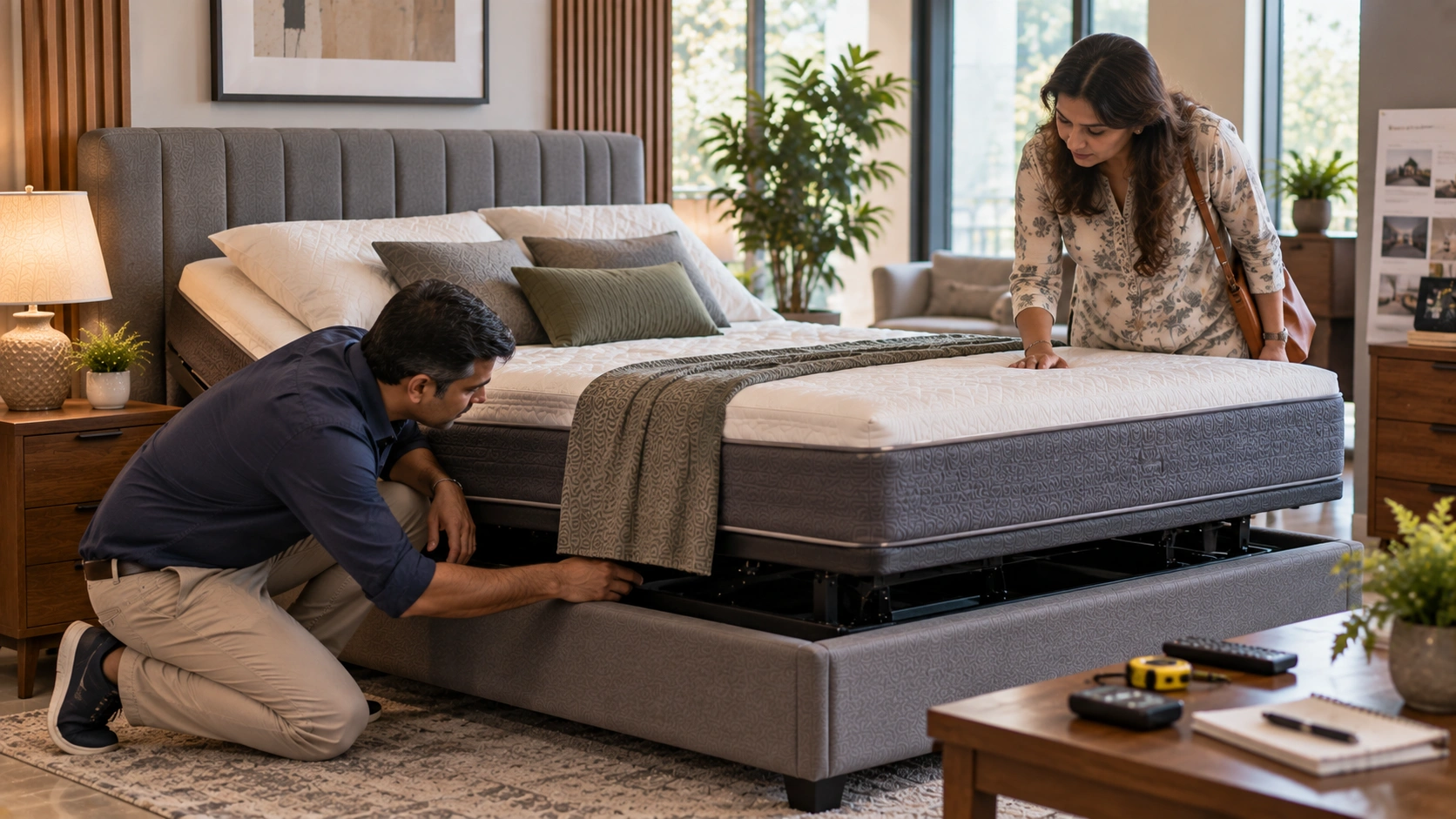

A motorised adjustable bed is designed to make positioning easier, but remote, power and motor problems can become frustrating when the bed stops responding or moves unexpectedly. Most issues have simple causes such as a disconnected power supply, weak remote batteries, loose cables or an overloaded mechanism.
This guide explains the most common adjustable-bed remote and motor problems, what you can safely check at home.
When you should stop troubleshooting and contact a technician, and how regular maintenance can reduce future problems.
This guide is general information about adjustable-bed operation and troubleshooting. It is not a substitute for the manufacturer’s instructions, electrical safety guidance or professional servicing.
If the bed is making unusual electrical noises, producing a burning smell, showing damaged wiring or moving unpredictably, disconnect the power if it is safe to do so and contact the manufacturer or a qualified technician.
Talk to a comfort advisor — free, no obligation. Call or WhatsApp: +91 9820138189. Tell us about the problem you’re experiencing and we’ll help you understand the next step. Email: info@zerogbeds.com
Why Is My Adjustable Bed Not Moving?
When an adjustable bed suddenly stops moving, it is tempting to assume that the motor has failed.
That isn’t necessarily the case.
The problem may be caused by:
- Power supply interruption
- Loose power connections
- Remote-control batteries
- Remote pairing or signal problems
- Cable connections
- Obstructions under the bed
- Excessive load on the mechanism
- A motor that has overheated
- Mechanical wear
- A damaged handset or control unit
Before assuming that you need a replacement motor, work through the basic checks first.
For a patient using an electric bed for patients, this is particularly important because unnecessary movement or repeated troubleshooting attempts can create additional safety risks.
- Check Whether the Bed Has Power
The first troubleshooting step is surprisingly simple: check the power supply.
Make sure the power cable is properly connected to the bed’s control unit and that the wall socket is working.
Try another suitable electrical appliance in the same socket to confirm that the outlet is supplying power.
Also check whether:
- The power cable has been pulled or stretched
- The plug is partially disconnected
- A switch near the socket has been turned off
- The cable is trapped beneath the bed
- An extension connection has become loose
Do not continue using a damaged power cable.
If the cable has exposed wires, cuts, melting or other visible damage, stop using the bed and contact the manufacturer or a qualified technician.
- Check the Remote Control Batteries
A remote that suddenly stops responding does not necessarily mean the bed has a motor problem.
Weak or completely discharged batteries are one of the easiest issues to eliminate.
Check whether the remote:
- Has a display that is no longer working
- Responds intermittently
- Requires repeated button presses
- Works only from certain positions
- Has recently been dropped or exposed to moisture
Replace the batteries with the correct type specified by the manufacturer.
If the remote still does not work after replacing the batteries, avoid repeatedly pressing every button. The problem may involve the remote, receiver, control box or connection rather than the battery itself.
A simple remote control bed for patient should allow the user or caregiver to operate the required functions without excessive force or repeated attempts.
- Check the Remote Connection or Pairing
Some adjustable beds use wired remotes, while others may use wireless remotes or additional mobile controls.
For a wired remote, inspect the connection between the handset and the control box.
For a wireless remote, the remote may need to be paired with the bed’s receiver according to the manufacturer’s instructions.
Do not randomly unplug and reconnect every cable while the bed is powered.
Instead, follow the specific instructions supplied with your model.
If you have lost the manual, contact the manufacturer before attempting a reset or reconfiguration.
- What If the Head Works but the Legs Do Not?
A common troubleshooting situation is that one section of the bed moves while another does not.
For example:
- Head section moves but legs don’t
- Legs move but head doesn’t
- One side moves but the other does not
- Bed moves upward but not downward
- One motor makes a sound but the section doesn’t move
These symptoms can point towards a problem with a particular motor, connection, control channel or mechanical component.
First check whether anything is physically blocking the affected section.
Look underneath the bed for:
- Cables
- Bedding
- Storage items
- Furniture
- Objects placed under the frame
- Anything caught around a moving component
Never put your hands into moving mechanisms while the bed is operating.
If the problem remains after checking for an obvious obstruction, professional inspection is safer than repeatedly activating the motor.
For families using an electric hospital bed, this is particularly important because the bed may be used multiple times throughout the day for patient positioning.
- Why Is My Adjustable Bed Making Noise?
Some motor noise during movement can be normal.
An adjustable bed contains motors and moving mechanical components, so completely silent operation should not necessarily be expected.
However, a sudden change in sound can be worth investigating.
Pay attention to sounds such as:
- Grinding
- Repeated clicking
- Loud knocking
- Scraping
- Unusual vibration
- Motor humming without movement
A motor that makes a sound but doesn’t move the bed may require professional inspection.
Similarly, if the bed suddenly becomes much louder than it was previously, don’t ignore the change.
Regular inspection can help identify developing problems before they become complete failures.
Zero G Beds’ earlier maintenance guidance also recommends checking electrical components, wiring and moving parts as part of keeping an adjustable bed in good working condition. How to Take Care of an Adjustable Bed
- What If the Motor Stops During Adjustment?
An adjustable-bed motor may stop because of an electrical, mechanical or load-related issue.
If the motor stops suddenly:
- Stop pressing the remote.
- Check whether the bed has power.
- Look for an obstruction.
- Allow the system to cool if the manufacturer permits this.
- Check the remote batteries.
- Check visible cable connections.
- Follow the manufacturer’s troubleshooting instructions.
- Contact service if the problem continues.
Avoid repeatedly holding the button down when the bed isn’t moving.
A motor that is already struggling should not be forced through repeated commands.
If the bed is being used as an electric bed for patients, caregivers should also make sure the patient remains in a safe position while troubleshooting.
If the bed has stopped in an awkward position and the patient cannot safely remain there, contact the manufacturer’s support team for guidance rather than attempting to manually force the mechanism.
- Why Is the Adjustable Bed Moving Slowly?
Slow movement can have several causes.
The first possibility is that the motor is under unusual load.
The second may be a mechanical issue.
Other possibilities include:
- Power-related problems
- Motor wear
- Obstruction
- Excessive weight
- Mechanical resistance
- Component deterioration
Do not automatically assume that a slow motor needs replacement.
A technician can determine whether the problem is electrical, mechanical or related to the load placed on the bed.
The manufacturer’s rated weight capacity should always be followed. The capacity of one adjustable bed cannot automatically be applied to another model.
- What If the Bed Moves but Stops at One Position?
If the bed consistently stops at approximately the same position, there may be an obstruction or a problem with the mechanism or control system.
Check whether the mattress, bedding or surrounding furniture is restricting movement.
Also consider whether the bed has reached a designed movement limit.
Adjustable beds are engineered to move through specific ranges. Trying to force the bed beyond those limits can damage the mechanism.
If the bed repeatedly stops at an unusual point even when nothing is blocking it, contact the manufacturer.
- Remote Works but the Motor Doesn’t
This is one of the more useful symptoms to identify.
If the remote lights up or appears to function but the bed does not respond, the issue may be somewhere between the handset and motor.
Possible causes include:
- Control-box issue
- Motor connection problem
- Power supply issue
- Damaged cable
- Motor failure
- Internal electronic fault
Do not open the motor housing or control box unless you are specifically qualified and authorised to do so.
Electrical components should be inspected by an appropriate technician.
This is especially important with a remote control bed for patient use because the equipment may be supporting someone with limited mobility.
- What If the Bed Moves Without Pressing the Remote?
Unexpected movement should not be treated as a minor inconvenience.
Stop using the affected function until the cause has been identified.
Possible causes could include:
- Faulty handset
- Damaged buttons
- Wireless-control problem
- Electrical fault
- Control-system issue
If the bed moves without a command, disconnect power only if doing so is safe and practical, then contact the manufacturer or service provider.
Do not continue using the bed simply because it eventually returns to normal.
Unexpected movement can create a safety risk for patients, seniors and anyone with limited mobility.
How Can You Prevent Remote and Motor Problems?
Prevention is usually easier than dealing with a complete motor failure.
Simple habits can make a difference.
Keep the Remote Dry
Do not leave the handset where it can be exposed to water, cleaning liquids or excessive humidity.
Keep it within easy reach but away from children or pets who may accidentally activate the controls.
Keep Cables Clear
Power and motor cables should not be trapped beneath the bed or repeatedly pulled during adjustment.
Make sure cables have enough room to move without becoming stretched.
Don’t Block the Moving Sections
Check underneath the bed periodically.
Objects stored beneath the frame can interfere with movement.
Don’t Overload the Bed
Always follow the manufacturer’s specified weight capacity.
Do not assume that because the bed physically moves with a particular load, that load is automatically within the safe rated capacity.
Don’t Sit on Unsupported Sections
Avoid placing unnecessary concentrated weight on the foot section or other parts of the bed while it is moving.
Keep the Bed Clean
Dust, moisture and inappropriate cleaning products can affect components over time.
For a more detailed maintenance approach, Zero G Beds also recommends regular cleaning, checking the frame and taking care around electrical components. How to Take Care of an Adjustable Bed
When Should You Stop Troubleshooting?
Not every adjustable-bed problem should be solved at home.
Stop troubleshooting and contact a qualified technician if you notice:
- Burning smell
- Smoke
- Sparks
- Exposed electrical wiring
- Damaged plugs
- Repeated electrical tripping
- Uncontrolled movement
- Severe grinding or knocking
- Motor overheating
- A bed that becomes unstable
- A patient who cannot be safely positioned
Never dismantle electrical components simply because a YouTube video suggests a quick fix.
A motorised bed is not just furniture. For someone dependent on the bed for daily positioning, it can become an important part of the home-care setup.
What Should You Tell the Service Technician?
You can make troubleshooting faster by recording exactly what happens.
Before calling, note:
Problem: What isn’t working?
Affected section: Head, legs, height or another function?
Remote: Does it light up or respond?
Sound: Is there a clicking, humming or grinding noise?
Power: Is the bed receiving power?
Movement: Does it move partially or not at all?
Timing: Did the issue start suddenly or gradually?
Recent changes: Was the bed moved, cleaned, relocated or overloaded?
If possible, take a short video of the problem without putting yourself or the patient at risk.
This information can help the technician understand whether the issue is likely to involve the remote, motor, control unit, wiring or mechanical assembly.
Does Regular Servicing Matter for an Electric Hospital Bed?
Yes.
Regular inspection can help identify worn cables, loose components, unusual motor sounds and mechanical problems before they become major failures.
Zero G Beds’ guidance on maintaining motorised hospital beds highlights checking power cords, remote wiring, mattress condition, moving mechanisms and other components as part of ongoing care. Top 5 Tips To Keep Motorised Hospital Bed Healthy For The Best Patient Care
The frequency of servicing should depend on the manufacturer’s recommendations and how frequently the bed is used.
A bed used every day for patient care may require more attention than one used occasionally.
Does the Adjustable Bed Need a Complete Replacement?
Not necessarily.
A remote that stops working does not automatically mean the complete bed needs replacement.
Depending on the model and fault, the affected component could potentially be serviced or replaced.
The same principle applies to motors and other components.
Before purchasing a new bed, ask the manufacturer:
- Is the remote replaceable?
- Are replacement motors available?
- Can the control unit be serviced?
- Are spare parts available?
- What does the warranty cover?
- Who provides after-sales service?
- What is the expected service response time?
These questions are particularly important when comparing an electric hospital bed for long-term home use.
How to Choose an Adjustable Bed With Easier Troubleshooting and Support
When purchasing a new adjustable bed, don’t look only at movement features.
Consider the ownership experience as well.
Simple Controls
A remote should be easy for both the patient and caregiver to understand.
Reliable Motors
Smooth and consistent movement is more important than simply having a large number of functions.
Accessible Service
Ask who will handle repairs if the remote or motor develops a problem.
Spare Parts Availability
A bed may have an excellent warranty, but replacement components should also be realistically available.
Clear Warranty Terms
Understand what is covered for motors, electronics, frame components and other parts.
Installation Support
Professional installation can reduce problems caused by incorrect assembly or connections.
Zero G Beds’ electric hospital bed safety guidance also highlights the importance of understanding controls, proper setup, maintenance and caregiver education when using motorised beds. How to Ensure Patient Safety with Electric Adjustable Beds
Quick Troubleshooting Checklist
Before contacting support, check:
- Is the power supply working?
- Is the power cable connected properly?
- Are the remote batteries working?
- Is the remote connection secure?
- Is anything blocking the moving sections?
- Are the cables free from damage?
- Is the bed within its rated weight capacity?
- Is the motor making an unusual sound?
- Does another function still work?
- Did the problem start suddenly or gradually?
- Is there any burning smell, smoke or sparking?
- Have you followed the manufacturer’s instructions?
If there is an electrical safety concern, stop using the bed rather than continuing the checklist.
Why Choose Zero G Beds for Adjustable Bed Support?
A reliable adjustable bed is about more than motorised movement. Long-term ownership also depends on installation, warranty, servicing and support.
Zero G Beds provides adjustable-bed solutions for home comfort, patient requirements and home care.
The company offers:
- Remote-controlled adjustable positioning
- Electric bed solutions for patients
- Home-care adjustable beds
- Professional delivery and installation
- Product demonstration by trained technicians
- After-sales assistance
- 15-year warranty
- CE-certified adjustable bed systems
- Customisation options
- Experience serving families in India since 2003
If you’re experiencing a remote or motor issue with your Zero G Beds product, contact the team before attempting repairs yourself.
Call or WhatsApp: +91 9820138189
Email: info@zerogbeds.com
Get Help With Your Adjustable Bed Problem
A remote that stops working or a motor that refuses to move can be frustrating, particularly when the bed is being used every day.
Start with the simple checks: power, batteries, cables, obstructions and the manufacturer’s instructions.
Don’t force a motor that isn’t moving, don’t dismantle electrical components without the required expertise and don’t continue using a bed that is behaving unpredictably.
For families using an adjustable bed for patients at home, reliable support is just as important as the original purchase.
Need help identifying an adjustable-bed issue? Call or WhatsApp +91 9820138189 or email info@zerogbeds.com.
The Bottom Line
Most adjustable-bed remote and motor problems don’t necessarily mean the entire bed has failed.
Start by checking the power supply, remote batteries, connections and possible obstructions. If the problem involves unusual noises, uncontrolled movement, damaged electrical components or a motor that repeatedly fails, professional inspection is the safer option.
When buying a new motorised bed, look beyond the feature list. Remote simplicity, motor reliability, spare-parts availability, warranty coverage, installation and after-sales support can have a much bigger impact on your ownership experience.
A well-maintained electric bed for patients should make daily positioning easier, not create another source of stress for the patient or caregiver.
If you need help with troubleshooting, servicing or choosing the right adjustable-bed configuration, Call/WhatsApp +91 9820138189 or email info@zerogbeds.com.
References
Zero G Beds — How to Take Care of an Adjustable Bed.
Zero G Beds — Top 5 Tips to Keep Motorised Hospital Bed Healthy for the Best Patient Care.
Zero G Beds — How to Ensure Patient Safety with Electric Adjustable Beds.
Zero G Beds — A Basic Guide for an Electric Hospital Bed.
Manufacturer’s operating and safety instructions should always take priority for model-specific troubleshooting.