
This guide explains how sleeping position and upper-body elevation may help improve nighttime comfort for people experiencing GERD or acid reflux. It is general information, not medical advice, and should not replace diagnosis, treatment or recommendations from a healthcare professional.
If you have severe or persistent symptoms, difficulty swallowing, unexplained weight loss, vomiting blood, black stools or chest pain, seek medical attention rather than relying on an adjustable bed or sleeping-position changes.
Acid reflux can become particularly frustrating at night. You may go to bed feeling fine, only to wake up with a burning sensation in your chest, a sour taste in your mouth or discomfort that makes it difficult to return to sleep.
For many people, lying completely flat can make nighttime reflux more noticeable.
So, can changing the sleeping position help?
For people whose GERD symptoms occur mainly at night, raising the upper body during sleep can help reduce reflux symptoms. The important distinction is that simply adding pillows under the head is not always the same as creating a proper upper-body incline.
This is where an adjustable bed can become useful.
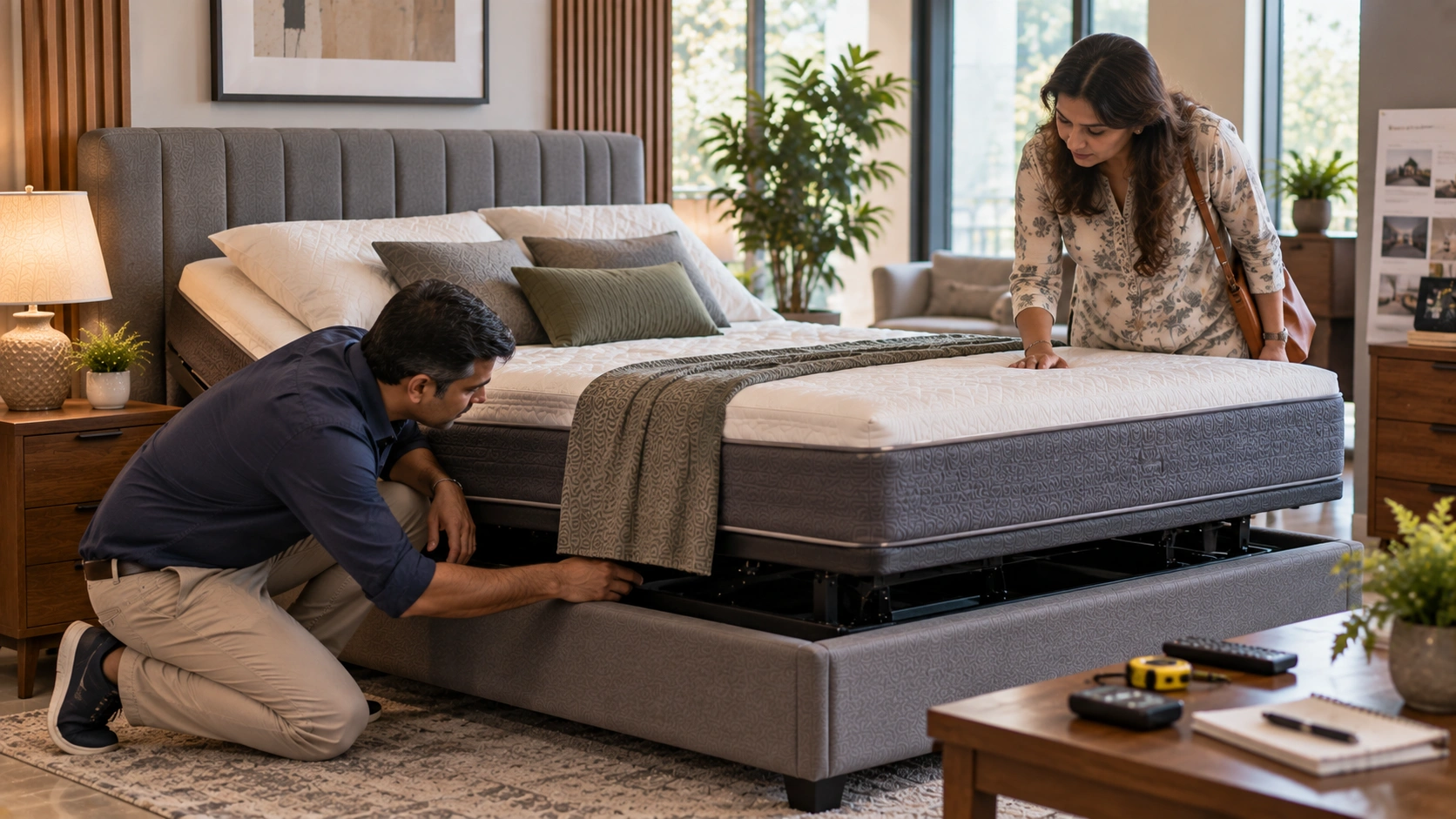
An adjustable bed allows the upper section of the sleeping surface to be raised gradually, creating an inclined position without requiring a large stack of pillows.
This guide explains why reflux can become worse when lying down, how to position an adjustable bed, whether Zero Gravity is suitable for GERD, which features matter and the common mistakes to avoid.
Talk to a comfort advisor — free, no obligation. Call or WhatsApp: +91 9820138189. Tell us what positioning or home-care requirements you have and we’ll help you understand the right adjustable-bed options. Email: info@zerogbeds.com
Why Can Acid Reflux Get Worse at Night?
GERD, or gastroesophageal reflux disease, occurs when stomach contents repeatedly flow back into the oesophagus.
That backflow can cause symptoms such as:
- Heartburn
- Regurgitation
- Sour or bitter taste
- Burning in the chest
- Difficulty sleeping
- Nighttime coughing or throat irritation in some people
One reason nighttime symptoms can be troublesome is simple gravity.
When you are upright during the day, gravity helps keep stomach contents lower. When you lie flat, that gravitational assistance is reduced, and reflux can become easier to experience.
The American College of Gastroenterology recommends elevating the head of the bed for patients with nighttime GERD symptoms. Importantly, its guideline distinguishes proper head-of-bed elevation from simply using extra pillows.
This is why someone researching an Adjustable Bed For Home may want to consider positioning as well as mattress comfort.
The purpose is not to make the bed extremely steep.
The objective is to create a comfortable incline that keeps the upper body elevated while allowing the person to sleep naturally.
What Is the Best Sleeping Position for GERD?
For nighttime GERD, elevating the upper body and sleeping on the left side are two commonly recommended strategies.
However, individual responses vary.
A practical setup may involve:
- Raising the upper body
- Keeping the head and torso supported
- Avoiding a completely flat position if it triggers symptoms
- Trying left-side sleeping if comfortable
- Avoiding large meals close to bedtime
The American College of Gastroenterology specifically suggests elevating the head of the bed and avoiding meals or snacks within three hours of bedtime for people with nighttime GERD symptoms.
An adjustable bed can make the first step significantly easier because the sleeping surface itself can be elevated.
- Gentle Upper-Body Elevation
Start by raising the head and upper-body section slightly.
You don’t necessarily need to use the highest available setting.
A gradual elevation can be easier to sleep with and may be more comfortable for the neck, shoulders and back.
The important thing is that the torso moves upward, rather than simply bending the neck with a large pillow.
If you are considering Electric Adjustable Beds, test how smoothly the head section moves and whether you can make small adjustments.
A useful adjustable bed should allow you to find a position rather than forcing you into one fixed angle.
- Left-Side Sleeping
Sleeping on the left side may help some people experience fewer reflux episodes than sleeping on the right side.
Research using objective reflux measurements has found that reflux episodes can be shorter and acid exposure lower in the left lateral position compared with the right lateral or supine position.
That does not mean everyone with GERD must sleep on the left side.
Comfort still matters.
If left-side sleeping causes shoulder, hip or other joint discomfort, forcing the position may make sleep worse overall.
An adjustable bed can complement side sleeping by providing upper-body elevation while the person remains on their preferred side.
- Avoid Sleeping Completely Flat If It Triggers Symptoms
Some people notice that their reflux becomes worse soon after lying down.
If this happens regularly, remaining completely flat may not be the most comfortable setup.
Instead of adding three or four pillows beneath the head, consider whether the entire upper body can be elevated.
This distinction is important.
A large pillow stack can lift the head while leaving the chest and torso relatively flat. It may also bend the neck forward.
An adjustable base changes the angle beneath the torso.
This can create a more consistent incline and reduce the need to constantly rearrange pillows.
How Does an Adjustable Bed Help With GERD?
An adjustable bed doesn’t stop the stomach from producing acid and does not cure GERD.
Its advantage is positioning.
With a flat bed, changing the sleeping angle generally requires pillows, wedges or physical repositioning.
With an adjustable bed, the user can raise or lower the upper section using a remote.
This makes it easier to:
- Elevate the upper body before sleeping
- Make small position changes
- Sit up for reading
- Return to a preferred sleeping position
- Adjust the bed without getting out
- Help a person with limited mobility change position
For someone who experiences reflux frequently at night, repeatable positioning can be more convenient than rebuilding a pillow arrangement every evening.
If you are comparing Hospital Adjustable Beds or patient-focused beds for someone who has multiple care requirements, upper-body elevation can also be considered alongside accessibility, bed height and ease of operation.
Need help comparing configurations? Call or WhatsApp +91 9820138189 or email info@zerogbeds.com.
Should You Use Zero Gravity Position for GERD?
This is where adjustable-bed marketing can sometimes become confusing.
The Zero Gravity position typically raises both the upper body and legs to create a reclined posture.
It can be comfortable for many people, but Zero Gravity should not automatically be considered the best position for GERD.
For reflux, the key positioning principle is upper-body elevation.
If raising the legs as well makes the person more comfortable, a Zero Gravity-style position may be useful. If the person prefers raising only the upper body, there is no reason to use the full Zero Gravity setting simply because the bed offers it.
Zero Gravity is a positioning option, not a treatment for GERD.
Zero G Beds has also covered the benefits of sleeping in the Zero Gravity position, including how the position changes the body’s posture.
The important thing is to distinguish comfort positioning from medical treatment.
Adjustable Bed vs. Wedge Pillow for Acid Reflux
A wedge pillow can be a useful option for someone who wants to test whether elevation improves nighttime reflux.
It is also significantly less expensive than purchasing an adjustable bed.
However, there are differences.
| Feature | Wedge Pillow | Adjustable Bed |
| Upper-body elevation | Yes | Yes |
| Adjustable angle | Limited | Yes |
| Easy position changes | Limited | Yes |
| Requires rearranging | Sometimes | No |
| Can lower flat during the day | No | Yes |
| Leg adjustment | No | Available on suitable models |
| Useful for sitting/reading | Somewhat | Yes |
| Initial cost | Generally lower | Generally higher |
The American College of Gastroenterology guideline specifically recommends elevating the head of the bed rather than relying on ordinary pillows for nighttime GERD.
This doesn’t mean an adjustable bed is necessary for everyone.
If a properly designed wedge provides comfortable elevation and the person sleeps well, there may be no reason to replace it.
An adjustable bed becomes more compelling when the user wants flexibility, repeatable positioning and easier transitions between sleeping, resting and sitting.
How High Should an Adjustable Bed Be for GERD?
There isn’t one universally appropriate adjustable-bed angle for every person.
This is an area where people often search for a precise number, but comfort, mattress configuration, body position and individual symptoms all matter.
Instead of choosing a setting because it is labelled “GERD position,” start conservatively.
Start With Moderate Elevation
Raise the upper body gradually.
Check the Whole Torso
The incline should support the torso rather than sharply bending the neck.
Make Small Adjustments
If symptoms continue, adjust gradually rather than immediately moving to the maximum setting.
Check Sleeping Comfort
The position should still allow you to sleep comfortably.
Try Side Sleeping
If you are comfortable sleeping on your side, experiment with left-side sleeping while maintaining appropriate upper-body support.
Reproduce the Position
If a particular configuration feels comfortable, use a programmable preset if the bed provides one.
The objective is consistent, comfortable elevation, not reaching a particular number on the remote.
What Features Matter When Choosing an Adjustable Bed for GERD?
You don’t need every available feature.
Focus on the functions that directly affect positioning.
Smooth Head Elevation
The upper section should move steadily so you can make small adjustments.
Simple Remote Control
A straightforward remote makes nighttime adjustments easier.
Programmable Positions
Useful if you have a preferred sleeping position and don’t want to manually recreate it every night.
Suitable Mattress
The mattress should be compatible with the specific adjustable mechanism.
Independent Adjustment
For couples, independent adjustment can be valuable if one person needs elevation while the other prefers a flatter position.
Appropriate Bed Height
If the bed is also being used by an older adult or someone with mobility limitations, getting in and out safely matters.
Reliable Motor and Warranty
A motorised bed is a long-term purchase, so motor reliability, warranty coverage and after-sales support should be part of the decision.
If you’re comparing an Electric Bed For Patients, don’t focus only on motor count or headline features. Look at how easily the actual user can control and use the bed.
What Lifestyle Changes Can Help Nighttime Acid Reflux?
An adjustable bed works best when combined with appropriate lifestyle and medical management.
The American College of Gastroenterology recommends avoiding meals within two to three hours of bedtime for people with nighttime GERD symptoms, while other guidance recommends a similar three-hour interval.
Depending on your individual triggers, useful measures may include:
- Avoiding large meals close to bedtime
- Identifying foods that consistently trigger symptoms
- Maintaining a healthy weight if recommended
- Avoiding smoking
- Limiting alcohol if it worsens symptoms
- Elevating the upper body during sleep
- Following prescribed GERD treatment
Don’t assume that changing your bed position can compensate for habits or treatment that need attention.
Common Mistakes When Using an Adjustable Bed for GERD
Raising Only the Head With Pillows
A large pillow stack can bend the neck instead of creating a consistent upper-body incline.
Choosing the Highest Possible Angle
More elevation isn’t automatically more effective or more comfortable.
Assuming Zero Gravity Is Required
Zero Gravity raises the legs as well, while the key consideration for reflux is upper-body elevation.
Eating a Large Meal Before Bed
A bed cannot compensate for eating immediately before lying down.
Ignoring Mattress Compatibility
An unsuitable mattress can restrict movement and reduce comfort.
Buying Based Only on Features
Massage, app control and other smart features may be useful, but they aren’t the reason an adjustable bed is relevant to nighttime reflux.
Treating the Bed as a Cure
An adjustable bed changes positioning. It doesn’t cure GERD or address its underlying cause.
Can an Adjustable Bed Cure Acid Reflux?
No.
This is one of the most important distinctions to understand when researching an adjustable bed for GERD.
Elevating the upper body can help reduce nighttime reflux symptoms for some people, but it does not eliminate the underlying condition.
GERD can require lifestyle changes, medication or further medical evaluation depending on the severity and cause.
If symptoms occur frequently, interfere with sleep or continue despite lifestyle changes, speak with a healthcare professional.
If you experience chest pain, particularly with shortness of breath or pain spreading to the jaw or arm, seek urgent medical attention rather than assuming it is acid reflux.
When Should You Consider an Adjustable Bed for GERD?
An adjustable bed may be worth considering if:
- Reflux regularly occurs after lying down
- You find sleeping flat uncomfortable
- You prefer sleeping with your upper body elevated
- Pillows frequently move during the night
- You want to change positions without getting out of bed
- You also need the bed for reading or daytime resting
- You have mobility limitations
- You share the bed and need independent positioning
- You want a repeatable elevation setting
It may not be necessary if your reflux is occasional and your current sleeping setup already provides adequate comfort.
The decision should be based on frequency of symptoms, positioning requirements and everyday usability, not simply the fact that adjustable beds can elevate.
What Should Couples Consider?
GERD can become more complicated when two people share a bed.
One person may want the upper body elevated while the other prefers sleeping completely flat.
In this situation, an adjustable bed with independent sides can be useful.
Before purchasing, check whether the model provides genuine independent adjustment and whether the mattress configuration supports that setup.
The goal is to avoid creating a situation where one person’s comfort requires changing the entire bed position for both people.
Why Choose Zero G Beds for Adjustable Positioning?
Zero G Beds offers adjustable-bed solutions for home comfort, senior care and patient requirements.
For people considering an adjustable bed because of nighttime reflux, the important factors are reliable upper-body positioning, simple operation, appropriate mattress compatibility and dependable after-sales support.
Zero G Beds provides:
- Adjustable head and leg positioning
- Remote-controlled operation
- Home-care and patient-focused solutions
- Mattress and configuration guidance
- Professional delivery and installation
- Product demonstration by trained technicians
- After-sales assistance
- 15-year warranty
- CE-certified adjustable bed systems
- Experience serving families in India since 2003
Need help choosing the right configuration? Call or WhatsApp +91 9820138189 or email info@zerogbeds.com.
Quick Checklist for a GERD-Friendly Sleeping Setup
Before changing your sleeping arrangement, check:
- Is lying completely flat triggering symptoms?
- Can the upper body be comfortably elevated?
- Does the torso remain properly supported?
- Is the neck in a comfortable position?
- Have you tried left-side sleeping if comfortable?
- Are large meals being avoided close to bedtime?
- Is the mattress compatible with the adjustable bed?
- Is the remote simple to operate?
- Can the preferred position be reproduced?
- Does the bed work for both partners if sharing?
- Are persistent symptoms being discussed with a healthcare professional?
Get Help Choosing the Right Adjustable Bed
If nighttime reflux is affecting sleep, the goal isn’t to find the most expensive bed or the highest elevation.
Start with the simplest question:
Does raising the upper body make resting more comfortable?
If it does, an adjustable bed can provide a convenient way to create and reproduce that position without repeatedly arranging pillows.
Consider the person’s sleeping position, mattress, mobility, room, partner requirements and frequency of adjustment before choosing a model.
Talk to Zero G Beds for personalised guidance. Call/WhatsApp: +91 9820138189 | Email: info@zerogbeds.com
The Bottom Line
Managing nighttime GERD isn’t simply about buying an adjustable bed.
For people whose reflux becomes worse when lying flat, upper-body elevation can be a useful part of a broader nighttime strategy. Left-side sleeping may also help some people, while avoiding meals close to bedtime can reduce the likelihood of nighttime symptoms.
An adjustable bed makes elevation easier because the sleeping surface itself can be changed rather than relying entirely on pillows.
There is no single angle that works for everyone. Start with comfortable, moderate elevation, make small adjustments and follow appropriate medical advice.
If symptoms are frequent, severe or persistent, address the underlying GERD with a healthcare professional rather than relying on positioning alone.
If you’re considering an adjustable bed for yourself or a family member, call/WhatsApp +91 9820138189 or email info@zerogbeds.com for help choosing a configuration based on your requirements.
References
- American College of Gastroenterology — Clinical Guideline for the Diagnosis and Management of Gastroesophageal Reflux Disease.
- American Gastroenterological Association — Clinical Practice Update on GERD.
- National Library of Medicine / PMC — Systematic evidence on body position and gastroesophageal reflux.
- NIDDK — Treatment for GER and GERD.