
This guide is general information to help families make informed decisions. It isn’t medical advice — please check anything specific to a health condition with a doctor, and confirm the rated specifications of any bed before you buy.
An adjustable bed isn’t just for hospitals or elderly relatives anymore — for a lot of Indian families, it’s becoming the practical answer to a handful of everyday, unglamorous problems: a partner who snores, a back that aches by evening, heartburn that shows up the moment you lie flat, or simply wanting a proper reading and TV-watching position that doesn’t collapse into a pillow fort by 10 p.m.
This guide walks through choosing the right adjustable bed for home and what an adjustable bed actually does, who it makes the most sense for, how to choose the right one for an Indian home, and what shapes the price — written plainly, without assuming you already know the jargon.
Talk to a comfort advisor — free, no obligation. Call or WhatsApp: +91 9820138189 Tell us what you’re hoping to fix and we’ll recommend the right bed.
What Is an Adjustable Bed?
An adjustable bed lets you raise or lower the head and foot sections independently — usually with a remote, sometimes with an app or voice control — instead of being stuck with a single flat sleeping surface. Some are stand-alone frames; others are retrofit systems that slot a motorised mechanism into a wooden bed you already own, so the room keeps its normal look.
The point isn’t to make your bedroom look clinical. It’s to let the bed adapt to what you’re actually doing in it — sleeping, reading, watching TV, working, or simply resting — rather than asking your body to adapt to one fixed shape all night.
Why Indian Families Are Choosing Adjustable Beds for Home
Better sleep and everyday back comfort
A flat mattress puts even, unsupported weight across your entire back, which is fine for some people and genuinely uncomfortable for others — especially with age, a desk job, or a history of back strain. Raising the head and knees slightly, or using a full recline position, spreads body weight more evenly and takes pressure off the lower back. It’s a simple mechanical change, but for people who’ve spent months layering pillows to get comfortable, it tends to make a noticeable difference within the first week.
Snoring relief for you or your partner
Snoring happens when the soft tissue at the back of the throat relaxes and narrows the airway — and lying flat on the back makes this worse, since gravity pulls that tissue backward. Raising the head and upper body is a recognised, non-invasive way to reduce positional snoring, by helping keep the airway more open. (Head-of-bed elevation and positional therapy for snoring — systematic review, NCBI) It’s worth being clear that this helps with snoring linked to sleeping position specifically — it isn’t a fix for every cause, and loud snoring with gasping or long pauses in breathing is worth discussing with a doctor, since it can be a sign of sleep apnea.
Easing acid reflux and heartburn at night
If lying flat brings on heartburn or a sour taste at the back of the throat, you’re not imagining it — a flat position makes it easier for stomach acid to travel backward. Raising the head of the bed is a well-established, drug-free way to reduce night-time reflux symptoms. (bed-head elevation & nocturnal GERD, PubMed)
Getting ahead of aging-in-place needs
Many families buy an adjustable bed years before it becomes a necessity, simply because it’s easier to build the habit — and the household budget — around it early, rather than scrambling for one during a health crisis. Features like hi-low height adjustment (which brings the bed up to make standing easier and safer) matter more with age, and choosing a bed with that capability now means you’re not starting from scratch later.
For anyone who is already largely bedbound or at risk of pressure injuries (bedsores), it’s worth being clear that an adjustable bed supports comfort and positioning — it doesn’t replace the regular repositioning schedule, skin checks, and nursing care that pressure-injury prevention actually needs. That side of care should stay directed by a doctor, nurse, or physiotherapist.
Who Benefits Most from an Adjustable Bed for Home?
- Anyone with recurring back discomfort, especially pain that’s worse lying flat or first thing in the morning
- People managing reflux, heartburn, or GERD symptoms at night
- Snorers, and their partners who lose sleep because of it
- People who read, work, or watch TV in bed regularly and want proper support
- Couples with different comfort preferences (via split/dual-adjustable frames)
- Families planning ahead for aging parents or their own aging-in-place comfort
How to Choose the Right Adjustable Bed for Your Home
- Decide what you’re actually solving for
Be honest about the main driver — back comfort, snoring, reflux, or general future-proofing — since it shapes how much recline range and how many independent zones you actually need.
- Manual, semi-electric, or fully electric
- Manual beds use a hand crank — the cheapest option, but effortful with regular use.
- Semi-electric beds motorise the head and foot but may still need manual height adjustment.
- Fully electric / smart beds adjust everything by remote, app, or voice — the option most families are glad they chose if they’ll use the recline function regularly.
- 3. Confirm size and space fit
Adjustable beds and adjustable bases are available in the sizes Indian households typically use — check the specific dimensions against your room, and if you’re considering a split/dual-adjustable king setup, confirm both halves operate independently.
- 4. Match weight capacity properly
Confirm the specific model’s rated capacity, accounting for the people, mattress, and bedding — don’t rely on a general industry figure.
- 5. Think about hi-low height, even if you don’t need it yet
If aging-in-place readiness is part of the decision, hi-low height (raising the whole bed to make standing easier) is worth prioritising now rather than needing a second purchase later.
- 6. Choose the right mattress alongside it
An adjustable bed for home only works well with a mattress built to flex at the same points — more on this below.
Not sure which features matter most for your household? Call/WhatsApp: +91 9820138189 — our team will help you match the right bed to your situation.
Manual vs. Semi-Electric vs. Fully Electric Adjustable Beds
| Feature | Manual | Semi-Electric | Fully Electric / Smart |
| Back-rest lift | Hand crank | Motor (remote) | Motor (remote / app / voice) |
| Leg lift | Hand crank | Motor (remote) | Motor (remote / app / voice) |
| Effort required | High | Medium | Low |
| Hi-low height | Rarely available | Sometimes | Commonly available |
| Bedroom look | More utilitarian | Semi-clinical | Can match home furniture |
| Best for | Occasional use | Moderate everyday use | Daily use, long-term value |
Warranty terms vary by maker and model — get frame, motor, and electronics coverage confirmed in writing before you buy.
What Is the Zero-Gravity Position in an Adjustable Bed?
Zero-Gravity is a reclined position where the head and knees are raised together, so the legs sit roughly level with the heart — a common setup uses the head at around 45° and the legs at around 15°, though this varies by bed. The idea is to spread body weight more evenly across the body and take pressure off the lower back. (how to set Zero-Gravity, Sleep Advisor)
It’s genuinely comfortable, and people commonly find it helps with back comfort and night-time reflux. Some people also report it feels easier on tired, achy legs by end of day — though it isn’t a treatment for circulation problems, swelling with an unknown cause, or any diagnosed vascular condition, which need a doctor’s assessment. It’s a comfort position, not a medical treatment, and any specific back or health condition is still worth discussing with a doctor.
Best Mattress for an Adjustable Bed
- 7-zone natural latex — varied support across the body, flexes cleanly at recline points.
- High-density foam — flexes well and offers even support.
- Memory foam — contours closely, helpful for pressure relief.
- Standard innerspring mattresses are best avoided on an adjustable base — they won’t bend properly at the hinge points and can strain the mechanism over time.
Adjustable Bed for Home: Quick Picks by Situation
- Everyday back comfort: electric adjustable bed with one-touch Zero-Gravity and a latex mattress.
- Snoring or a restless partner: split/dual-adjustable frame, each side independently controlled.
- Reflux or heartburn: reliable, consistent head elevation.
- Planning ahead for aging in place: fully electric with hi-low height, even if not needed immediately.
Tell us what you’re solving for, get a matched recommendation. Call/WhatsApp: +91 9820138189 — we’ll suggest the right bed and mattress combination.
What Affects the Price of an Adjustable Bed?
- Adjustment type — manual is cheapest, semi-electric sits in the middle, fully electric and smart beds cost more.
- Motor quality and features — quieter motors, hi-low height, and split configurations add to the cost.
- Frame strength and weight capacity — reinforced frames cost more.
- Mattress choice — a basic foam mattress costs a fraction of a premium latex option.
- Design and finish — wood-finish and retrofit-into-your-own-bed options generally cost more than plain metal frames.
- Accessories, warranty, and installation — extended coverage and professional setup all factor in.
Flexible EMI options are available. Contact +91 9820138189 for current pricing and guidance.
Get a personalised quote. Call/WhatsApp: +91 9820138189 — tell us what you’re looking for and we’ll send exact pricing, mattress options, and delivery timelines.
Adjustable Bed Delivery, Setup, and Maintenance
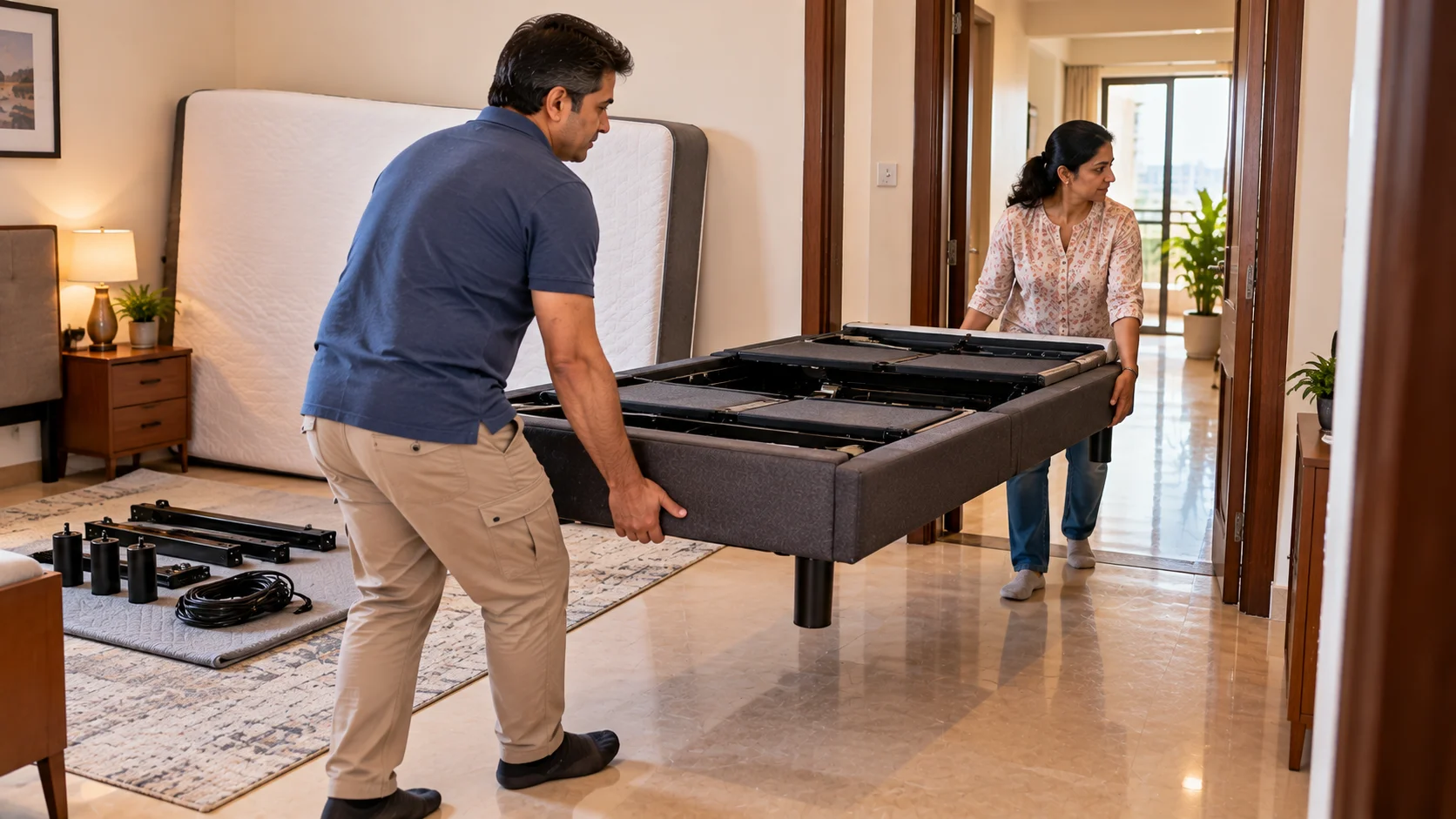
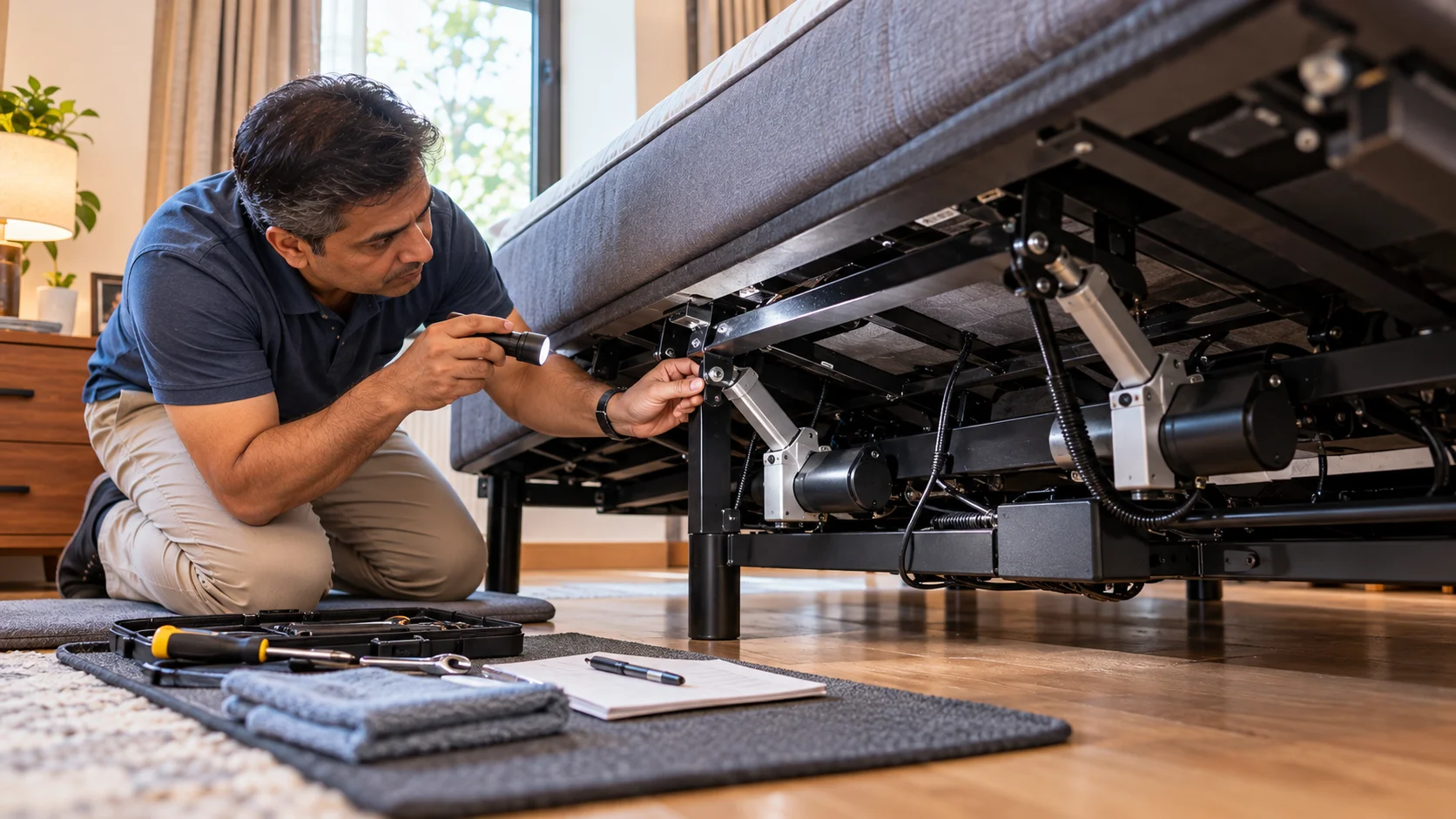
Setting it up: components are checked against the parts list, the frame or conversion kit is assembled and aligned, mattress stoppers are fitted, motors connected to a low-voltage power source, and the remote or app is paired and tested through its full range before handover.
Keeping it going: wipe surfaces down periodically, and check cables every few months for wear. If anything looks damaged, pause use until it’s checked.
Mistakes Worth Avoiding
- Assuming an adjustable bed will look clinical — retrofit and wood-finish options exist specifically to avoid this.
- Pairing it with a standard innerspring mattress that won’t flex properly.
- Choosing based on price alone without confirming the specific model’s weight capacity.
- Skipping hi-low height if aging-in-place readiness matters, even if it’s not needed today.
- Overlooking warranty terms — get frame, motor, and electronics coverage in writing.
- Ignoring room size and door/staircase access when planning delivery.
Adjustable Bed for Home: Buying Checklist
- Clear on the main problem you’re solving (back comfort, snoring, reflux, future-proofing)
- Adjustment type matches how often you’ll use it
- Rated weight capacity confirmed for the specific model
- Understand what any safety certification actually covers
- Size and room fit confirmed
- Hi-low height considered for future needs
- Mattress suited to flexing at recline points
- Warranty confirmed in writing
- Delivery, setup, and after-sales support clarified
Why Families Choose Zero G Beds
- Wide range of Manual, Semi-Electric, and Fully Electric adjustable beds for Indian homes.
- At Zero G Beds, we can convert your existing bed into a customised adjustable bed based on your comfort and support requirements—without replacing your current bed.
- Split/dual-adjustable options for couples with different comfort needs.
- 15-year warranty for long-lasting performance and peace of mind.
- Professional delivery within 1 week, along with installation and a complete product demonstration by trained technicians.
- CE-certified adjustable bed systems that meet internationally recognised European safety and quality standards.
- Dedicated after-sales support for setup and servicing.
- Easy assistance via Call/WhatsApp: +91 9820138189 for guidance, pricing, and support.
- Trusted by 10,000+ families across India since 2003.
Ready to upgrade your everyday comfort? Talk to us: +91 9820138189 or email info@zerogbeds.com
Bottom Line
An adjustable bed for home has quietly stopped being a niche medical product and become a practical everyday comfort upgrade for Indian families — solving real, common problems like back discomfort, snoring, and reflux, while also setting a household up well for aging-in-place needs down the line. Match the adjustment type to how you’ll actually use it, confirm the weight capacity and safety details for the specific model, and pair it with a mattress built to flex.
Whatever’s driving the decision, adjustable beds can provide long-term comfort, and — a bad back, a snoring partner, or simply planning ahead — it’s worth getting right, and you don’t have to figure it out alone.
Tell us what you’re looking for and we’ll recommend the right bed today. Call/WhatsApp: +91 9820138189
References
- IEC 60601-2-52:2009 — Medical electrical equipment, Part 2-52: basic safety and essential performance of medical beds. https://www.iso.org/standard/36067.html
- IEC 60601 vs. ISO 13485: Medical Device Risk Management. https://eureka.patsnap.com/article/iec-60601-vs-iso-13485-medical-device-risk-management
- Khan BA et al. Effect of bed-head elevation during sleep in nocturnal gastroesophageal reflux. PubMed. https://pubmed.ncbi.nlm.nih.gov/22098332/
- The Potential Effect of Changing Patient Position on Snoring: A Systematic Review. NCBI/PMC. https://www.ncbi.nlm.nih.gov/pmc/articles/PMC11277951/
- Sleep Advisor — How to get the Zero-Gravity position on an adjustable bed. https://www.sleepadvisor.org/how-to-get-zero-gravity-position-on-adjustable-bed/
- Central Drugs Standard Control Organisation (CDSCO), Ministry of Health & Family Welfare, Government of India — Medical Devices Rules, 2017 (governs hospital and adjustable bed classification and registration in India). https://cdsco.gov.in/opencms/opencms/en/Acts-and-rules/Medical-Devices-Rules/