
This guide is general information to help families make informed decisions. It isn’t medical advice — please check anything specific to a loved one’s condition with their doctor or physiotherapist and confirm the rated specifications of any bed before you buy.
There’s usually a moment that starts this search — a parent who’s begun struggling to sit up in the morning, a knee or hip that makes getting out of bed a slow, careful process, or simply a growing worry about a fall in the night. None of these are dramatic on their own, but together they’re often the sign that the bed itself has quietly become part of the problem.
A motorised recliner bed is designed to solve exactly that — not by treating any condition, but by removing the physical strain of everyday movements: sitting up, lying down, getting the legs up, and making position changes easier. This guide walks through who benefits, what matters when choosing recliner beds for elderly family members, and what shapes the price, so families searching for a reliable reclining bed for elderly in India can make this decision with confidence.
If you’re comparing a reclining bed for elderly india options, focus on the features that make daily transfers and positioning easier.
Talk to a comfort advisor — free, no obligation. Call or WhatsApp: +91 9820138189. Tell us about your parent’s or loved one’s needs and we’ll recommend the right bed and mattress.
Why Ageing Changes What a Bed Needs to Do
For families researching a reclining bed for elderly india, the key question is not simply how comfortable the bed feels, but how easily it supports everyday movement.
A standard bed asks the body to do a lot of unassisted work — pushing up from flat to sitting, swinging the legs round, and pushing off the mattress edge to stand. For a younger body, none of those registers as an effort. For someone managing stiff joints, reduced muscle strength, balance concerns, or recovery from a fall or illness, each of those small movements adds real strain and real risk, several times a day, every single day.
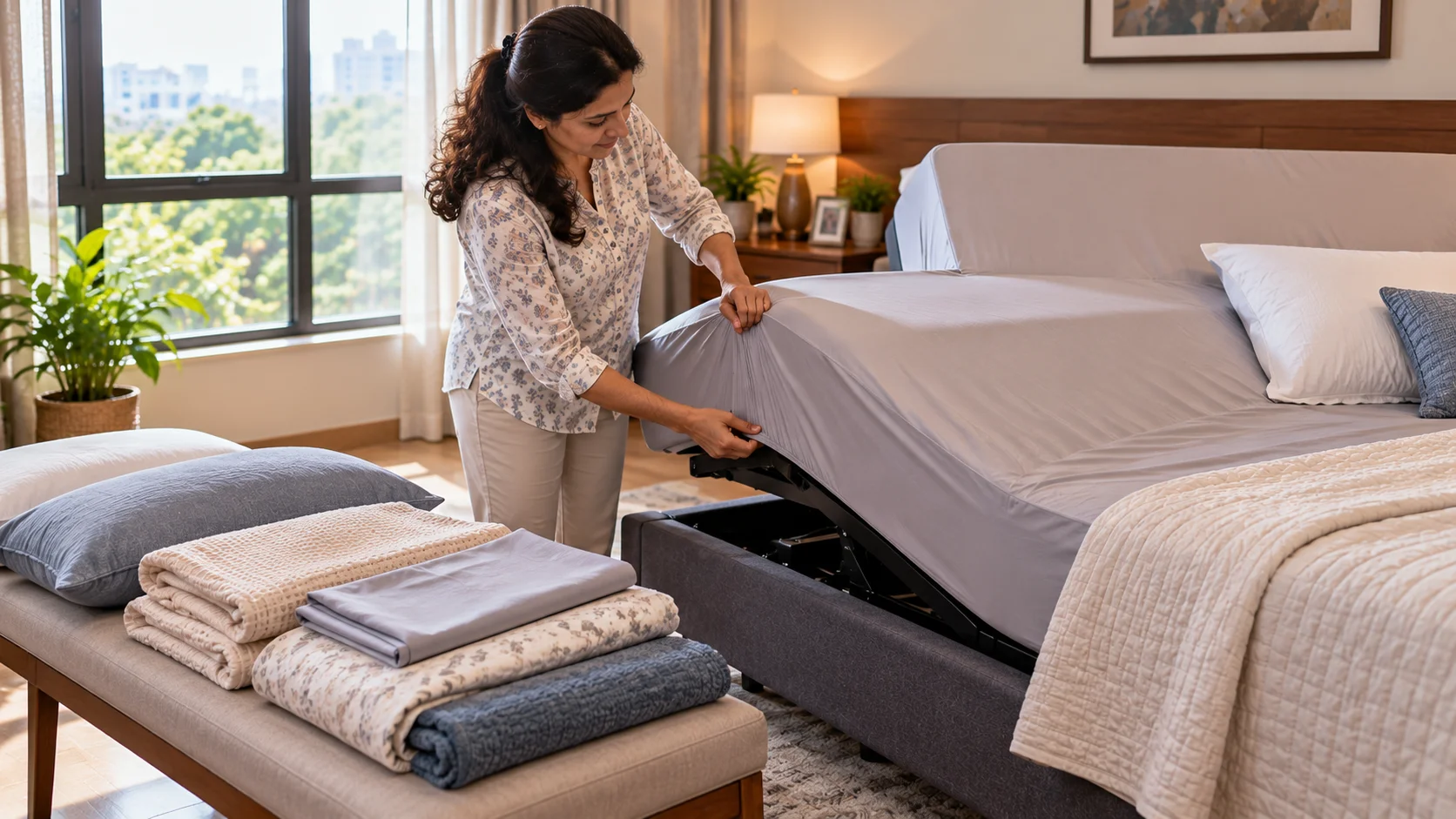
A motorised recliner bed can assist with much of that positioning work. The backrest rises to meet the person instead of the person having to lift themselves; on models that include height adjustment, the bed can be raised or lowered to a more suitable height for transfers; and the legs can be raised without anyone needing to prop pillows underneath. None of this is about illness — it’s about making every day positioning and resting easier, while supporting as much independence as the individual’s mobility allows.
Who Benefits Most from a Motorised Recliner Bed?
- Seniors with arthritis or joint stiffness, for whom sitting up and standing from a flat, low bed is the hardest part of the morning.
- Anyone with reduced balance or a history of falls, where a supported and appropriately assessed transfer in and out of bed matters more than almost anything else in the room.
- People managing circulation issues or leg swelling, who may find gentle leg elevation comfortable during periods of rest.
- Seniors dealing with acid reflux or heartburn, since a raised upper body at night may help reduce nighttime reflux symptoms for some people.
- People with breathing difficulties, who may find resting with the upper body slightly elevated more comfortable than lying completely flat.
- Family caregivers, who benefit just as much — a bed that helps someone sit up or makes positioning easier is one less movement the caregiver has to physically support.
If several of these situations apply, a motorised recliner bed may be worth considering as a practical way to make everyday positioning, resting and transfers easier. The benefit will depend on the person’s mobility, health needs and the features of the specific model.
What Actually Matters When Choosing One
- Hi-low height adjustment — the most underrated feature
A bed that can be raised or lowered can be useful when someone has difficulty getting in or out of bed. For older adults who need help with transfers, hi-low adjustment — where available on the specific model — can allow the bed height to be set at a more suitable level.
Falls are a recognised concern for older adults, and fall-prevention programmes such as the CDC’s STEADI initiative focus on assessing and addressing individual fall risks. A suitable bed height can be one part of a wider approach to safer transfers, but it should not be treated as a standalone fall-prevention measure.
- Assisted sit-to-stand support
For seniors with arthritis, particularly in the knees or hips, the mechanical assistance of a rising backrest and adjustable height may make the transition from lying to sitting easier. How much assistance a person needs will depend on their mobility, balance and strength, so families should not assume that a motorised bed will provide independent standing support.
- Independent head and leg elevation
Look for a bed where the head and legs adjust separately, not just together. This matters for:
Reflux relief — raising the head may reduce nighttime reflux symptoms for some people, and bed-head elevation has been studied specifically for nocturnal reflux.
- Circulation and swelling — gentle leg elevation during rest may help with some types of mild swelling. However, persistent, sudden, painful or one-sided swelling should be assessed by a healthcare professional rather than managed with bed positioning alone.
- Breathing comfort — some people find resting with the upper body elevated more comfortably when lying flat is uncomfortable. New, worsening or unexplained breathing difficulty requires medical assessment rather than relying on bed positioning alone.
- Zero-Gravity positioning for general comfort
Combining head and leg elevation into the Zero-Gravity position spreads body weight more evenly and reduces pressure concentrated on the lower back — a genuinely comfortable resting position, though it’s worth being clear this is comfort, not treatment.
- Simple, reliable controls
Fine-print remotes with dozens of small buttons are a poor fit for anyone with reduced eyesight, dexterity, or memory concerns. Look for large, clearly labelled buttons, and consider whether voice control genuinely adds ease of use here rather than added complexity.
CE marking is a manufacturer’s self-declared conformity statement — useful context, not a substitute for asking what was actually tested.
- 6. Match the frame and weight capacity properly
Confirm the specific model’s rated weight capacity, accounting for the person, mattress, and bedding, and leave a sensible margin rather than trusting a general figure.
Not sure which features matter most for your parent? Call/WhatsApp: +91 9820138189 — our team will talk through the situation and recommend the right configuration.
Manual vs. semi-electric vs. fully electric — which suits elderly use?
| Feature | Manual | Semi-Electric | Fully Electric / Smart |
| Back-rest lift | Hand crank | Motor (remote) | Motor (remote / app / voice) |
| Leg lift | Hand crank | Motor (remote) | Motor (remote / app / voice) |
| Effort required from the user | High | Medium | Low |
| Independence for the senior | Very limited | Some | High — can self-adjust |
| Assisted standing (hi-low) | Rarely available | Sometimes | Commonly available |
| Best for | Very light, occasional use | Moderate daily use | Daily use, safety-focused households |
For elderly users specifically, fully electric beds with hi-low height are consistently the option families are glad they chose — the daily reduction in physical strain, for both the senior and the caregiver, is the whole point of the purchase.
Choosing the Right Mattress
An adjustable bed only works well with a mattress designed to flex at the same points:
- 7-zone latex or high-density foam — flexes cleanly at the recline points and offers even support.
- Memory foam — helpful for pressure relief at the hips and shoulders, particularly for those spending more time resting.
- Standard innerspring mattresses are best avoided — they won’t bend properly at the hinge points and can strain the mechanism.
Quick Picks by Situation
When choosing a reclining bed for elderly india, match the bed‘s functions to the senior’s mobility, transfer needs and preferred sleeping or resting positions.
- Fall risk / balance concerns: fully electric bed with hi-low height as the top priority.
- Arthritis or joint pain: assisted backrest lift plus hi-low height to ease the sit-to-stand transition.
- Reflux or breathing difficulty: reliable, independent head elevation.
- Circulation or leg swelling: independent leg elevation, used regularly throughout the day.
- Caregiver relief: hi-low height plus simple controls the senior can use unassisted.
Tell us the situation, get a matched recommendation. Call/WhatsApp: +91 9820138189 — we’ll suggest the right bed and mattress and send you the details.
What Affects the Price of a Motorised Recliner Bed?
- Hi-low height and assisted-stand features — these add meaningfully to the cost but are usually the highest-value feature for elderly users.
- Motor quality — quieter, longer-lasting motors cost more but matter for daily, long-term use.
- Frame strength and weight capacity — reinforced frames cost more.
- Mattress choice — from basic foam through to pressure-relieving options.
- Design and finish — wood-finish and retrofit-into-existing-bed options cost more than plain metal frames.
- Accessories, warranty, and installation — rails, tables, extended coverage, and professional setup all factor in.
Flexible EMI options are available. Contact +91 9820138189 for current pricing and guidance for your situation.
Get a personalised quote. Call/WhatsApp: +91 9820138189 — share your parent’s or loved one’s needs and we’ll send exact pricing, mattress options, and delivery timelines.
Delivery, Setup, and Looking After the Bed
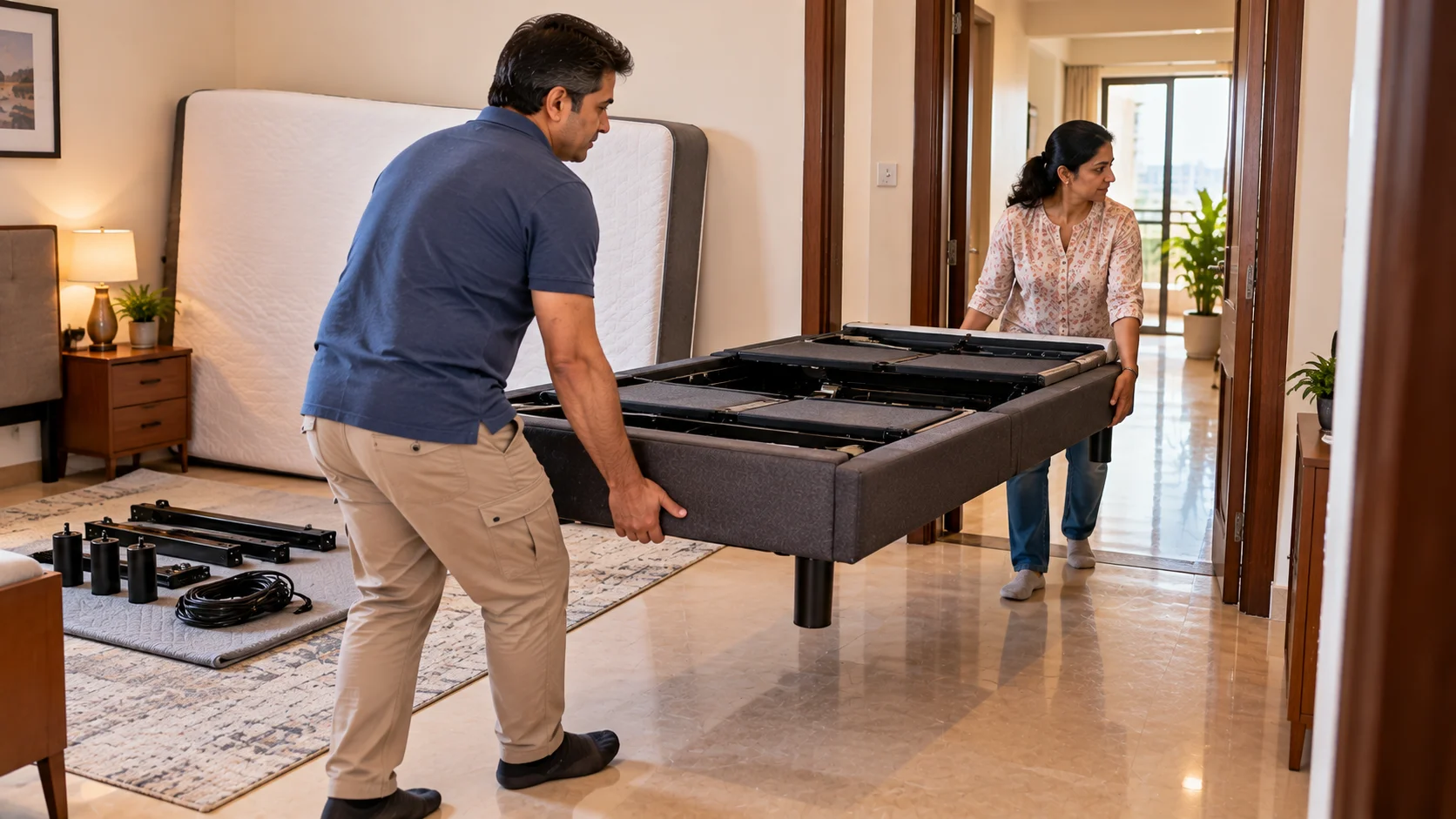
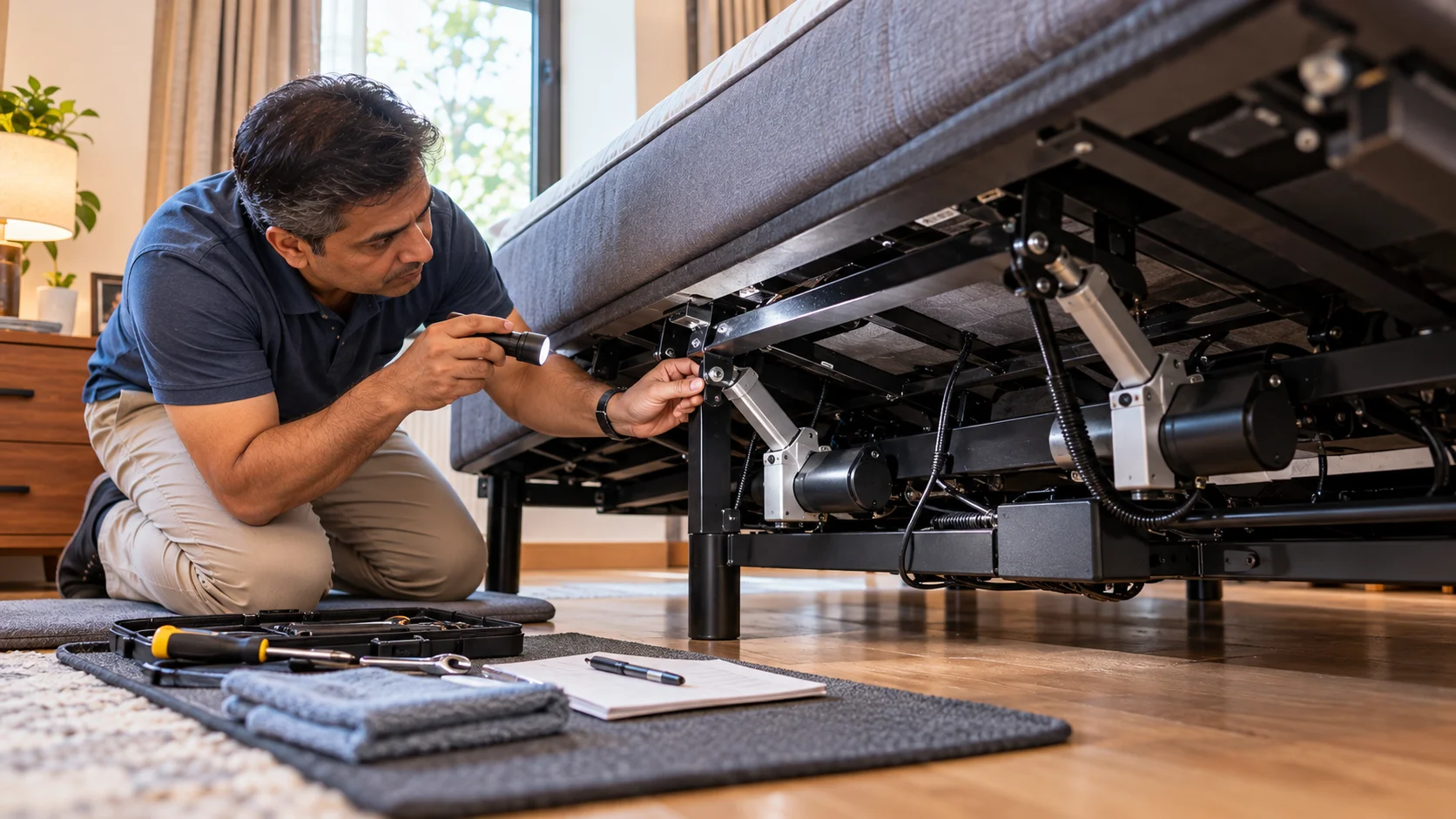
Setting it up: components are checked against the parts list, the frame or conversion kit is assembled and aligned, mattress stoppers are fitted, motors connected, and the remote paired and tested through its full range — with a check that the available movements operate smoothly before handover.
Keeping it going: wipe surfaces down periodically, and check cables every few months for wear. Encourage the senior to understand how the remote works and, where provided, how to use the emergency-stop or manual-override function.
Mistakes Worth Avoiding
- Choosing a bed without hi-low height, which is often the single most useful feature for elderly safety.
- Overlooking motor noise and smoothness — jerky movement can be uncomfortable or even alarming for an older user.
- Pair the bed with a standard innerspring mattress that won’t flex properly.
- Picking overly complex controls that end up unused because they’re hard to see or operate.
- Skipping the warranty details — get frame, motor, and electronics coverage in writing.
- Assuming a general weight capacity applies without checking the specific model.
Quick Buying Checklist
- Hi-low height adjustment included, if fall risk or transfers are a concern
- Independent head and leg elevation
- Motor smoothness checked, ideally via demonstration
- Controls are simple enough for the senior to use unassisted
- Rated weight capacity confirmed for the specific model
- Understand what any safety certification actually covers
- Mattress suited to flexing at recline points
- Warranty confirmed in writing
- Delivery, setup, and after-sales support clarified
Why Families Choose Zero G Beds
- Wide range of Single-Zone, Split, and Split King adjustable bed frames designed to suit different bedroom setups.
- At Zero G Beds, we can convert your existing bed into a customised adjustable bed based on your comfort and support requirements—without replacing the entire bed.
- Compatible mattress options designed to flex with the adjustable frame’s movement.
- Professional delivery within 1 week, including installation and a complete product demonstration by trained technicians.
- Dedicated after-sales support to assist with setup, servicing, and product-related queries.
- 15-year written warranty covering the frame and motors for long-term peace of mind.
- Call or WhatsApp +91 9820138189 for product guidance, pricing, and support.
- CE-certified adjustable bed systems designed to meet applicable European safety and quality requirements.
- Trusted by families and couples across India for comfortable and practical bedroom upgrades.
Ready to make daily movement easier and safer? Talk to us: +91 9820138189 or email info@zerogbeds.com
The Bottom Line
A reclining bed for elderly india can be a practical option when the priority is easier positioning, comfortable rest and greater day-to-day independence.
Ageing doesn’t change what a bed is for — it changes what a bed needs to do. A motorised recliner bed with hi-low height, independent head and leg elevation, and controls that are genuinely easy to use turns a daily source of strain and fall risk into something safe, comfortable, and largely independent. It’s one of the highest-impact changes a family can make to support a parent’s comfort and safety at home.
Whatever the specific concern — joint pain, balance, reflux, or simply an easier morning — this is a decision worth taking the time to get right, and you don’t have to work it out alone.
Tell us about your loved one’s needs and we’ll recommend the right bed today. Call/WhatsApp: +91 9820138189
References
- IEC 60601-2-52:2009 — Medical electrical equipment, Part 2-52: basic safety and essential performance of medical beds. https://www.iso.org/standard/36067.html
- IEC 60601 vs. ISO 13485: Medical Device Risk Management. https://eureka.patsnap.com/article/iec-60601-vs-iso-13485-medical-device-risk-management
- Khan BA et al. Effect of bed-head elevation during sleep in nocturnal gastroesophageal reflux. PubMed. https://pubmed.ncbi.nlm.nih.gov/22098332/
- US Vein Clinics — Health benefits of elevating your legs. https://www.usaveinclinics.com/blog/health-benefits-of-elevating-your-legs/
- Sleep Advisor — How to get the Zero-Gravity position on an adjustable bed. https://www.sleepadvisor.org/how-to-get-zero-gravity-position-on-adjustable-bed/
- CDC STEADI — Older Adult Fall Prevention Initiative. https://www.cdc.gov/steadi/about/index.html
- Vivid Care — Specialist Seating for People with Arthritis (sit-to-stand transfer considerations). https://www.vivid.care/insights/advice-tips/specialist-seating-for-people-with-arthritis/