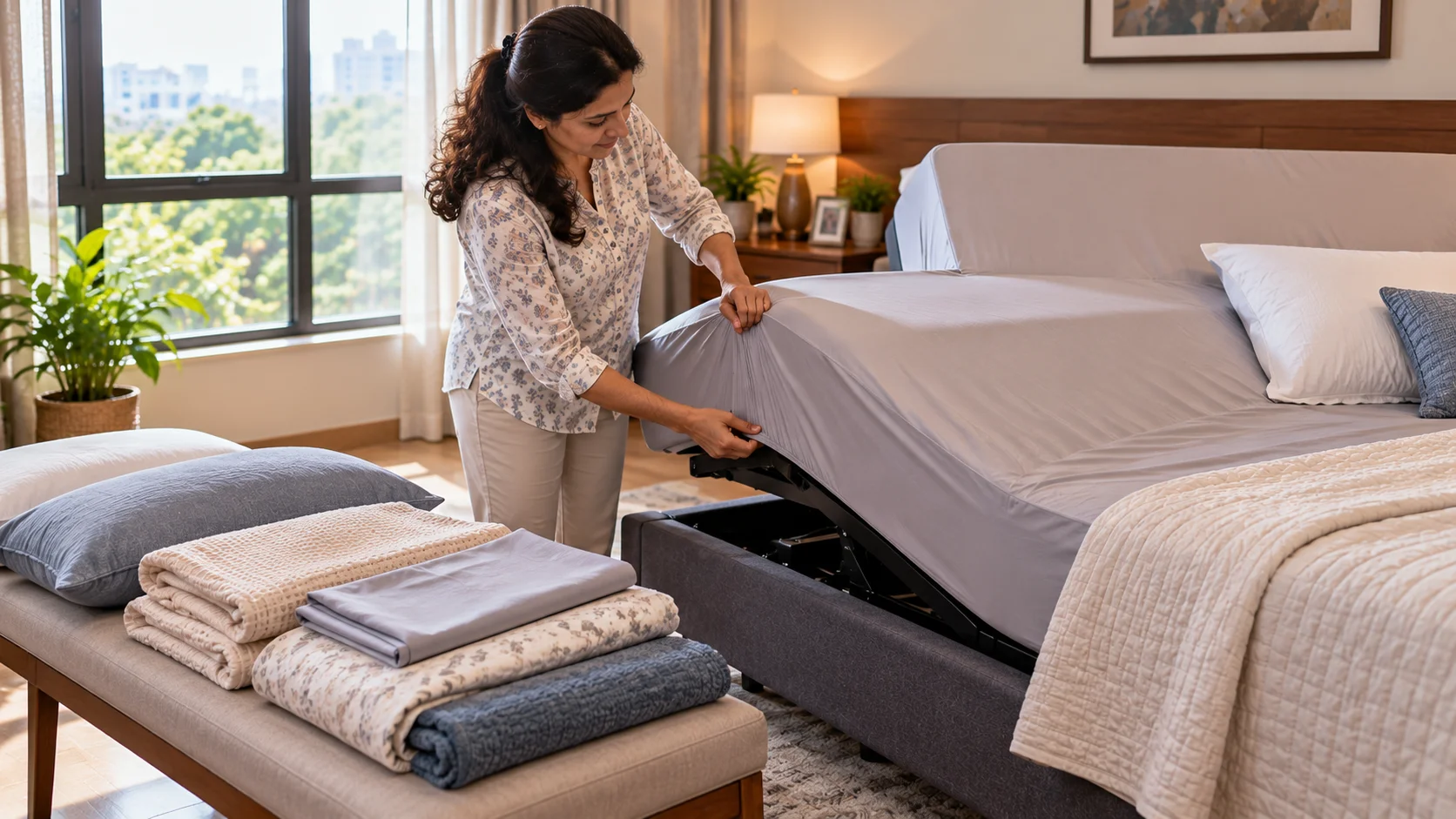
Standard fitted sheets are cut for a flat mattress and often bunch or pop off at the corners once a frame starts flexing at the hinge points. Bedding with deep pockets and genuine stretch, ideally marketed as adjustable-bed-compatible, holds its shape through repeated elevation and protects both your comfort and the mattress itself from uneven wear.
Bedding is one of those small details that can quietly undermine an otherwise well-set-up adjustable bed. A sheet that looked perfectly fitted on a flat mattress can bunch, pull, or pop off entirely once the frame starts bending at the knee and upper-back hinge points -and the resulting lumps and wrinkles are an easy, avoidable source of discomfort.
Why Standard Sheets Struggle on Adjustable Frames
A standard fitted sheet is cut and elasticated for a flat, static mattress. When the frame flexes, the mattress itself changes shape slightly at the hinge points, and a sheet without enough stretch or pocket depth can’t follow that movement smoothly. The result is bunching exactly where you need a smooth surface most, and repeated flexing against a mismatched sheet can also accelerate wear at those same stress points on the mattress itself.
What to Look For in Adjustable-Bed Bedding
| Feature | Why It Matters | What to Check |
| Deep, elasticated corner pockets | Standard pockets can pop off during frame movement | Look for pockets rated for 14 to 18 inches or more of mattress depth |
| Genuine fabric stretch | Allows the sheet to move with the frame’s flex points | Jersey knit and sateen with added elastane tend to perform better than rigid cotton percale |
| All-around elastic, not just corners | Keeps the sheet seated during repeated elevation changes | Some adjustable-bed-specific sheets include a full elastic band around the hem |
| Breathable material | Supports comfort, especially in elevated, less airflow-friendly positions | Cotton blends and bamboo-based fabrics are commonly recommended |
Sizing for Split and Dual-Adjustable Frames
If you have a dual-adjustable or split frame, standard single-piece sheets can actually work against the independent movement of each side, pulling taut across the gap when one side is raised and the other stays flat. Split sheet sets, designed with two independently fitted sections joined at a shared top sheet or left fully separate, allow each side to move without tugging on the other -worth asking about specifically if you’re setting up a dual-adjustable bed for the first time.
A Simple Shopping Checklist
- Check the pocket depth rating against your actual mattress thickness, including any mattress topper you use.
- Look for “adjustable bed compatible” or “deep pocket stretch” in the product description, which usually signals the manufacturer has accounted for frame flexing.
- Choose split sheets if you have a dual-adjustable frame, rather than assuming a standard single sheet will work across both independently moving sides.
- Avoid very rigid, high-thread-count cotton with minimal stretch, which tends to perform the worst on a flexing frame despite sometimes being marketed as premium.
- Buy one set first and test it through a full range of motion before committing to multiple sets in the same material.
Protecting Your Mattress at the Same Time
The right bedding does double duty: comfort for you, and protection for the mattress’s flex points from the kind of bunching and pulling that can accelerate wear over time. This connects directly to the mattress longevity principles in our guide on adjustable bed mattress care, cleaning, maintenance and lifespan, where bedding choice is one of the habits that meaningfully affects how long your mattress performs well.
Common Bedding Mistakes to Avoid
- Using a flat top sheet tucked in tightly, which resists the frame’s movement and can feel like it’s working against you at a steep incline -many adjustable bed users skip the top sheet in favor of a duvet alone for exactly this reason.
- Choosing decorative bedding over functional fit, particularly for the fitted sheet specifically, where stretch and pocket depth matter more than pattern or thread count.
- Ignoring split-sheet options on a dual-adjustable frame, assuming a standard sheet will simply stretch enough -it usually won’t move correctly across two independently flexing sections.
- Washing and drying in ways that reduce elastane stretch over time, since high heat can degrade the stretch fibers that make adjustable-bed sheets work properly in the first place.
Choosing a Mattress Protector That Moves With the Frame
A mattress protector faces the same flexing challenge as the fitted sheet, often more so since it sits directly against the mattress surface and is used every night regardless of which top sheets are in rotation. Look for a protector specifically described as stretch-fit or adjustable-bed compatible, with the same deep, elasticated pocket construction recommended for sheets above. A protector that bunches at the hinge points doesn’t just feel uncomfortable, it can also create the exact kind of uneven pressure point that undermines the careful positioning setup you’ve otherwise dialed in.
Budget-Friendly Alternatives Worth Knowing About
If dedicated adjustable-bed bedding isn’t immediately available or affordable, a reasonable interim option is a slightly oversized standard fitted sheet with deeper-than-average pockets, which gives a bit more give than an exactly-sized sheet without needing specialty marketing. Securing loose corners with sheet straps or clips, sold inexpensively for exactly this kind of fit problem, is another practical stopgap while you source proper adjustable-bed-compatible bedding, and costs considerably less than replacing an entire bedding set at once.
Bedding is an easy detail to overlook, but the wrong sheets can undo some of the comfort an otherwise well-set adjustable bed provides. Prioritize genuine stretch and adequate pocket depth over decorative features, and consider split sheets if you’re running a dual-adjustable frame.
Explore our Natural Latex Mattress range, and pair it with bedding built to move the same way your frame does.
Related Reading: